
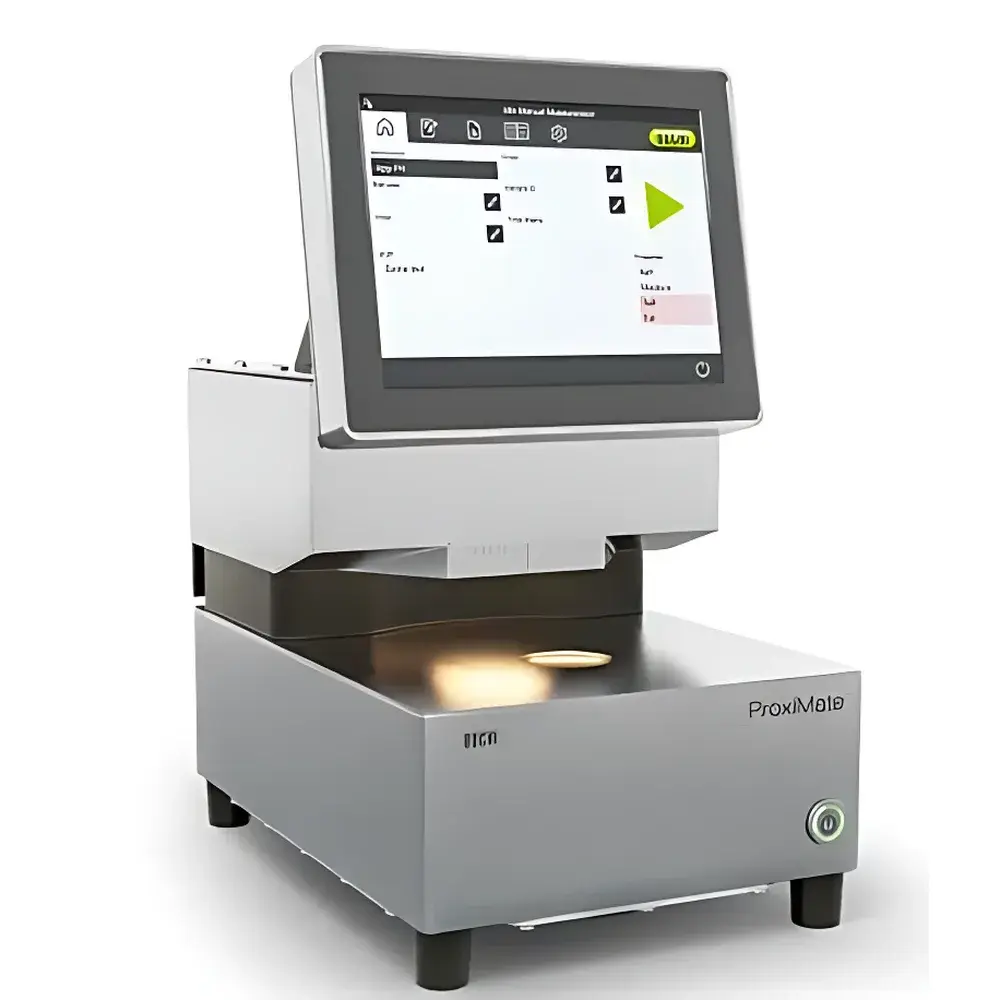
BUCHI ProxiMate Near Infrared Spectrometer
| Brand | BUCHI |
|---|---|
| Origin | Switzerland |
| Manufacturer Type | Manufacturer |
| Origin Category | Imported |
| Model | ProxiMate |
| Instrument Type | Laboratory |
| Measurement Principle | Grating-based non-scanning spectrometer with diode array detector |
| Wavelength Range | 400–1700 nm |
| Scan Speed | 10 ms |
| Data Sampling Interval | 10 nm (visible), 7 nm (NIR) |
| Measurement Mode | Diffuse Reflectance |
| Chemometrics Software | Autocal |
| IP Rating | IP69 |
| Weight | 23 kg |
| Dimensions (W × D × H) | 260 × 435 × 500 mm |
| Power Consumption | 60 W |
| Operating Frequency | 50/60 Hz |
| Operating Temperature | 5–40 °C |
| Relative Humidity | ≤80 % (at ≤31 °C) |
| Storage Temperature | ≤45 °C |
| Altitude Limit | ≤2000 m |
| Measurement Time | Configurable, default 15 s |
| Optical Configuration Options | Standard NIR only |
Overview
The BUCHI ProxiMate is a rugged, non-scanning near-infrared (NIR) spectrometer engineered for reliable旁-line (at-line) process monitoring and quality control in food and feed manufacturing environments. It operates on the principle of diffuse reflectance spectroscopy using a fixed grating and diode array detector architecture—eliminating moving parts to ensure high reproducibility, long-term photometric stability, and minimal maintenance. Unlike scanning instruments, the ProxiMate captures full-spectrum data across 400–1700 nm in a single 10-ms acquisition, enabling rapid, repeatable measurements without mechanical wear or wavelength drift. Its dual-range optical design integrates visible (400–900 nm, 10 nm resolution) and near-infrared (900–1700 nm, 7 nm resolution) detection in one compact unit, supporting both colorimetric and compositional analysis—such as moisture, fat, protein, starch, and ash content—without sample preparation.
Key Features
- Rugged stainless-steel housing rated IP69K—fully sealed against high-pressure, high-temperature washdowns, compliant with EHEDG and USDA hygiene standards for wet-process environments.
- Factory-standardized optics and electronics—enabling direct calibration transfer between instruments without recalibration or standardization, critical for multi-site production consistency under GMP/GLP frameworks.
- Configurable measurement time (default 15 s), optimized for integration into real-time process feedback loops—e.g., adjusting mixer speed, conveyor rate, or raw material dosing based on live NIR output.
- Modular optical configurations: Standard NIR-only, Professional NIR+VIS, or dual-direction (top-down + bottom-up) illumination—adapting to diverse sample geometries including powders, pellets, pastes, and irregular solids.
- Embedded Autocal chemometrics software with pre-validated application packages—developed by BUCHI’s application chemists for dairy (cheese, milk powder), meat (ground meat, sausages), cereals, and compound feed matrices.
- Touchscreen interface built on BUCHI’s unified UI architecture—intuitive navigation, role-based access control, and guided workflows reduce operator training time and minimize human error.
Sample Compatibility & Compliance
The ProxiMate supports non-destructive, contactless diffuse reflectance analysis of heterogeneous, opaque, or semi-solid samples typical in food and feed production—including shredded cheese, dried whey, extruded pet food, and minced meat. Its optical design mitigates interference from surface texture, particle size variation, and ambient lighting fluctuations. The instrument complies with IEC 61000-6-2 (immunity) and IEC 61000-6-3 (emissions), meets CE marking requirements, and is designed for use in environments aligned with ISO 22000, FSSC 22000, and FDA 21 CFR Part 11-ready data integrity workflows when paired with validated Autocal software deployment. Calibration models are traceable to NIST-traceable reference materials and developed per ASTM E1655 and ISO 12099 guidelines.
Software & Data Management
- Autocal software provides model development, validation, and deployment tools compliant with ASTM E1655-22 for multivariate calibration lifecycle management.
- Full audit trail functionality—including user login, parameter changes, calibration updates, and measurement history—with timestamped, immutable records supporting GLP/GMP compliance.
- Seamless integration via Ethernet (RJ-45), Wi-Fi, or Bluetooth—enabling OPC UA or Modbus TCP connectivity to MES, SCADA, or LIMS platforms for automated data routing and SPC charting.
- Legacy calibration migration: Existing NIR models from prior-generation instruments can be imported and re-validated on ProxiMate, significantly reducing commissioning time and preserving historical method continuity.
- Secure database synchronization ensures consistent calibration deployment across distributed manufacturing sites—enabling centralized model governance and version-controlled updates.
Applications
The ProxiMate delivers quantitative and qualitative analysis across core food and feed QC checkpoints: incoming raw material verification (e.g., soybean meal protein content), in-process blend uniformity assessment (e.g., vitamin premix homogeneity), and final product release testing (e.g., moisture in extruded kibble). It replaces time-consuming wet chemistry methods for parameters such as crude protein (by Kjeldahl correlation), fat (by ether extraction correlation), lactose (in dairy powders), and mycotoxin screening support (via spectral anomaly detection). Its at-line placement minimizes lab turnaround time, reduces sampling frequency, and enables immediate corrective action—directly contributing to OEE improvement and waste reduction in continuous processing lines.
FAQ
Is the ProxiMate suitable for regulatory submissions under FDA or EU food safety frameworks?
Yes—when deployed with validated Autocal methods, documented SOPs, and enabled audit trails, it supports data integrity requirements per FDA 21 CFR Part 11 and EU Annex 11 for computerized systems used in quality-critical decisions.
Can existing calibration models from other NIR instruments be transferred to ProxiMate?
Yes—Autocal supports import of PLS and PCR models from common formats (e.g., .cal, .nir), followed by performance verification using local reference data and bias correction if needed.
What environmental conditions does the IP69K rating cover?
IP69K certifies resistance to high-pressure (up to 100 bar), high-temperature (80 °C) steam jet cleaning—making it suitable for CIP/SIP environments in dairy, meat, and wet pet food facilities.
Does ProxiMate require routine wavelength or intensity calibration?
No—factory standardization and thermally stabilized optics eliminate daily or weekly recalibration. Only periodic performance qualification (PQ) using certified reference tiles is recommended per ISO/IEC 17025 internal QA protocols.
How is measurement repeatability ensured across multiple ProxiMate units in different plants?
All units ship with identical optical path geometry, detector response profiles, and firmware—enabling direct calibration portability. No site-specific standardization is required, ensuring metrological equivalence across global operations.





