
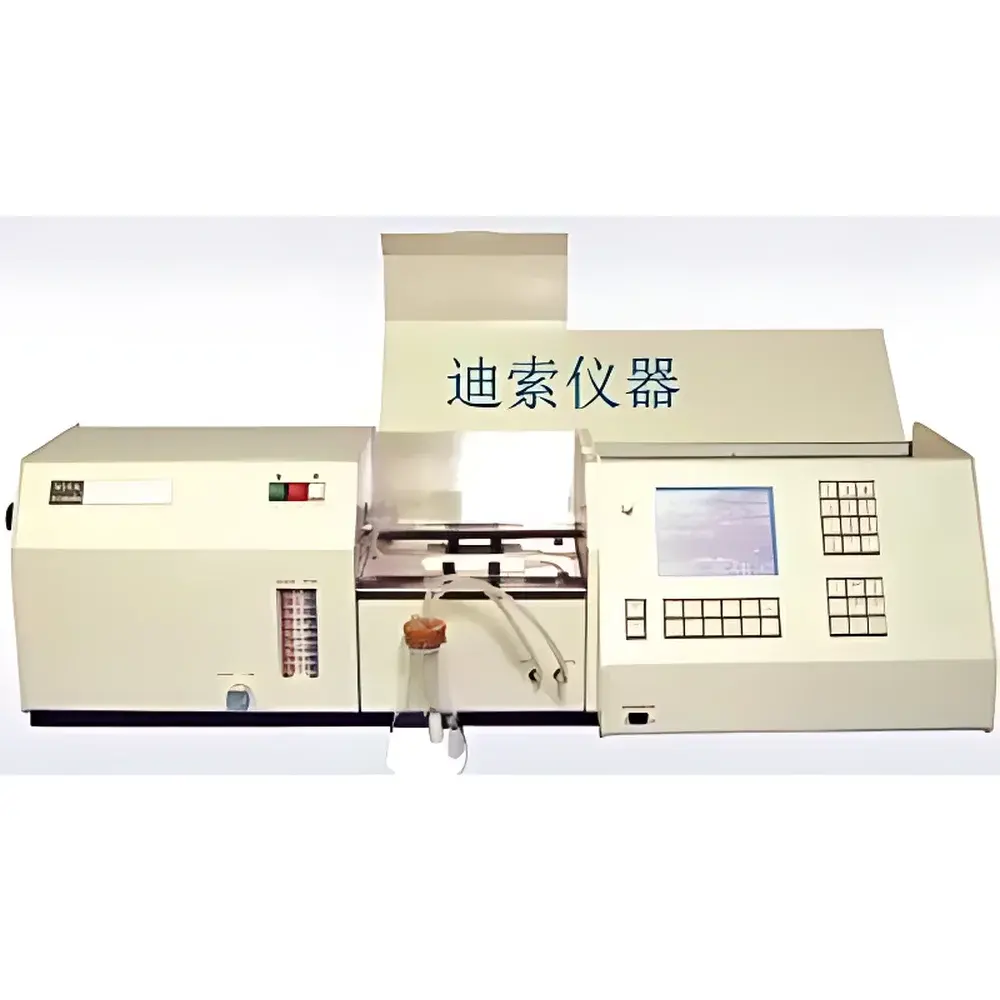
BUCK Model 410 Cold Vapor Atomic Absorption Mercury Analyzer
| Brand | BUCK |
|---|---|
| Origin | USA |
| Instrument Type | Benchtop Laboratory Analyzer |
| Principle | Cold Vapor Atomic Absorption Spectrometry (CVAAS) |
| Detection Wavelength | 253.7 nm |
| Detection Limit | 10 pg/L (ppt) under controlled clean-lab conditions |
| Sample Cell Path Length | 400 mm fused silica window |
| Background Correction | Online Deuterium Lamp (D₂) |
| Output Interfaces | RS-232 serial port, analog output (0–1 V or 4–20 mA) |
| Sample Introduction | Air-driven purge-and-trap with integrated desiccant and charcoal filtration |
| Dimensions (W×D×H) | 991 × 279 × 305 mm |
| Weight | 21 kg |
| Power Requirement | 220 V, 50 Hz, 80 W |
| Compliance | Fully compliant with U.S. EPA Method 245.1 |
| Calibration | Up to 8-point linear or quadratic calibration curves |
| Operational Features | Quick-Purge button for flow-cell cleaning, Peak-Picker peak-area integration, GLP-ready data handling |
Overview
The BUCK Model 410 Cold Vapor Atomic Absorption Mercury Analyzer is a benchtop laboratory instrument engineered for the quantitative determination of total mercury at ultratrace concentrations in aqueous matrices. It operates on the principle of Cold Vapor Atomic Absorption Spectrometry (CVAAS), leveraging the strong, element-specific absorption of mercury vapor at the resonance line of 253.7 nm. In accordance with U.S. Environmental Protection Agency Method 245.1, the system first reduces mercury species—whether inorganic, organic, or complexed—to elemental mercury (Hg⁰) via acidic potassium permanganate/bromide oxidation and subsequent stannous chloride reduction. The liberated Hg⁰ is then purged from solution using a precisely regulated, dried, and charcoal-filtered air stream, transported into a long-path (400 mm) quartz absorption cell, and quantified by measuring attenuation of light from a low-pressure mercury hollow cathode lamp. This method delivers high specificity, minimal interferences, and excellent reproducibility for regulatory-compliant mercury analysis in drinking water, surface water, seawater, wastewater, and digested biological or solid samples.
Key Features
- Full compliance with U.S. EPA Method 245.1 for total mercury determination in water and wastewater
- Detection limit of 10 pg/L (ppt) achievable under ISO 17025-aligned clean-lab conditions with optimized reagent purity and procedural blanks
- 400 mm path-length absorption cell with fused silica windows ensures enhanced sensitivity for low-concentration applications
- Integrated D₂ background correction eliminates spectral interference from molecular absorption or scattering in complex matrices
- Onboard “Peak-Picker” digital integration algorithm records peak area—not just height—improving precision across variable purge kinetics
- Quick-Purge function enables rapid, operator-initiated cleaning of the flow-through sample cell without disassembly
- Eight-point calibration capability supports both linear and quadratic curve fitting for extended dynamic range (0.01–100 ng/mL)
- RS-232 serial interface and analog output (0–1 V / 4–20 mA) allow seamless integration with LIMS, SCADA systems, or strip-chart recorders
- Self-contained air transport system includes desiccant dryer and activated charcoal filter to prevent moisture and organic vapor interference
- Benchtop footprint (991 × 279 × 305 mm) and 21 kg mass facilitate installation in standard analytical laboratories without structural reinforcement
Sample Compatibility & Compliance
The Model 410 is validated for use with liquid samples requiring no pre-concentration when mercury levels exceed 0.01 ng/mL. It accepts direct analysis of filtered, acid-preserved water samples—including potable water per EPA 1631E, estuarine and marine waters per ASTM D3919, and industrial effluents per ISO 12846. For solid or semi-solid matrices (e.g., soils, sediments, tissues), users must perform certified digestion protocols (e.g., EPA 7471B, ISO 17294-2) prior to analysis. The instrument meets design and performance criteria outlined in ISO/IEC 17025:2017 for testing laboratories, and its data acquisition architecture supports audit trails required under FDA 21 CFR Part 11 when paired with compliant software. All calibration, blank, and QC data are timestamped and exportable for GLP/GMP documentation.
Software & Data Management
While the Model 410 operates as a stand-alone analyzer with front-panel controls and digital display, it is designed for interoperability with third-party laboratory data management systems. The RS-232 interface transmits real-time absorbance values, peak area integrals, calibration status flags, and instrument diagnostics using ASCII-based command-response protocol. Analog outputs enable connection to legacy chart recorders or PLC-based monitoring systems. BUCK provides free firmware updates and technical support for integration troubleshooting, including configuration guidance for LabVIEW, MATLAB, or custom Python-based acquisition scripts. No proprietary software license is required for basic operation; however, optional PC-based control modules (sold separately) add automated sequence execution, multi-sample batch reporting, and electronic signature functionality aligned with 21 CFR Part 11 Annex 11 requirements.
Applications
- Regulatory monitoring of drinking water supplies per U.S. Safe Drinking Water Act (SDWA) and EU Directive 98/83/EC
- Environmental compliance testing for wastewater discharge permits (NPDES), including mercury speciation screening when coupled with selective pre-reduction steps
- Quality control in pharmaceutical manufacturing where mercury is a Class 1 elemental impurity per ICH Q3D guidelines
- Research applications in aquatic biogeochemistry, including methylation/demethylation rate studies in sediment porewater
- Food safety laboratories analyzing fish tissue hydrolysates or infant formula extracts following AOAC 979.08 or ISO 17294-2
- Calibration verification of field-deployable mercury sensors (e.g., gold-film amalgamation analyzers) using NIST-traceable standards
FAQ
What sample preparation is required before analysis?
Aqueous samples must be filtered (0.45 µm), preserved with BrCl or HNO₃ to pH < 2, and analyzed within 28 days. Solid samples require hot-block or microwave-assisted acid digestion per EPA 3050B or ISO 11466.
Is the instrument suitable for seawater analysis?
Yes—when combined with appropriate matrix-matched calibration and chloride-tolerant digestion (e.g., EPA 1631E with BrCl oxidation), the Model 410 achieves reliable recovery in saline matrices up to 35 ppt salinity.
Does the system support automated sample introduction?
The base Model 410 is manual-load; however, it is compatible with third-party XYZ autosamplers via TTL-triggered purge initiation and RS-232 handshake protocols.
How often must the D₂ lamp be replaced?
Typical lifetime exceeds 1,000 hours under normal usage; replacement is indicated when background correction efficiency drops below 95% during routine verification checks.
Can the instrument quantify methylmercury?
No—the Model 410 measures total mercury only. Methylmercury requires separation via GC-CVAFS or LC-ICP-MS prior to detection.






