
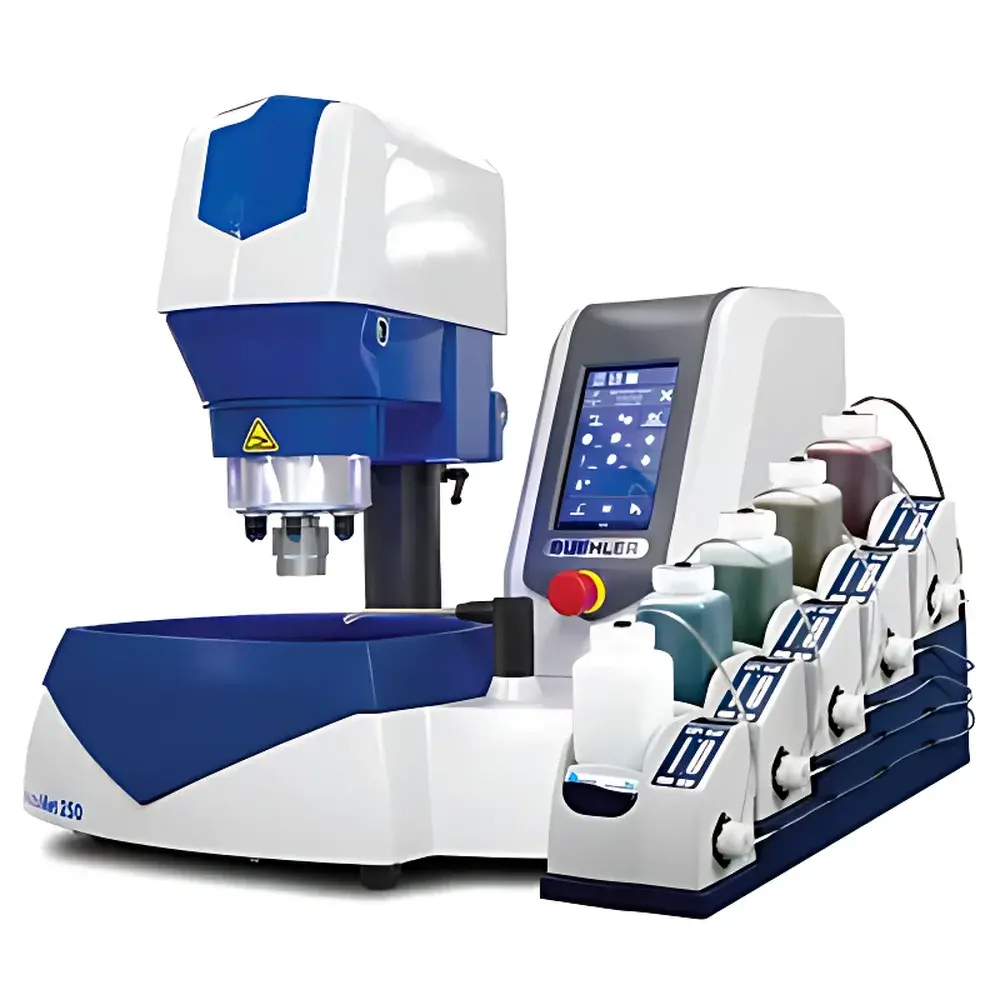
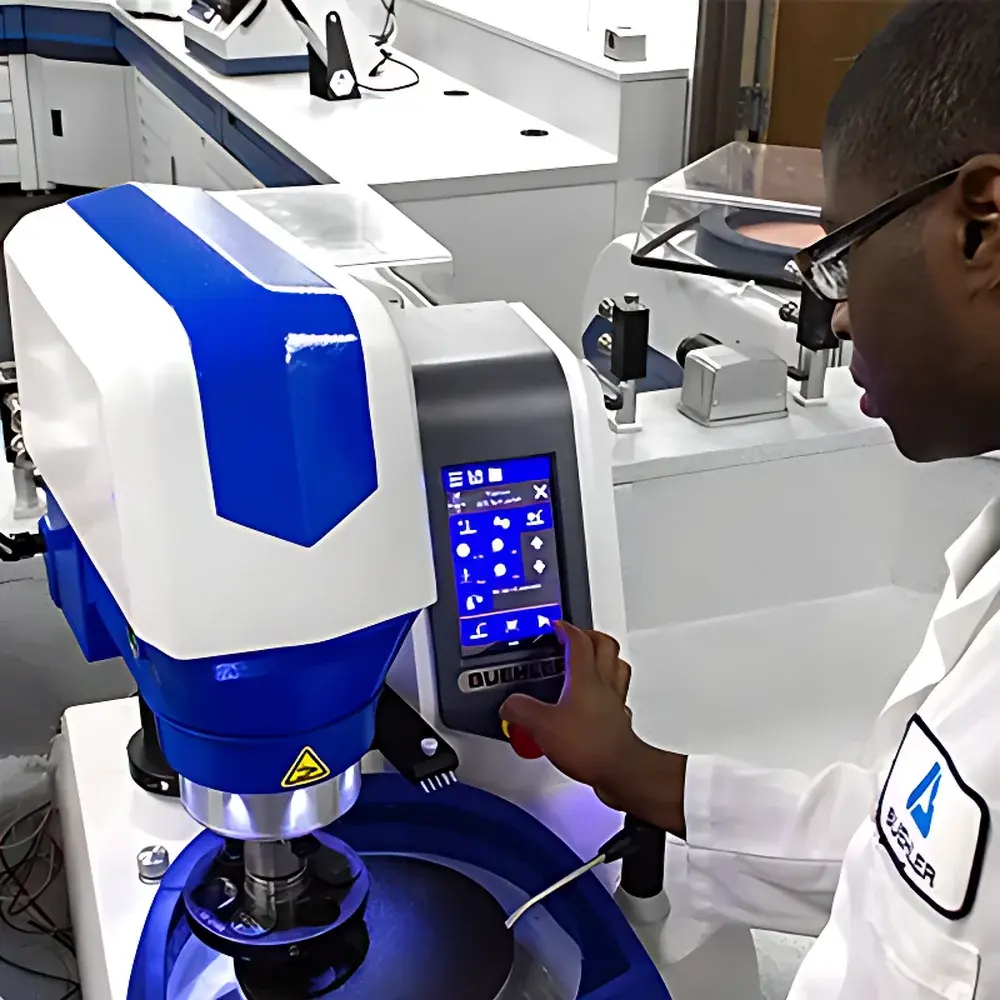
Buehler AutoMet™ 300 Pro Automated Grinding and Polishing System
| Brand | Buehler |
|---|---|
| Origin | USA |
| Model | AutoMet™ 300 Pro |
| Grinding Disc Diameter | 10 in (254 mm) or 12 in (305 mm) |
| Disc Speed | 50–400 rpm (10 rpm increments) |
| Motor Power (Base) | 2 HP (1500 W) |
| Motor Power (Head) | 0.75 HP (560 W) |
| Center Load Range | 10–120 lbf (40–535 N) |
| Single-Point Load Range | 1–20 lbf (5–90 N) |
| Touchscreen Display | 7-inch full-color LCD, NEMA 4 / IP65 rated |
| Water Supply | 0.25 in (6 mm) OD tubing, 40–100 psi (2.8–6.9 bar) |
| Compressed Air | 0.25 in (6 mm) OD tubing, 35 psi (2.4 bar) |
| Noise Level (Base only, 0.5 m, 100 rpm) | 51.5 dB(A) |
| Weight (Base + Head) | 219 lbs (99 kg) |
| Compliance | CE-marked per EU Machinery Directive 2006/42/EC and EMC Directive 2014/30/EU |
Overview
The Buehler AutoMet™ 300 Pro is a fully automated grinding and polishing system engineered for precision, repeatability, and operational robustness in high-throughput metallurgical, materials science, and failure analysis laboratories. Designed around the principles of controlled material removal via sequential abrasive action—first coarse grinding, then fine grinding, followed by mechanical polishing—the system employs closed-loop force control, programmable rotational speed, and precise Z-axis displacement to ensure consistent surface preparation across diverse sample geometries and hardnesses. Its modular architecture integrates seamlessly into ISO/IEC 17025-accredited workflows and supports GLP/GMP-aligned documentation requirements through audit-trail-capable software logging. Unlike manual or semi-automated systems, the AutoMet™ 300 Pro eliminates operator-dependent variability by standardizing load application, dwell time, and motion profiles—critical for ASTM E3, ISO 14577, and USP compliant microstructural evaluation.
Key Features
- Programmable multi-step protocols with independent control of disc speed (50–400 rpm), head rotation (60–150 rpm), and vertical feed rate for quantitative material removal.
- Intuitive 7-inch full-color touchscreen interface with NEMA 4/IP65 protection—designed for wet lab environments and glove-compatible operation.
- Dual-load capability: center-loaded mode (10–120 lbf) for standard cylindrical or rectangular specimens; single-point loading (1–20 lbf) for irregular, thin, or fragile samples including coatings, ceramics, and electronic substrates.
- Integrated water delivery system with retractable hose and bowl-style liner to prevent slurry accumulation and simplify post-run cleaning—reducing downtime between batches.
- Motorized Z-axis with real-time position feedback enables repeatable thickness reduction and cross-sectioning accuracy within ±1 µm per cycle under calibrated conditions.
- CE-compliant electromagnetic compatibility and safety architecture—including emergency stop circuitry, interlocked guard doors, and overload-protected motor drives—ensures compliance with EU Machinery Directive 2006/42/EC.
Sample Compatibility & Compliance
The AutoMet™ 300 Pro accommodates specimens ranging from 1 inch (25 mm) to 2 inches (50 mm) in diameter under center-loading configuration, with optional fixtures supporting non-standard shapes and oversized samples up to 125 mm. It is routinely deployed in laboratories adhering to ASTM E3 (Standard Guide for Preparation of Metallographic Specimens), ASTM E407 (Microetching Metals and Alloys), and ISO 15510 (Metallographic Specimen Preparation). The system’s force calibration traceability, temperature-stable motor control, and sealed electronics meet environmental stability criteria outlined in ISO/IEC 17025:2017 Clause 6.4.1 for equipment suitability. All firmware revisions are version-controlled and documented per internal quality management system (QMS) requirements aligned with FDA 21 CFR Part 11 data integrity expectations when used in regulated pharmaceutical or biomedical device development settings.
Software & Data Management
The embedded control software supports method creation, storage, and recall of up to 99 user-defined preparation sequences—including speed ramps, dwell durations, load profiles, and coolant activation timing. Each run generates a timestamped log file containing motor current draw, actual applied load, disc RPM deviation, and thermal sensor readings—exportable as CSV for integration into LIMS or ELN platforms. Audit trail functionality records all user actions (login/logout, parameter edits, method execution) with immutable timestamps and operator ID tagging. Optional Buehler OmniMet™ Software extends capabilities with remote monitoring, statistical process control (SPC) charting, and PDF report generation featuring digital signatures and electronic record retention—fully compatible with ALCOA+ (Attributable, Legible, Contemporaneous, Original, Accurate, Complete, Consistent, Enduring, Available) principles.
Applications
- Preparation of metallographic sections for optical and electron microscopy (SEM/EBSD), particularly in aerospace turbine blade inspection and automotive powertrain component validation.
- Planarization of geological thin sections and ceramic composites where topographic uniformity is critical for XRD and Raman mapping.
- Edge preservation grinding of semiconductor packaging substrates and MEMS devices requiring sub-micron flatness control.
- Routine QC of additive manufactured (AM) metal parts, where layer boundary visibility and porosity assessment demand reproducible surface finish.
- Forensic metallurgy and failure analysis labs performing fracture surface replication and inclusion rating per ASTM E45 and ISO 4967 standards.
FAQ
What sample sizes can be prepared using the AutoMet™ 300 Pro?
Standard center-loading configurations support diameters of 25 mm, 30 mm, 40 mm, and 50 mm; custom chucks enable handling of irregular or oversized specimens up to 125 mm.
Is the system compatible with third-party consumables?
Yes—Buehler designs its systems to accept industry-standard 10-inch and 12-inch grinding/polishing discs, diamond suspensions, and colloidal silica slurries from multiple suppliers, provided dimensional and chemical compatibility is verified.
How does the AutoMet™ 300 Pro ensure process traceability?
Each preparation cycle logs full operational metadata—including operator ID, method version, environmental sensor readings, and real-time load/speed deviations—stored locally and exportable for regulatory review.
Can the system be integrated into an automated lab workflow?
It features RS-232 and Ethernet interfaces for PLC-level communication and supports integration with robotic sample handlers and conveyor-based loading systems via I/O triggers and Modbus TCP protocol.
What maintenance intervals are recommended for optimal performance?
Daily: rinse bowl liner and inspect water lines; weekly: verify torque on grinding disc mounting bolts and calibrate load sensors; annually: motor brush inspection and firmware update verification per Buehler Service Bulletin SB-AM300-2023-01.



