
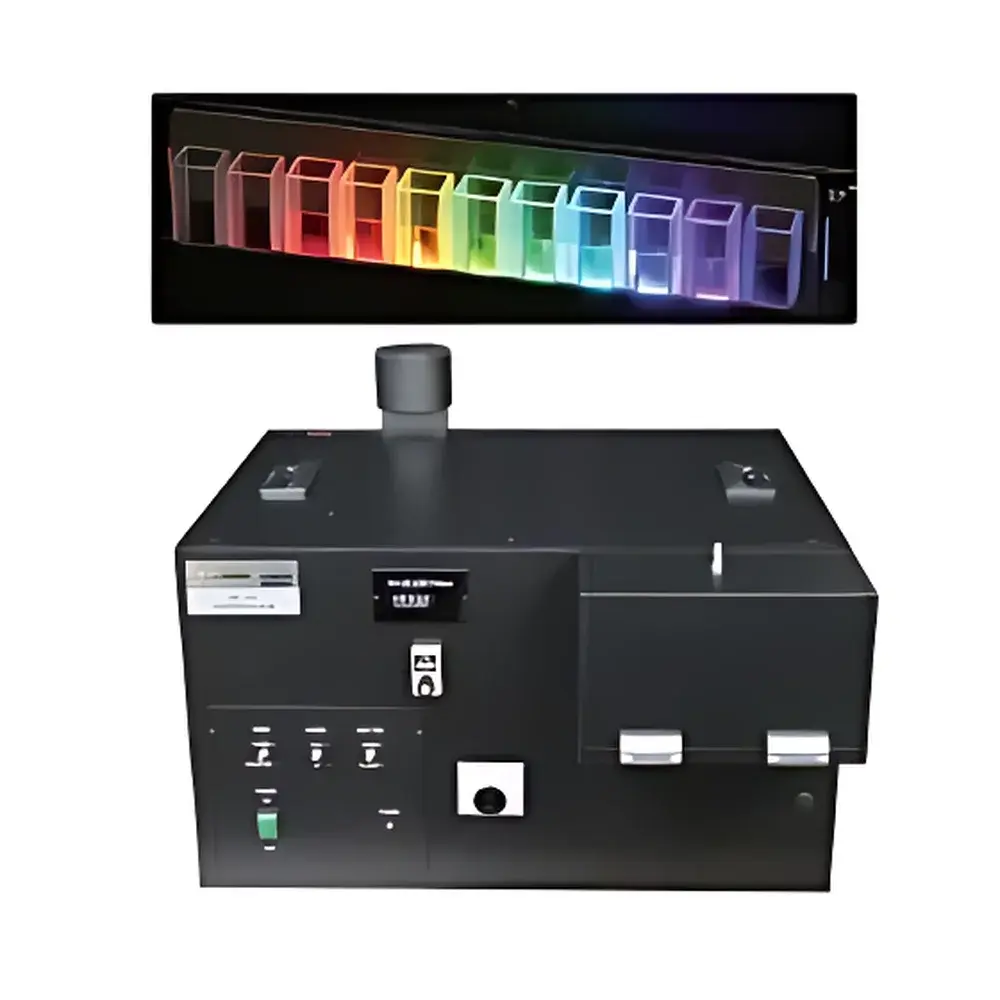
Bunkoukeiki WAD China Single-Wavelength Tunable Photostability Test Chamber
| Brand | Bunkoukeiki |
|---|---|
| Origin | Japan |
| Model | WAD China |
| Light Source | 150 W Xenon Lamp |
| Spectral Range | 300–1150 nm |
| Bandwidth Options | 5 / 10 / 20 nm (FWHM) |
| Irradiance | >1 mW/cm² (≥40 μmol·m⁻²·s⁻¹) |
| Illuminated Area | Ø ≥3 mm |
| Fiber Optic Coupling | Ø3 mm, 1 m length |
| Dimensions (W×D×H) | 230 × 295 × 414 mm (excluding protrusions) |
| Shutter | Manual |
| Calibration Option | Silicon Photodiode Sensor |
Overview
The Bunkoukeiki WAD China Single-Wavelength Tunable Photostability Test Chamber is a precision-engineered instrument designed for ICH Q1B-compliant photostability testing of pharmaceutical substances and products. It employs a high-stability 150 W xenon arc lamp coupled with a monochromator-based optical system to deliver narrowband irradiation across the full UV-Vis-NIR spectrum (300–1150 nm). Unlike broadband or fixed-filter light sources, this system enables discrete wavelength selection with spectral purity options of 5 nm, 10 nm, or 20 nm full width at half maximum (FWHM), facilitating mechanistic photochemical studies—such as identifying wavelength-specific degradation pathways—or replicating specific environmental or regulatory irradiance conditions (e.g., ICH Q1B Option 2: “UV-only” or “Visible-only” protocols). The collimated output is delivered via a 1-meter, Ø3 mm core silica fiber, ensuring spatially uniform irradiance over a minimum Ø3 mm spot—ideal for micro-scale sample exposure in vials, cuvettes, or solid-state dosage forms. Its compact, benchtop-integrated architecture eliminates the need for external optics benches or cooling infrastructure, while embedded status indicators and manual shutter control support intuitive, GLP-aligned operation.
Key Features
- Monochromator-driven single-wavelength tunability across 300–1150 nm with selectable bandwidths (5/10/20 nm FWHM) for precise photochemical excitation
- Stable 150 W xenon lamp with calibrated output exceeding 1 mW/cm² (≥40 μmol·m⁻²·s⁻¹) at target wavelengths—validated per ISO 17025-accredited procedures
- Integrated Ø3 mm quartz fiber optic delivery (1 m length) enabling flexible sample positioning without realignment
- Manual mechanical shutter for controlled exposure timing—compatible with external timer relays for automated duty-cycle protocols
- Benchtop footprint (230 × 295 × 414 mm) with minimal protrusions; operates without external water cooling or exhaust ducting
- Front-panel LED indicators for lamp status, shutter position, and system readiness—designed for unambiguous operator verification
Sample Compatibility & Compliance
The WAD China chamber accommodates standard pharmaceutical sample formats including 1–10 mL amber or clear glass vials, 1 cm pathlength quartz cuvettes, and small-area solid films or tablets mounted on non-reflective substrates. Its collimated beam geometry ensures minimal thermal load (<0.5 °C rise at sample surface under continuous irradiation), preserving thermo-sensitive analytes during extended exposure. The system supports ICH Q1B photostability testing requirements—including Option 1 (broadband UV + visible), Option 2 (separate UV-only and visible-only exposures), and Option 3 (near-UV only)—and is routinely validated against reference radiometers traceable to NIST standards. Optional silicon photodiode sensor enables real-time, wavelength-specific irradiance monitoring (mW/cm²) at the sample plane, satisfying FDA 21 CFR Part 11 data integrity requirements when paired with compliant logging software. All electrical and optical components conform to IEC 61010-1 safety standards and CE marking directives.
Software & Data Management
While the base WAD China configuration operates via hardware controls, optional integration with Bunkoukeiki’s PC-based Photostability Control Suite (v3.2+) enables time-stamped irradiance logging, wavelength sweep automation, exposure dose accumulation (J/cm²), and export of CSV-formatted datasets compatible with LIMS and statistical analysis platforms (e.g., JMP, Minitab). Audit trails record all parameter changes, shutter actuations, and calibration events—fully compliant with ALCOA+ principles and supporting 21 CFR Part 11 electronic signature workflows when deployed on validated Windows OS environments. Raw spectral output data can be exported in ASCII format for third-party spectral modeling (e.g., using MATLAB or Python SciPy libraries).
Applications
- ICH Q1B photostability assessment of active pharmaceutical ingredients (APIs) and final drug products
- Wavelength-resolved photodegradation kinetics studies to identify critical absorption bands driving decomposition
- Validation of light-protective packaging efficacy under defined spectral stress conditions
- Development of photostable formulations by screening excipient interactions under monochromatic irradiation
- Reference material stability monitoring in metrology laboratories requiring traceable spectral irradiance
- Academic research in photochemistry, photobiology, and polymer photodegradation mechanisms
FAQ
What wavelength resolution options are available, and how is bandwidth defined?
Bandwidth is specified as full width at half maximum (FWHM) and is selectable as 5 nm, 10 nm, or 20 nm—verified using a calibrated spectroradiometer per ISO/IEC 17025 procedures.
Is radiometric calibration included with the system?
The base unit includes factory calibration against NIST-traceable standards. Optional silicon photodiode sensors (Cat. No. PD-WAD-Si) provide user-accessible in-situ irradiance verification at the sample plane.
Can the system be integrated into an automated stability testing workflow?
Yes—via TTL-compatible shutter trigger input and RS-232/USB interface for synchronization with environmental chambers, robotic samplers, or LIMS-controlled test sequences.
Does the chamber meet ICH Q1B Option 2 requirements for separate UV and visible exposure?
Yes—by selecting 320–400 nm (UV) or 400–800 nm (visible) bands with ≤10 nm FWHM, users achieve spectrally isolated irradiation compliant with ICH Q1B Option 2 specifications.
What maintenance is required for long-term irradiance stability?
Xenon lamp replacement is recommended every 1,000 hours of operation; optical alignment verification is advised annually or after lamp replacement—both supported by Bunkoukeiki’s service network in APAC and EMEA regions.






