
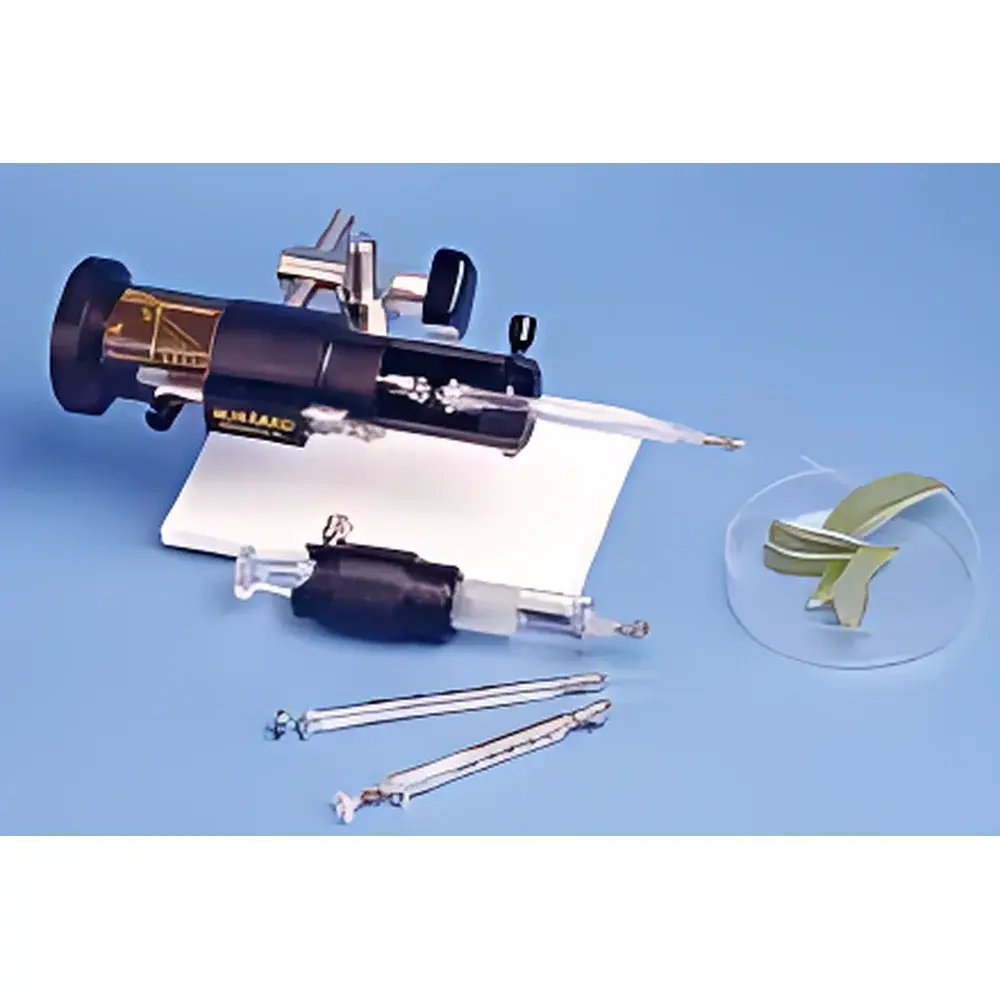
Burkard Micro-Spotter Handheld Precision Microdispenser
| Brand | Burkard |
|---|---|
| Origin | United Kingdom |
| Model | Burkard Micro-Spotter |
| Power Source | None (Manual Mechanical Operation) |
| Construction | Stainless Steel & Chemically Resistant Electroplated Components |
| Syringe Compatibility | 1 mL all-glass syringe (standard) |
| Volume Selection | 0.25, 0.5, 1, 2, 5 mL (×10 scalable) |
| Adjustment Mechanism | Rotating drum with indexed volume dial and precision-aligned reference mark |
| Mounting Options | Universal lab stand clamp, optional micrometer-adjustable positioning stage or custom mounting adapters |
| Regulatory Context | Compliant with GLP laboratory practice requirements for manual dispensing traceability |
Overview
The Burkard Micro-Spotter is a manually operated, battery-free precision microdispensing instrument engineered for reproducible, operator-controlled delivery of discrete liquid volumes in life science research environments. Unlike motorized or pneumatic spotting systems, this mechanical dispenser operates on a calibrated rotary drum mechanism coupled with a high-tolerance glass piston syringe—enabling direct volumetric control without electronic feedback loops or external power sources. Its design adheres to fundamental principles of positive displacement fluid handling, where volume is determined solely by the linear displacement of the syringe plunger, translated via gear reduction and indexed rotation into repeatable aliquots. This architecture ensures intrinsic stability across ambient temperature fluctuations and eliminates drift associated with thermal expansion in electronic actuators. The device is widely deployed in agricultural biotechnology labs for pesticide formulation screening, in genomics core facilities for low-volume reagent pre-aliquoting onto microarray substrates, and in developmental biology for targeted microinjection into plant tissues or insect embryos—where portability, chemical resistance, and tactile control are prioritized over high-throughput automation.
Key Features
- Zero-power mechanical operation: Fully manual actuation ensures consistent performance in field settings, cleanrooms, or electromagnetic-sensitive environments.
- Precision volume indexing: Rotating drum with engraved scale and alignment index mark enables rapid, error-resistant selection of standard volumes (0.25–5 mL), scalable ×10 with appropriate syringe configuration.
- All-glass 1 mL syringe as standard: Borosilicate glass barrel and PTFE-coated plunger provide inertness against organic solvents, acids, bases, and bioactive compounds; certified per ISO 8655-3 for volumetric accuracy.
- Modular mounting interface: Integrated universal clamp accepts standard 12–16 mm lab stand rods; optional micrometer translation stages (±0.01 mm resolution) support microscope-integrated microinjection workflows.
- Chemically robust construction: Stainless steel body or electroplated housing resists corrosion from ethanol, acetone, chloroform, aqueous buffers, and agrochemical formulations.
- Tool-free syringe exchange: Quick-release mechanism allows sub-30-second replacement of syringes between experiments—critical for cross-contamination avoidance in multi-analyte workflows.
Sample Compatibility & Compliance
The Burkard Micro-Spotter accommodates viscous solutions up to 1000 mPa·s (e.g., glycerol-diluted DNA probes, polymer-based pesticide carriers) and suspensions containing particles <5 µm in diameter. It maintains volumetric fidelity across pH 1–14 and temperatures from 5 °C to 40 °C. While not an automated GMP-compliant system, its mechanical repeatability (CV < 2.5% at 1 mL, n=10, per ASTM E2758) supports GLP documentation protocols when paired with standardized operator training logs and syringe calibration certificates. The absence of firmware or data storage aligns with laboratories requiring minimal 21 CFR Part 11 audit trails for manual dispensing steps in method validation.
Software & Data Management
This is a standalone mechanical instrument with no embedded electronics, firmware, or connectivity interfaces. Volume selection, actuation timing, and positional placement are operator-determined and documented externally—typically within ELN entries or paper-based SOP records. For labs integrating it into validated workflows, we recommend pairing with calibrated gravimetric verification (using analytical balances traceable to NIST standards) and maintaining syringe calibration logs per ISO/IEC 17025 guidelines. Optional digital add-ons—such as the PAX-100 electronic controller—are available separately for users requiring programmable stepwise dispensing, but they constitute a distinct instrumentation tier and do not modify the core Micro-Spotter’s mechanical architecture.
Applications
- Agricultural research: Precise deposition of pesticide candidates onto leaf discs or insect cuticles for dose-response assays.
- Microarray fabrication: Manual spotting of antibody, oligonucleotide, or carbohydrate solutions onto nitrocellulose or coated glass slides.
- Cell culture preparation: Controlled seeding of stem cell suspensions into microwell arrays prior to differentiation induction.
- Plant phenotyping: Localized application of phytohormones or elicitors to specific leaf zones under stereomicroscope guidance.
- Educational laboratories: Teaching volumetric precision, pipetting ergonomics, and fluid mechanics principles without dependency on consumable electronics.
FAQ
Does the Burkard Micro-Spotter require calibration certification?
Yes—while the mechanical index system provides inherent repeatability, syringes must be individually calibrated per ISO 8655-3 using gravimetric or coulometric methods. Calibration certificates are issued upon request.
Can it dispense volatile solvents like chloroform or hexane?
Yes—the all-glass syringe and chemically resistant seals ensure compatibility; however, use in fume hoods is mandatory per OSHA and local safety regulations.
Is the 10 mL syringe option supplied with the base unit?
No—the 10 mL configuration requires separate purchase of the syringe, adapter kit, and recalibration verification.
What is the minimum droplet volume achievable?
At full mechanical reduction, the smallest selectable increment is 0.25 mL; sub-microliter delivery is not supported—users requiring <1 µL should consider piezoelectric or pressure-driven microdispensers.
Can it be mounted on inverted microscopes?
Yes—via optional vertical-positioning brackets and micrometer-adjustable XYZ stages designed for Nikon, Olympus, and Zeiss inverted platforms.
Related Products





