
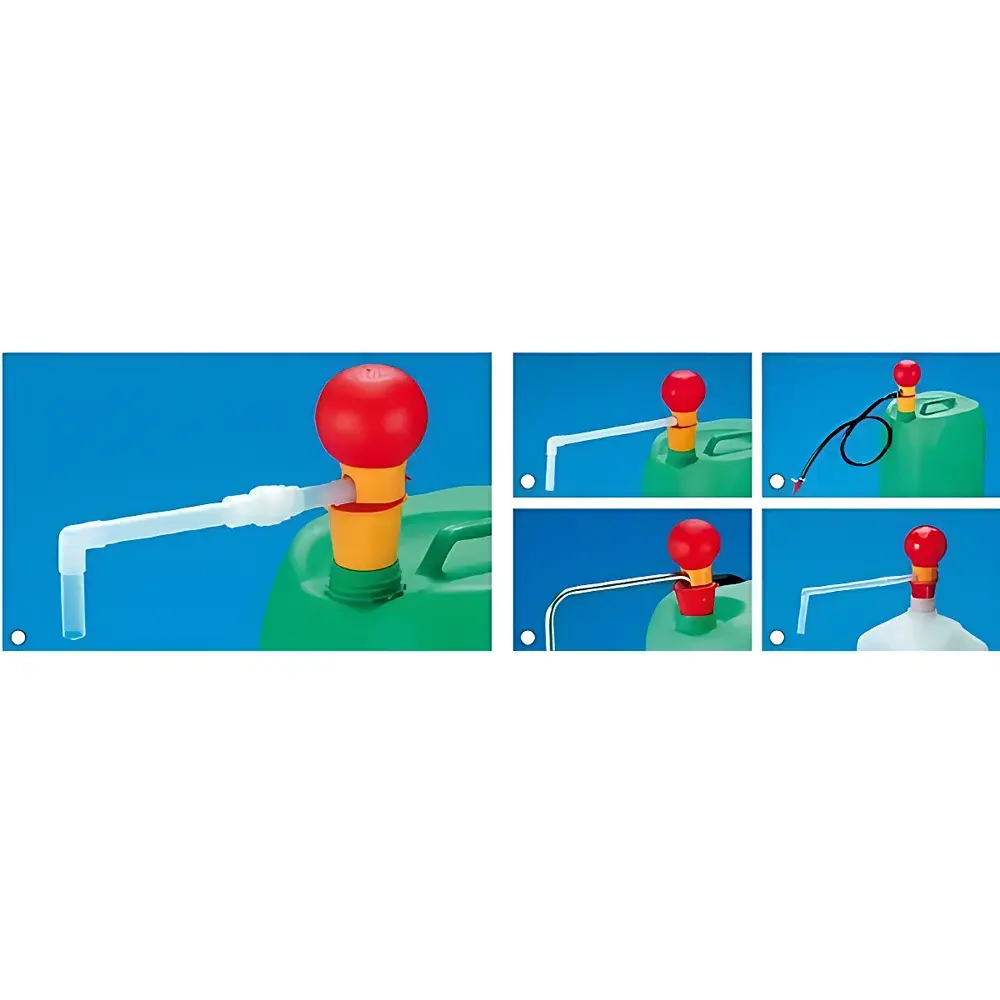
Burkle MTD5005 Series Manual Liquid Dispensing Pump
| Origin | Germany |
|---|---|
| Manufacturer Type | Authorized Distributor |
| Import Status | Imported |
| Model Numbers | MTD5005-1200 / MTD5005-3000 |
| Pricing | Upon Request |
Overview
The Burkle MTD5005 Series Manual Liquid Dispensing Pump is a precision-engineered, hand-operated fluid transfer device designed for safe, controlled, and residue-minimized liquid handling in analytical, quality control, and industrial laboratory environments. Based on positive displacement piston mechanics, the pump operates without electricity or compressed air—ensuring intrinsic safety when handling flammable, corrosive, or volatile liquids such as hydrocarbons, solvents, acids, and base solutions. Its modular architecture integrates a telescoping immersion tube, ergonomic lever actuation, and chemically resistant wetted materials to support repeatable volumetric transfer across variable container depths. Developed by Bürkle GmbH (Germany), a long-standing specialist in laboratory fluid management systems, the MTD5005 series complies with fundamental principles of ISO 8573-1 (compressed air purity) and EN 61326-1 (electromagnetic compatibility), though its manual operation eliminates electrical hazards entirely—making it suitable for Zone 0/1 hazardous area applications per ATEX guidelines.
Key Features
- Telescoping immersion tube: Automatically adjusts length (45–90 cm range depending on model) to match container height—maximizing liquid recovery and minimizing residual volume.
- Universal soft PVC stopper: Forms secure, leak-tight seal on container openings measuring 30–70 mm in diameter; compatible with glass, HDPE, stainless steel, and PET containers.
- Chemically inert wetted path options: Available with PVDF, V2A stainless steel (1.4404/316L), soft PVC, or polypropylene (PP) tubing—each selected per chemical compatibility tables (e.g., ASTM D471, ISO 1817).
- Ergonomic two-stage lever mechanism: Delivers consistent stroke force and flow rate control without operator fatigue; no priming required.
- No external power source: Eliminates spark risk, grounding requirements, and calibration drift associated with motorized or pneumatic systems.
- Modular service design: All consumable components—including piston seals, valves, and immersion tubes—are field-replaceable using standard tools.
Sample Compatibility & Compliance
The MTD5005 series accommodates a broad spectrum of liquid samples including petroleum fractions (gasoline, diesel, lubricants), aqueous reagents, organic solvents (acetone, methanol, THF), and mildly aggressive media (dilute HCl, NaOH up to 10%). It is not intended for viscous fluids (>500 mPa·s at 20 °C), particulate-laden suspensions, or high-vapor-pressure liquids requiring vapor-tight containment. Each configuration meets material traceability requirements under ISO 17025:2017 Clause 6.4.3 and supports GLP-compliant documentation when used with validated SOPs. While not certified to FDA 21 CFR Part 11, the pump’s mechanical operation ensures full auditability of usage cycles via maintenance logs—supporting GMP-aligned lab practices in petrochemical QC workflows.
Software & Data Management
As a purely mechanical instrument, the MTD5005 series does not incorporate embedded electronics, firmware, or digital interfaces. Consequently, it requires no software installation, network connectivity, or cybersecurity validation. Flow consistency is verified through periodic gravimetric testing per ASTM D1298 or ISO 3675, with results recorded manually or integrated into LIMS via standardized template entry. Optional accessories—including calibrated volumetric receivers and temperature-compensated density meters—enable full traceability to NIST-traceable standards.
Applications
- Sampling and dispensing of refinery intermediates and finished fuels in upstream/downstream QC labs.
- Transfer of reference standards and calibration solutions in environmental testing laboratories (EPA Method 1664, ISO 9377-2).
- Safe decanting of hazardous reagents during method development for GC-FID, ICP-OES, and Karl Fischer titration.
- Preparation of homogenized blends for octane number determination (ASTM D2699/D2700) and cetane testing (ISO 5165).
- Residue-free emptying of sample bottles prior to GC-MS analysis to prevent cross-contamination.
FAQ
What is the maximum recommended viscosity for reliable operation?
Viscosity should not exceed 500 mPa·s at 20 °C. Higher viscosities impair piston retraction and reduce flow reproducibility.
Can the pump be sterilized or autoclaved?
No—PVDF and PP components tolerate steam exposure up to 121 °C for short durations, but repeated autoclaving degrades elastomeric seals. Chemical disinfection (e.g., 70% ethanol, 0.5% sodium hypochlorite) is recommended.
Is there a documented calibration procedure?
Yes—Bürkle provides a gravimetric verification protocol aligned with EURACHEM/CITAC Guide CG4. Users perform three consecutive 100 mL transfers into a tared balance and calculate mean deviation against theoretical volume.
How often should maintenance be performed?
Inspect piston seals and valve seats after every 500 operating cycles or quarterly—whichever occurs first. Replace seals if visible cracking or compression set exceeds 15% of original thickness.
Does the pump meet USP requirements for pharmaceutical sampling?
While not specifically validated for USP , its non-metallic wetted parts (PVDF, PP) and absence of lubricants satisfy extractables/leachables criteria when used with appropriate cleaning validation.



