
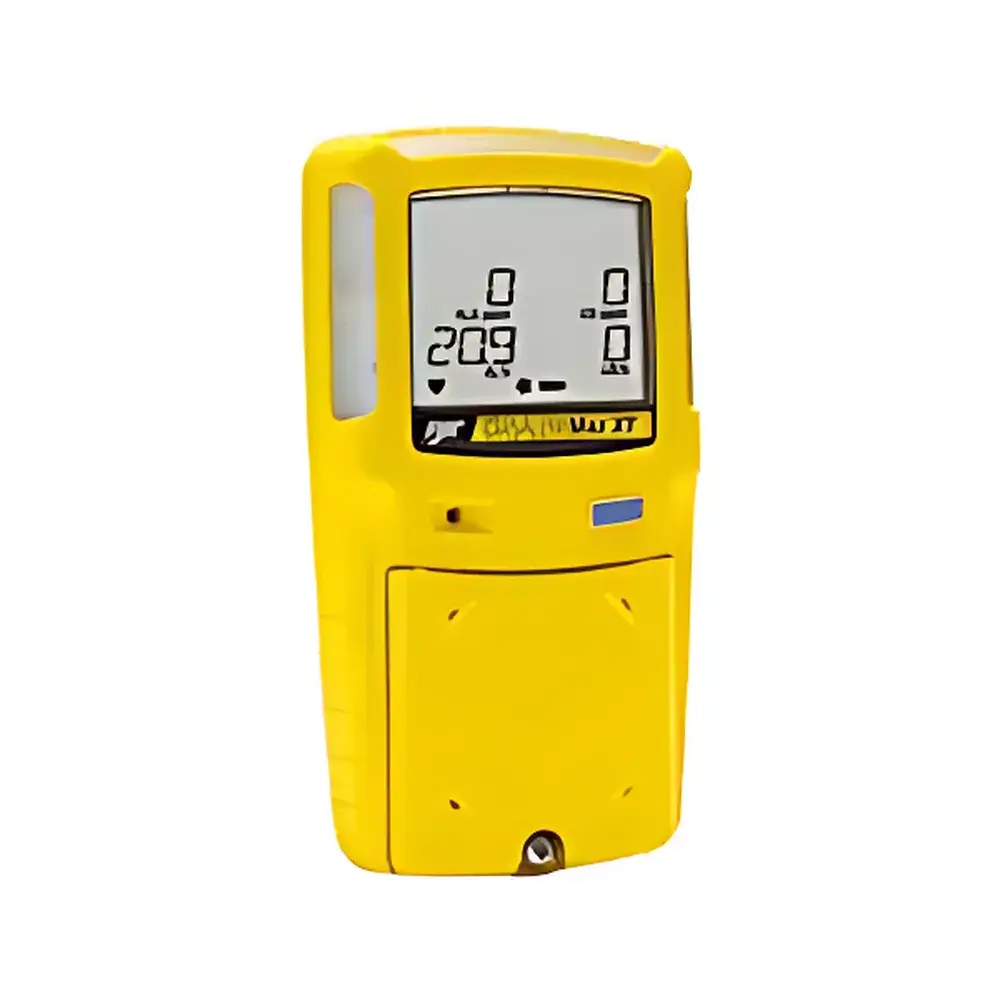
BW GasAlertMaxXT-4 Portable Pumped Gas Detector
| Brand | BW |
|---|---|
| Origin | Canada |
| Model | XT-4 |
| Instrument Type | Portable |
| Detectable Gases | H₂S, CO, O₂, LEL (configurable 1–4 gas combinations) |
| Response Time | ≤30 s |
| Measurement Accuracy | ±1 ppm (H₂S), ±1 ppm (CO), ±0.1% vol (O₂), ±1% LEL (combustibles), ±0.1% v/v (optional hydrocarbons) |
| Measurement Ranges | 0–100 ppm (H₂S), 0–500 ppm (CO), 0–30.0% vol (O₂), 0–100% LEL, 0–5.0% v/v (hydrocarbons) |
| Pump Type | Integrated diaphragm pump with SmartSample™ technology |
| IP Rating | IP66/IP67 |
| Operating Temperature | –20 °C to +50 °C |
| Battery Life | Up to 18 hours (alkaline) / 24+ hours (rechargeable Li-ion) |
| Compliance | ATEX II 2G Ex ib IIC T4 Gb, IECEx Ex ib IIC T4 Gb, UL 913 Class I, Div 1, Groups A–D, CSA C22.2 No. 152, EN 60079-0/-11, EN 61000-6-2/-6-3, RoHS, REACH |
Overview
The BW GasAlertMaxXT-4 is a certified intrinsically safe, portable pumped gas detector engineered for reliable multi-gas monitoring in demanding industrial and confined-space environments. Utilizing electrochemical sensors for toxic gases (H₂S, CO), catalytic bead (pellistor) technology for combustible gas (LEL), and paramagnetic or electrochemical sensing for oxygen (O₂), the instrument delivers real-time, quantitative concentration measurements across four independent channels. Its integrated SmartSample™ diaphragm pump enables active sampling at distances up to 30 meters via flexible probe tubing—critical for pre-entry verification of tanks, silos, sewers, and other permit-required confined spaces. Unlike diffusion-based detectors, the MaxXT-4 ensures representative sample acquisition even under low-flow or stagnant air conditions, minimizing false negatives and supporting compliance with OSHA 1910.146 and ANSI/ASSP Z117.1 standards for atmospheric testing prior to entry.
Key Features
- Intrinsically safe design certified to ATEX, IECEx, UL, and CSA standards for use in hazardous locations (Class I, Div 1; Zone 1)
- SmartSample™ intelligent pump system with automatic flow compensation and real-time blockage detection using semiconductor pressure sensing
- Single-button operation with intuitive icon-driven interface supporting English, French, German, Spanish, and Portuguese
- Backlit LCD display showing real-time gas concentrations, battery status, pump operation, and alarm history
- Ruggedized housing with IP66/IP67 ingress protection and shock-absorbing overmold for field durability
- Full self-test at power-on: sensor integrity, battery voltage, circuit continuity, and simultaneous functional check of audible (95 dB) and visual (360° high-intensity LED) alarms
- Internal data logging (up to 12 months of 1-minute interval records) with time-stamped event logs (alarms, calibrations, bump tests, pump faults)
Sample Compatibility & Compliance
The GasAlertMaxXT-4 is validated for continuous monitoring of ambient air in occupational hygiene, utility infrastructure, wastewater treatment, petrochemical facilities, and emergency response operations. Sensor cross-sensitivity profiles are documented per IEC 60079-29-1 and meet performance criteria outlined in ISO 16000-23 for indoor air quality assessment. The device supports regulatory workflows requiring audit-ready records—including GLP-aligned calibration logs and bump test documentation. When paired with MicroDock II automated docking station, it satisfies FDA 21 CFR Part 11 requirements for electronic records and signatures through secure user authentication, calibrated timestamping, and immutable audit trails. All firmware and configuration changes are logged with operator ID and timestamp.
Software & Data Management
Data retrieval is enabled via USB or optional Bluetooth® 4.2 module, compatible with BW’s FleetManager II software platform. FleetManager II provides centralized instrument management—including remote firmware updates, group calibration scheduling, customizable alarm thresholds, and automated report generation (PDF/CSV). Logged data exports support ISO/IEC 17025-compliant laboratory information management systems (LIMS) and integrate with enterprise EHS platforms via standard RESTful API. Calibration certificates generated by MicroDock II include NIST-traceable reference gas details, environmental conditions, and pass/fail validation against manufacturer specifications.
Applications
- Confined space entry pre-testing and continuous atmospheric monitoring during work execution
- Leak detection and area surveillance in refineries, chemical plants, and LNG terminals
- Emergency response triage for H₂S or CO exposure incidents in municipal infrastructure
- Indoor air quality verification in remediation projects and post-construction commissioning
- Periodic safety audits and compliance verification per OSHA PELs, ACGIH TLVs®, and EU Directive 2017/164
FAQ
Does the GasAlertMaxXT-4 require daily bump testing before use?
Yes—OSHA and manufacturer guidelines mandate functional verification with certified span gas prior to each day’s use. The instrument supports automated bump test protocols when docked in MicroDock II.
Can sensor configurations be changed in the field?
No—sensor modules are factory-installed and not user-replaceable. Gas combinations must be specified at time of order (e.g., H₂S/CO/O₂/LEL or custom 3-gas variants).
What is the expected service life of the electrochemical sensors?
Typical operational lifespan is 24 months under normal conditions; however, exposure to extreme humidity, high gas concentrations, or corrosive atmospheres may reduce longevity. Sensors undergo automatic stability diagnostics during each power cycle.
Is the pump maintenance-free?
The SmartSample™ diaphragm pump is designed for >10,000 hours of operation without scheduled maintenance. Filter elements in the inlet assembly should be inspected and replaced quarterly in dusty or particulate-laden environments.
How does the instrument handle zero drift in oxygen measurement?
The O₂ sensor performs automatic baseline correction during startup using ambient air as reference. Field recalibration is required only if readings deviate beyond ±0.2% vol from certified air standard—verified via MicroDock II’s traceable calibration routine.
Related Products







