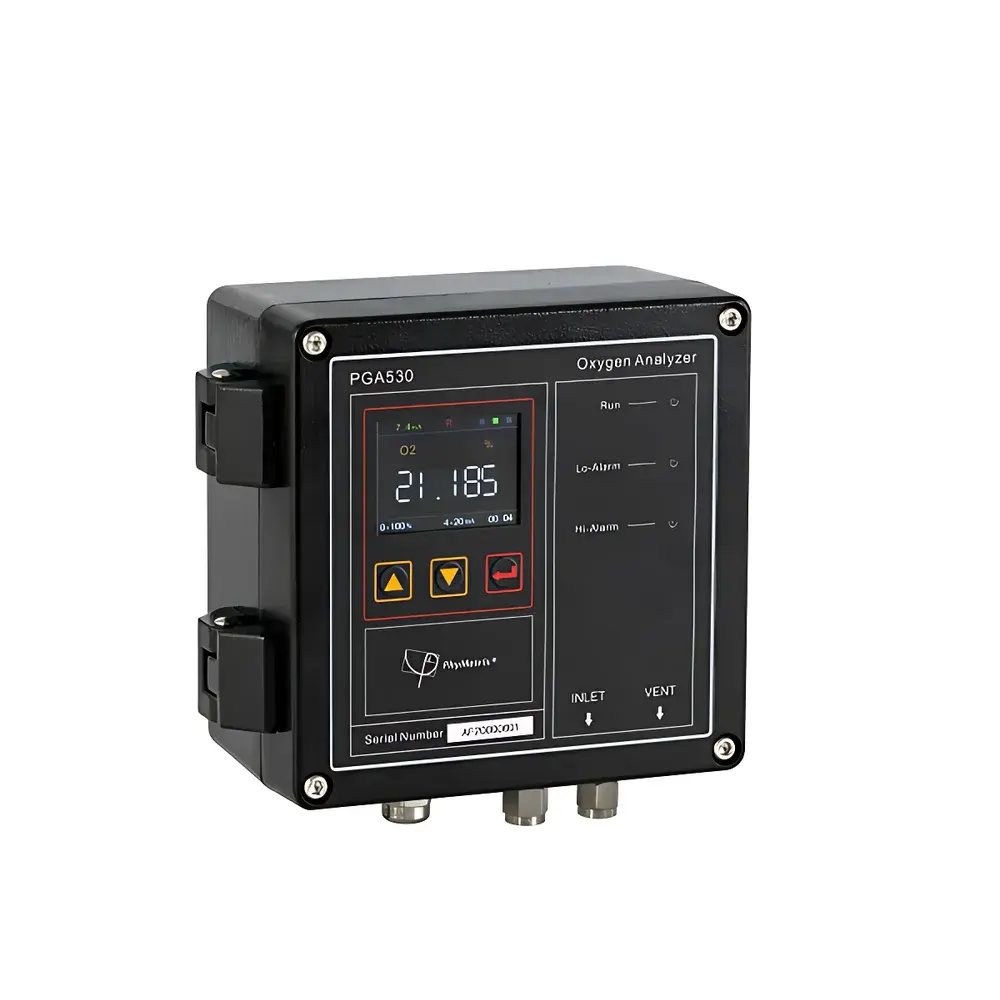
PhyMetrix PGA530 Online Paramagnetic Oxygen Analyzer
| Brand | PhyMetrix |
|---|---|
| Origin | USA |
| Manufacturer Type | Authorized Distributor |
| Product Origin | Imported |
| Model | PGA530 |
| Sensor Type | Electrochemical |
| Measurement Accuracy | ±1% FS |
| Response Time | T90 < 15 s, T95 < 25 s |
| Resolution | 0.001% O₂ |
| Measurement Ranges | 0–1%, 0–5%, 0–10%, 0–25%, 0–100% O₂ (auto-ranging) |
| Repeatability | ±0.5% FS |
| Operating Temperature | 0–45 °C with full-range temperature compensation |
| Power Supply | 110–220 VAC or 12–36 VDC |
| Dimensions | 200 × 80 × 102 mm (H × W × D) |
| Weight | 1.6 kg |
| Process Connection | 1/4" Swagelok compression fitting (male thread) |
| Enclosure Rating | IP67 |
| Display | Full-color LCD with adjustable backlight |
| Output Options | 4–20 mA analog, relay alarm (SPDT), RS485 Modbus RTU |
| Environmental Compliance | CE, RoHS, UL-listed power input |
Overview
The PhyMetrix PGA530 is a high-reliability, continuous-duty online oxygen analyzer engineered for precise, stable measurement of oxygen concentration in industrial process streams across a wide dynamic range—from trace-level monitoring at 0–1% O₂ up to ambient and enriched air applications up to 100% O₂. Unlike paramagnetic or zirconia-based analyzers, the PGA530 employs a solid-state electrochemical sensor with proprietary electrolyte formulation and gas-diffusion membrane architecture, delivering long-term stability without consumable anodes or frequent calibration drift. Its measurement principle relies on the amperometric detection of oxygen reduction current proportional to partial pressure—fully compensated for ambient temperature fluctuations across the entire 0–45 °C operating envelope. Designed for unattended operation in demanding environments—including chemical reactors, inert gas blanketing systems, combustion air monitoring, and pharmaceutical nitrogen purge validation—the PGA530 integrates seamlessly into distributed control systems (DCS) and safety instrumented systems (SIS) via industry-standard analog and digital interfaces.
Key Features
- Electrochemical sensor with >5-year operational lifetime under continuous exposure to process gas, validated per IEC 60747-17 accelerated aging protocols
- True auto-ranging capability across five user-selectable spans (0–1%, 0–5%, 0–10%, 0–25%, 0–100% O₂), eliminating manual range switching or hardware reconfiguration
- IP67-rated aluminum-magnesium alloy enclosure with corrosion-resistant surface treatment, certified for outdoor mounting and washdown-prone areas
- Full-color transflective LCD display with programmable backlight intensity—optimized for legibility under direct sunlight (>10,000 lux ambient illumination)
- Dual-power architecture supporting both AC line voltage (110–220 VAC) and low-voltage DC (12–36 VDC), including integrated transient voltage suppression (TVS) for lightning-induced surge protection
- Real-time multi-parameter display: O₂ concentration (%), system timestamp (date/time), 4–20 mA output current value, internal sensor temperature, and diagnostic status flags
Sample Compatibility & Compliance
The PGA530 is compatible with dry, non-corrosive, non-condensing gas streams containing oxygen concentrations from 0 to 100% by volume. It is not recommended for use with halogenated hydrocarbons, hydrogen sulfide, chlorine, or high-humidity samples (>90% RH) without optional heated sample conditioning. The analyzer complies with EN 61000-6-2 (immunity) and EN 61000-6-4 (emissions), carries CE marking per EU Machinery Directive 2006/42/EC, and meets UL 61010-1 requirements for electrical safety in industrial instrumentation. Its analog output conforms to NAMUR NE43 fault signaling standards, and relay outputs are rated for SIL2-capable safety loops per IEC 61508. For regulated industries, audit trails, calibration logs, and user access controls can be implemented through external SCADA integration compliant with FDA 21 CFR Part 11 when paired with validated data acquisition software.
Software & Data Management
While the PGA530 operates as a standalone field instrument, its RS485 Modbus RTU interface enables bidirectional communication with supervisory systems for remote configuration, real-time data polling, and event-driven alarm reporting. Configuration parameters—including range selection, damping time, alarm thresholds, and zero/span calibration offsets—are stored in non-volatile memory with write-protection logic to prevent accidental modification. Firmware updates are performed via secure serial protocol using manufacturer-provided utilities; all versions are version-controlled and traceable per ISO 9001 change management procedures. Data logging functionality resides externally, but the unit supports time-synchronized output tagging to ensure alignment with historian timestamps in compliance with ASTM D6299 precision monitoring guidelines.
Applications
- Continuous monitoring of inerting atmospheres in petrochemical storage tanks and reactor vessels
- Oxygen verification in pharmaceutical nitrogen purging cycles per USP and EU GMP Annex 1
- Combustion efficiency optimization in boiler and furnace control systems
- Quality assurance in modified atmosphere packaging (MAP) gas mixtures
- Safety interlock triggering for oxygen-deficient or oxygen-enriched hazard zones (OSHA 1910.134, NFPA 51B)
- Environmental emissions monitoring where O₂ serves as a diluent correction parameter for NOₓ/SO₂ reporting
FAQ
What is the expected service life of the electrochemical sensor under continuous operation?
The sensor is rated for ≥5 years of uninterrupted operation when exposed to clean, dry process gas within specified temperature and humidity limits. Actual lifespan may vary based on gas composition, particulate loading, and calibration frequency.
Does the PGA530 require periodic zero or span calibration?
Yes—routine calibration is recommended every 3–6 months depending on application severity. The unit supports two-point (zero/span) calibration using certified gas standards traceable to NIST.
Can the analyzer operate in sub-zero ambient temperatures?
The specified operating range is 0–45 °C. For installations below 0 °C, an optional thermostatically controlled heating jacket is available to maintain sensor head temperature within specification.
Is the 4–20 mA output intrinsically safe?
No—the standard output is non-IS. For hazardous area installation, a separately certified intrinsic safety barrier (e.g., Pepperl+Fuchs KFD2-STC4) must be used in series with the loop.
How is temperature compensation implemented?
A high-stability platinum RTD (PT1000) is embedded adjacent to the sensing electrode, feeding real-time thermal data to a microprocessor that applies a polynomial correction algorithm across the full 0–45 °C range, ensuring ±1% FS accuracy without external compensation hardware.
Related Products