
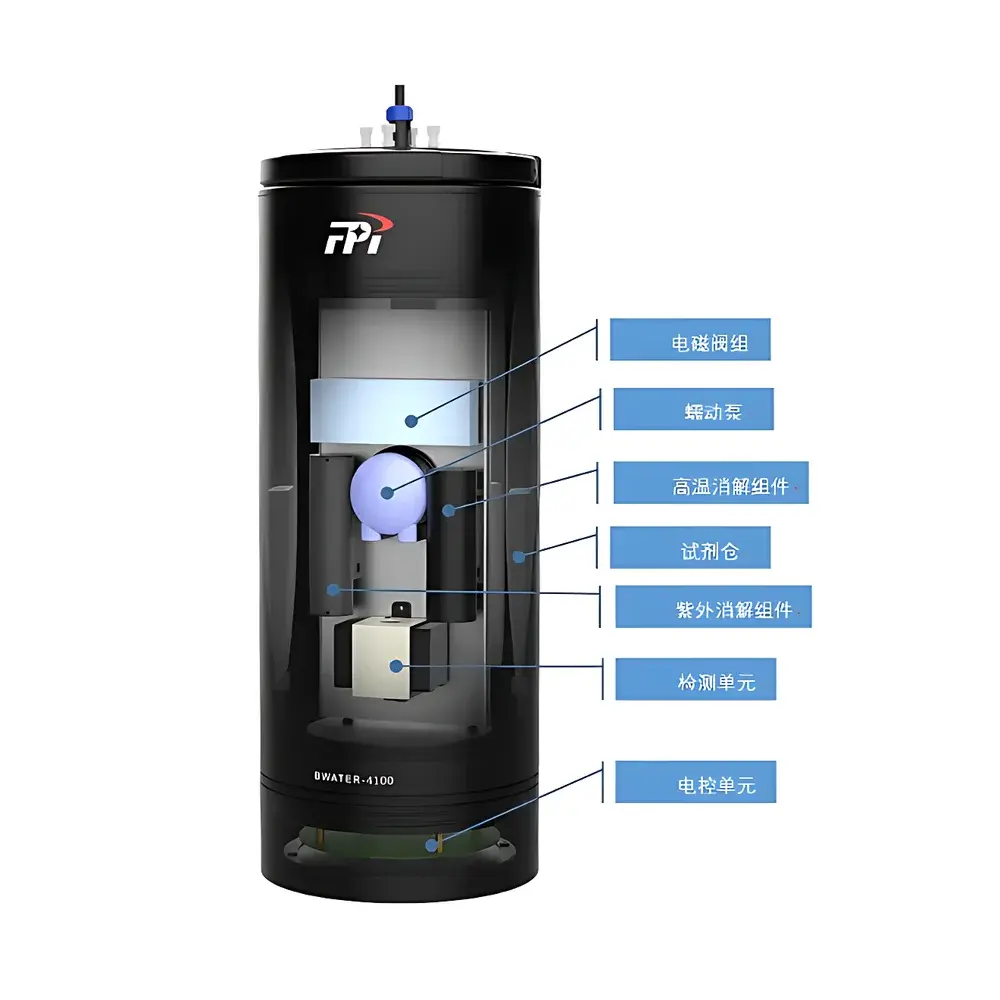
BWATER4100 In-situ Water Quality Analyzer by FPI
| Brand | FPI |
|---|---|
| Origin | Zhejiang, China |
| Manufacturer Type | Original Equipment Manufacturer (OEM) |
| Product Category | Domestic |
| Model | BWATER4100 |
| Instrument Type | Online Multi-parameter Water Quality Analyzer |
| Measured Parameters | Ammonia Nitrogen (NH₃-N), Total Phosphorus (TP) |
| Enclosure Rating | IP68 |
| Power Supply | Battery or Solar Compatible |
| Reagent Replacement Interval | Up to 6 Weeks |
| Sample Reaction Volume | <3 mL |
| Digestion Method | UV Irradiation + High-Temperature Thermal Digestion |
| Typical Analysis Time per Parameter | <30 minutes |
| Compliance | GB/T 7479–2023 (NH₃-N), GB/T 11893–1989 (TP), ISO 15681-2:2022 (Phosphorus), ASTM D1426–22 (Ammonia) |
Overview
The BWATER4100 In-situ Water Quality Analyzer is an OEM-engineered, submersible online analyzer designed for continuous, unattended measurement of key eutrophication indicators—ammonia nitrogen (NH₃-N) and total phosphorus (TP)—in natural water bodies. It operates on the principle of segmented flow analysis (SFA) with a proprietary annular injection manifold, enabling precise reagent-sample metering and controlled reaction kinetics under field conditions. Unlike conventional benchtop analyzers requiring sample extraction and manual handling, the BWATER4100 performs fully automated wet-chemical analysis directly in situ—eliminating transport-induced matrix changes and preserving temporal resolution critical for dynamic aquatic systems. Its core architecture integrates high-precision micro-peristaltic pumping, UV-assisted oxidative digestion, thermally accelerated hydrolysis, and dual-wavelength photometric detection (typically at 630 nm for NH₃-N and 700 nm for TP), all housed within a corrosion-resistant, pressure-rated enclosure certified to IP68. The system is engineered for deployment in ambient freshwater, estuarine, and coastal marine environments where long-term stability, low maintenance frequency, and minimal reagent consumption are operational imperatives.
Key Features
- Simultaneous dual-parameter quantification of NH₃-N and TP using standardized colorimetric methods aligned with Chinese National Standards (GB/T 7479–2023 and GB/T 11893–1989) and internationally recognized protocols (ISO 15681-2:2022, ASTM D1426–22)
- Annular injection flow path design minimizes internal volume (40% compared to conventional flow-injection systems, and enables full parameter cycling within 30 minutes
- Dual-mode digestion: UV photolysis (254 nm) for organic nitrogen cleavage followed by high-temperature thermal digestion (120 °C, 30 min) for total phosphorus mineralization—ensuring complete oxidation of refractory species
- Modular quick-release reagent cartridge system allows tool-free replacement of reagents and deionized water reservoirs in under 90 seconds—critical for remote or unmanned deployments
- IP68-rated titanium-alloy-reinforced polymer housing with acid-alkali resistant surface finish (pH 2–12 operational range); rated for continuous submersion up to 10 m depth
- Ultra-low power architecture: average current draw <120 mA @ 12 VDC; compatible with LiFePO₄ battery banks (7–14 day autonomy) or integrated solar-charged systems (≥20 W panel + charge controller)
Sample Compatibility & Compliance
The BWATER4100 accepts raw, unfiltered water samples from rivers, lakes, reservoirs, estuaries, and nearshore marine zones. Turbidity up to 100 NTU and suspended solids ≤200 mg/L do not require pre-filtration due to robust fluidic design and self-cleaning valve sequencing. All analytical procedures conform to regulatory frameworks governing environmental monitoring data integrity: method validation follows ISO/IEC 17025:2017 principles; data acquisition supports audit trails compliant with GLP and GMP documentation requirements. While not FDA 21 CFR Part 11-certified out-of-the-box, the embedded firmware architecture permits integration with third-party LIMS platforms supporting electronic signature and data immutability features.
Software & Data Management
Embedded firmware provides local data logging (1 Hz sampling, 30-day buffer), configurable measurement intervals (15 min to 24 h), and real-time diagnostics via Modbus RTU/ASCII over RS-485. Optional cellular or LoRaWAN telemetry modules enable secure MQTT-based transmission to cloud platforms (e.g., AWS IoT Core or Azure IoT Hub). Firmware supports remote configuration, firmware over-the-air (FOTA) updates, and diagnostic event logging—including pump cycle counts, digestion temperature deviations, and photometer baseline drift alerts. Raw absorbance values, calibration coefficients, and QC flag metadata (e.g., “digestion timeout”, “low reagent level”) are retained alongside concentration outputs to support traceable QA/QC workflows.
Applications
- Fixed-platform deployments on buoy-mounted environmental monitoring stations for longitudinal nutrient trend analysis
- Integration into autonomous surface vehicles (ASVs) and unmanned underwater vehicles (UUVs) for spatially resolved, high-resolution mapping of nutrient plumes
- Rapid-deployment configurations for emergency response scenarios (e.g., post-spill or algal bloom events) where lab turnaround time is prohibitive
- Long-term ecological research sites requiring year-round, low-maintenance operation in remote watersheds or protected marine reserves
- Supplemental verification layer in regulatory compliance programs—cross-validating grab-sample laboratory results with continuous in-situ profiles
FAQ
What sample pretreatment is required prior to analysis?
None—raw water samples may be introduced directly. The system handles turbidity ≤100 NTU and suspended solids ≤200 mg/L without filtration.
How often must reagents be replaced?
Reagent cartridges last up to six weeks under standard 2-hour measurement intervals; usage frequency and ambient temperature affect actual longevity.
Is the instrument suitable for seawater applications?
Yes—the housing material and fluidic components are resistant to chloride-induced corrosion; salinity up to 35 ppt has been validated in field trials.
Does the analyzer support remote calibration verification?
Yes—built-in optical reference channels and programmable zero/span checks allow automated calibration verification without physical access.
Can the BWATER4100 be integrated with existing SCADA or water quality network infrastructure?
Yes—Modbus RTU/ASCII protocol ensures seamless interoperability with most industrial control systems; custom OPC UA drivers available upon request.
Related Products







