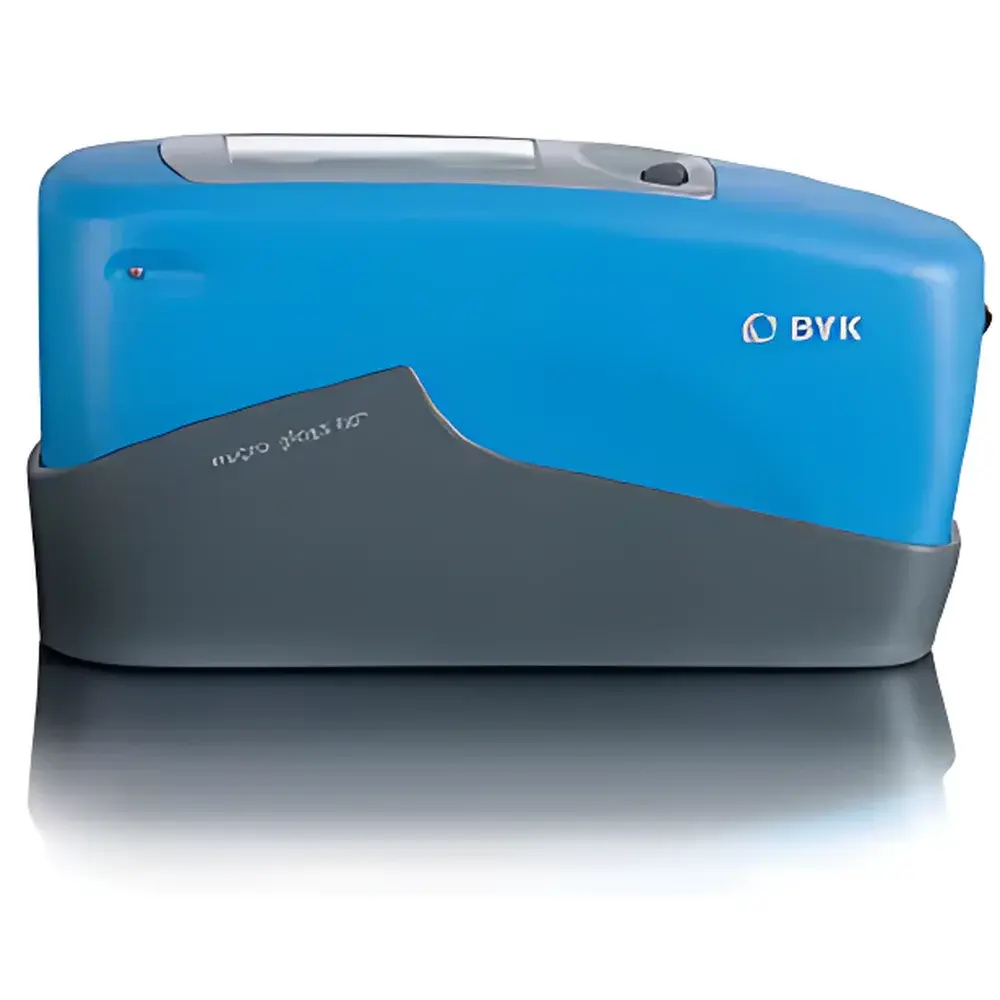
BYK-Gardner micro-TRI-gloss 4569 Portable Gloss Meter for Small Parts
| Brand | BYK-Gardner |
|---|---|
| Origin | Germany |
| Model | BYK 4569 |
| Measurement Angles | 60° only |
| Aperture Size | 2 × 4 mm |
| Gloss Range | 0–2000 GU |
| Repeatability | ±0.2 GU (0–100 GU), ±0.2% (100–2000 GU) |
| Reproducibility | ±0.5 GU (0–100 GU), ±0.5% (100–2000 GU) |
| Spectral Response | CIE standard observer (illuminant C) |
| Measurement Time | 0.5 s |
| Substrate Compatibility | Fe (magnetic) and NFe (non-magnetic) |
| Coating Thickness Range | 0–500 µm |
| Thickness Accuracy | ±(1.5 µm + 2% of reading) |
| Memory Capacity | 999 readings with timestamp |
| Interface | USB |
| Power | 1 × AA alkaline battery (≈4,000 measurements) or USB bus power |
| Dimensions | 155 × 73 × 48 mm |
| Weight | 0.4 kg |
| Operating Temperature | 15–40 °C |
| Relative Humidity | ≤85% RH (non-condensing) |
| Compliance | ISO 2813, ASTM D523, DIN 67530, JIS Z8741 |
Overview
The BYK-Gardner micro-TRI-gloss 4569 is a precision-engineered portable gloss meter designed specifically for high-accuracy surface gloss assessment of small, geometrically constrained components—such as automotive trim inserts, consumer electronics housings, appliance control panels, and precision injection-molded parts. Unlike conventional gloss meters with standard apertures (e.g., 9 × 15 mm or 5 × 38 mm), the 4569 features an ultra-compact 2 × 4 mm measurement spot, enabling reliable, repeatable gloss quantification on surfaces as narrow as 3 mm wide or curved with radii down to 10 mm. It operates exclusively at the 60° geometry, which is internationally standardized for medium-gloss evaluation and widely specified in automotive OEM paint standards (e.g., VW TL 226, GMW 14872) and industrial coating specifications. The instrument employs a stabilized tungsten-halogen light source and a silicon photodiode detector aligned per ISO 2813 and ASTM D523, ensuring traceable, geometry-compliant specular reflectance measurement. Its optical architecture minimizes edge diffraction effects and stray-light interference, critical when measuring near feature boundaries or textured substrates.
Key Features
- Ultra-small aperture (2 × 4 mm) optimized for micro-components, buttons, bezels, and narrow mold lines
- Single-angle 60° configuration—fully compliant with ISO 2813, ASTM D523, DIN 67530, and JIS Z8741
- Integrated non-destructive coating thickness measurement (0–500 µm) on both ferrous (Fe) and non-ferrous (NFe) substrates
- High-resolution color TFT display with intuitive icon-based navigation and tactile scroll wheel interface
- Onboard statistical mode: calculates mean, range, and standard deviation from ≥3 readings per sample—essential for uniformity validation
- Auto-diagnostic system continuously monitors calibration status, standard plate cleanliness, and optical path integrity
- Dual-power operation: long-life AA alkaline battery (≈4,000 measurements) or direct USB bus power for lab/production-line use
- Rugged, ergonomic housing (155 × 73 × 48 mm; 0.4 kg) with IP52-rated ingress protection against dust and light splashes
Sample Compatibility & Compliance
The micro-TRI-gloss 4569 accommodates diverse material classes including solvent-borne and waterborne automotive basecoats/clearcoats, thermoplastic elastomers (TPE), polypropylene (PP) with matte additives, PU-leather, anodized aluminum, and PVD-coated stainless steel. Its 2 × 4 mm aperture ensures representative sampling even on embossed, grained, or laser-etched surfaces where larger apertures would average over topographic variation. All measurements adhere strictly to ISO 2813:2019 (plastics and paint), ASTM D523-14 (specular gloss), and DIN 67530 (optical geometry tolerances). For regulated environments—including automotive Tier-1 supplier QC labs and medical device coating validation—the instrument supports full audit trails when paired with smart-process Gloss software (21 CFR Part 11–compliant electronic signatures and data integrity controls available via optional license).
Software & Data Management
Data acquisition and reporting are enabled via two dedicated PC applications: smart-lab Gloss (for laboratory documentation, trend analysis, and PDF/Excel export) and smart-process Gloss (for real-time SPC, multi-station process monitoring, and automated pass/fail flagging against user-defined limits). Both support XML-based import/export for LIMS integration and offer multilingual UI (English, German, French, Japanese, Chinese, Spanish, Italian). The software suite logs full metadata—including operator ID, timestamp, GPS coordinates (if enabled), environmental conditions, and instrument serial number—ensuring GLP/GMP traceability. Raw gloss and thickness values are stored with 0.1 GU/0.1 µm resolution; statistical summaries comply with ISO 5725-2 for precision evaluation. A USB interface provides bidirectional communication, firmware updates, and secure certificate-of-calibration upload.
Applications
This instrument is routinely deployed in: (1) Automotive interior quality assurance—measuring gloss consistency across dashboard trims, air vent louvers, and gear shift knobs; (2) Consumer electronics—verifying visual match between aluminum chassis, glass displays, and polymer buttons; (3) Appliance manufacturing—validating matte-finish consistency on refrigerator doors and oven control panels; (4) Medical device coating verification—quantifying gloss and film thickness of biocompatible Parylene or silicone coatings on surgical instrument housings; (5) Packaging R&D—assessing varnish gloss uniformity on foil-laminated cartons and blister packaging. Its ability to co-measure gloss and thickness at the same location eliminates spatial registration error—critical when correlating optical appearance with functional barrier performance.
FAQ
What standards does the BYK 4569 comply with?
ISO 2813, ASTM D523, DIN 67530, JIS Z8741, and TAPPI T 480 (for paper-related derivatives).
Can it measure on curved or textured surfaces?
Yes—the 2 × 4 mm aperture and short working distance (0.5 mm) enable stable contact measurement on radii ≥10 mm and structured surfaces such as leather grain or brushed metal.
Is calibration traceable to national standards?
Yes—each unit ships with a UKAS-accredited certificate of calibration (NIST-traceable reference standards), valid for 12 months under normal use.
Does it require annual recalibration?
Recommended annually or after 10,000 measurements—BYK’s auto-diagnostic system alerts users when calibration drift exceeds ±0.3 GU.
How is data security managed in regulated environments?
When used with smart-process Gloss licensed for 21 CFR Part 11, the system enforces role-based access, electronic signatures, immutable audit trails, and encrypted local database storage.