
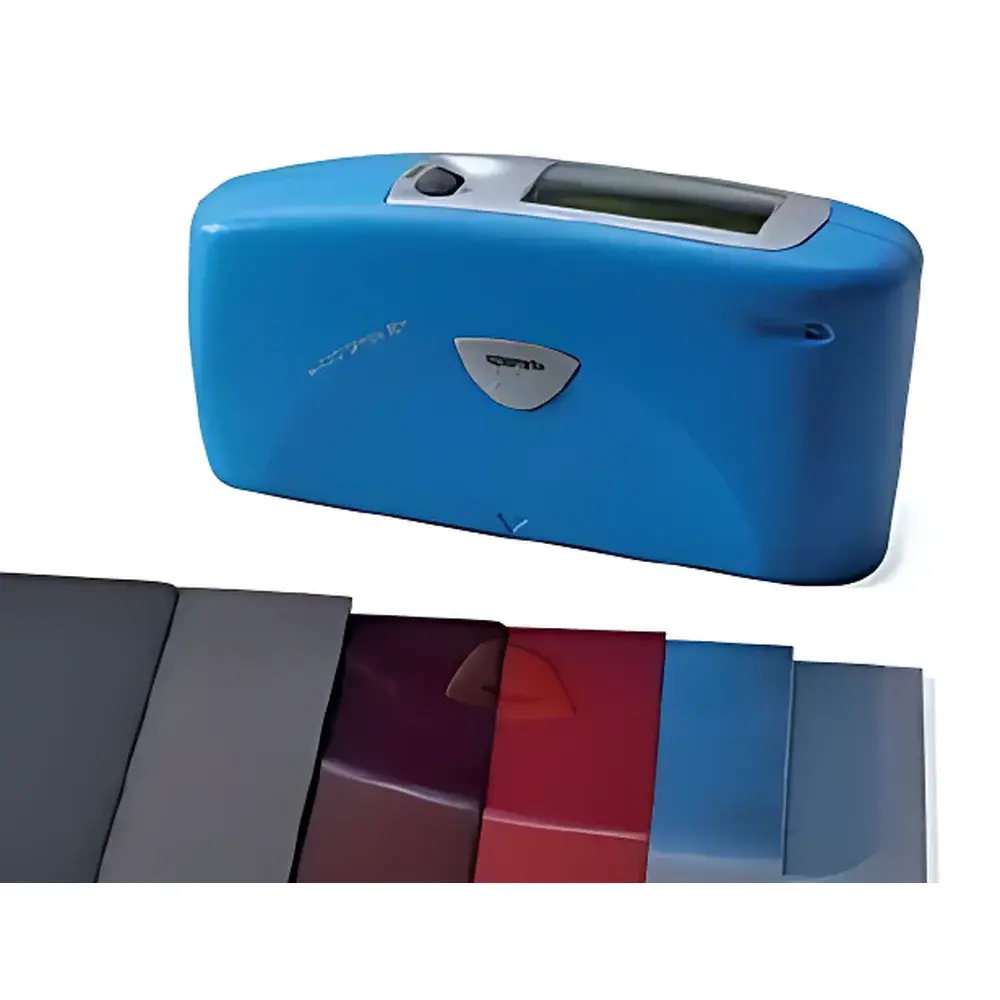
BYK-Gardner micro-TRI-gloss S Model BYK 4566 Gloss Meter
| Brand | BYK-Gardner |
|---|---|
| Origin | Germany |
| Model | BYK 4566 |
| Measurement Angles | 20°, 60°, 85° |
| Display | Full-color TFT touchscreen |
| Interface | USB |
| Compliance | ISO 2813, ASTM D523, DIN 67530, JIS Z8741 |
| Measurement Range | 0–2000 GU (angle-dependent) |
| Repeatability | ±0.1 GU (0–20 GU), ±0.2 GU (20–100 GU), ±0.2% (100–2000 GU) |
| Reproducibility | ±0.2 GU (0–20 GU), ±0.5 GU (20–100 GU), ±0.5% (100–2000 GU) |
| Probe Type | Dual-mode (magnetic/non-magnetic) for coating thickness integration |
| Optional Thickness Measurement | ISO 2360, ISO 2808, ASTM B499, D1400 |
| Calibration | Traceable certified standard tile included |
| Software Compatibility | smart-lab Gloss & smart-process Gloss (30-day trial, dual-license) |
Overview
The BYK-Gardner micro-TRI-gloss S Model BYK 4566 is a compact, handheld tri-angle gloss meter engineered for high-precision surface reflectance quantification across industrial quality control environments—particularly in automotive OEM and Tier-1 supplier facilities. It operates on the principle of specular reflectance measurement: a collimated beam of visible light (CIE illuminant D65) is directed at defined incidence angles (20°, 60°, and 85°) onto the sample surface; the intensity of reflected light measured at the mirror angle is normalized against a reference standard (gloss unit, GU) to yield a dimensionless gloss value. This geometry adheres strictly to ISO 2813 and ASTM D523, ensuring metrological traceability and inter-laboratory comparability. Unlike single-angle instruments, the BYK 4566 enables concurrent evaluation of high-, medium-, and low-gloss regimes within one measurement cycle—critical for detecting subtle deviations in clearcoat integrity, basecoat uniformity, or leather grain consistency across heterogeneous substrates such as painted steel, anodized aluminum, thermoplastic polyolefins, and PU-coated synthetic leathers.
Key Features
- Tri-angle measurement capability (20°, 60°, 85°) in a single ergonomic housing—no manual angle switching or recalibration required between readings
- Full-color TFT touchscreen with intuitive icon-based navigation and tactile scroll wheel for glove-compatible operation in production-floor conditions
- Integrated automatic diagnostic system: real-time verification of calibration status, standard tile cleanliness, and optical path integrity prior to each measurement
- Dual-mode probe design supporting both magnetic (ferrous substrates) and non-magnetic (aluminum, composites, plastics) coating thickness measurement per ISO 2360 and ASTM B499
- Extended dynamic range up to 2000 GU with optimized signal-to-noise ratio—enabling reliable quantification from matte interior trim (1800 GU)
- Onboard statistical mode: calculates mean, standard deviation, and min/max spread across ≥3 user-defined positions—essential for assessing gloss uniformity across large panels or molded components
- Traceable calibration certificate included; standard tile permanently housed in protective calibration dock to prevent contamination or mechanical damage
Sample Compatibility & Compliance
The BYK 4566 accommodates diverse material classes without accessory modification: liquid-applied coatings (waterborne, solventborne, UV-curable), powder-coated metals, injection-molded thermoplastics (PP, ABS, PC), laminated composites, and natural/synthetic leathers. Its 20° optics resolve fine texture effects in high-gloss applications (e.g., automotive clearcoats), while the 85° configuration delivers enhanced sensitivity for low-gloss surfaces such as instrument panel soft-touch finishes or textured door trims. The instrument complies with ISO 2813 (general-purpose gloss), ASTM D523 (plastics and coatings), DIN 67530 (automotive paint systems), and JIS Z8741 (Japanese industrial standards). For regulated environments—including IATF 16949-certified production lines—the device supports audit-ready documentation via GLP-compliant data export and meets requirements for instrument qualification under FDA 21 CFR Part 11 when used with smart-process Gloss software (electronic signatures, audit trails, and user access controls enabled).
Software & Data Management
Data acquisition and reporting are managed through two complementary software platforms: smart-lab Gloss (for R&D and lab-based comparative analysis) and smart-process Gloss (for inline QC and statistical process control). Both support CSV, PDF, and Excel exports; generate customizable reports with embedded measurement images; and maintain full metadata (operator ID, timestamp, location tag, environmental temperature/humidity if logged externally). smart-process Gloss includes SPC charting (X-bar/R, Cpk/Ppk), alarm thresholds for out-of-spec results, and seamless integration with MES/ERP systems via OPC UA or RESTful API. All measurements store raw angular data—not just averaged values—preserving granularity for root-cause analysis of gloss anomalies. Software installation requires Windows 10/11 (64-bit), Intel Core i5 or higher, 4 GB RAM minimum, and 300 MB free disk space. A USB port is mandatory for instrument communication and license activation.
Applications
The BYK 4566 serves critical functions across multiple stages of automotive manufacturing: incoming inspection of raw materials (e.g., pre-painted sheet metal, leather hides); in-process verification of electrocoat, primer, basecoat, and clearcoat application parameters; final audit of assembled body panels, bumpers, and interior modules; and supplier scorecarding for Tier-2 component vendors. Beyond automotive, it is deployed in aerospace cabin interior finishing (carbon fiber composites, phenolic laminates), consumer electronics (anodized aluminum housings, AR-coated glass displays), packaging (metallized PET films, coated paperboard), and architectural coatings (ceramic tiles, decorative laminates). Its 60° S variant (integrated into the 4566 platform) extends detection limits into sub-2 GU ranges—enabling objective specification of “anti-glare” surfaces required in HUD projection zones or medical device enclosures where stray light must be minimized.
FAQ
Does the BYK 4566 require annual recalibration?
Yes. While the integrated diagnostic system monitors long-term stability, ISO/IEC 17025-accredited laboratories recommend annual traceable recalibration using NIST-traceable reference standards. BYK-Gardner service centers provide certified recalibration with uncertainty budgets.
Can the instrument measure curved surfaces?
It can measure convex or concave geometries with radii ≥25 mm. For tighter radii, use the optional 60° XS probe (2 × 4 mm aperture), which minimizes edge diffraction effects.
Is thickness measurement performed simultaneously with gloss?
No. Gloss and thickness are sequential but co-located measurements: the user initiates gloss first, then toggles to thickness mode without repositioning the probe—ensuring spatial correlation between optical and eddy-current/magnetic induction readings.
What environmental conditions affect measurement accuracy?
Ambient temperature fluctuations >±2°C during measurement may induce thermal drift in detector response. Relative humidity above 85% risks condensation on the optical window; BYK recommends operation between 10–40°C and 30–70% RH.
How does the instrument handle multi-layer or translucent coatings?
It measures total specular reflectance only. For subsurface scattering effects (e.g., metallic flake orientation, pigment dispersion), complementary techniques such as goniospectrophotometry or SEM-EDS are recommended.




