
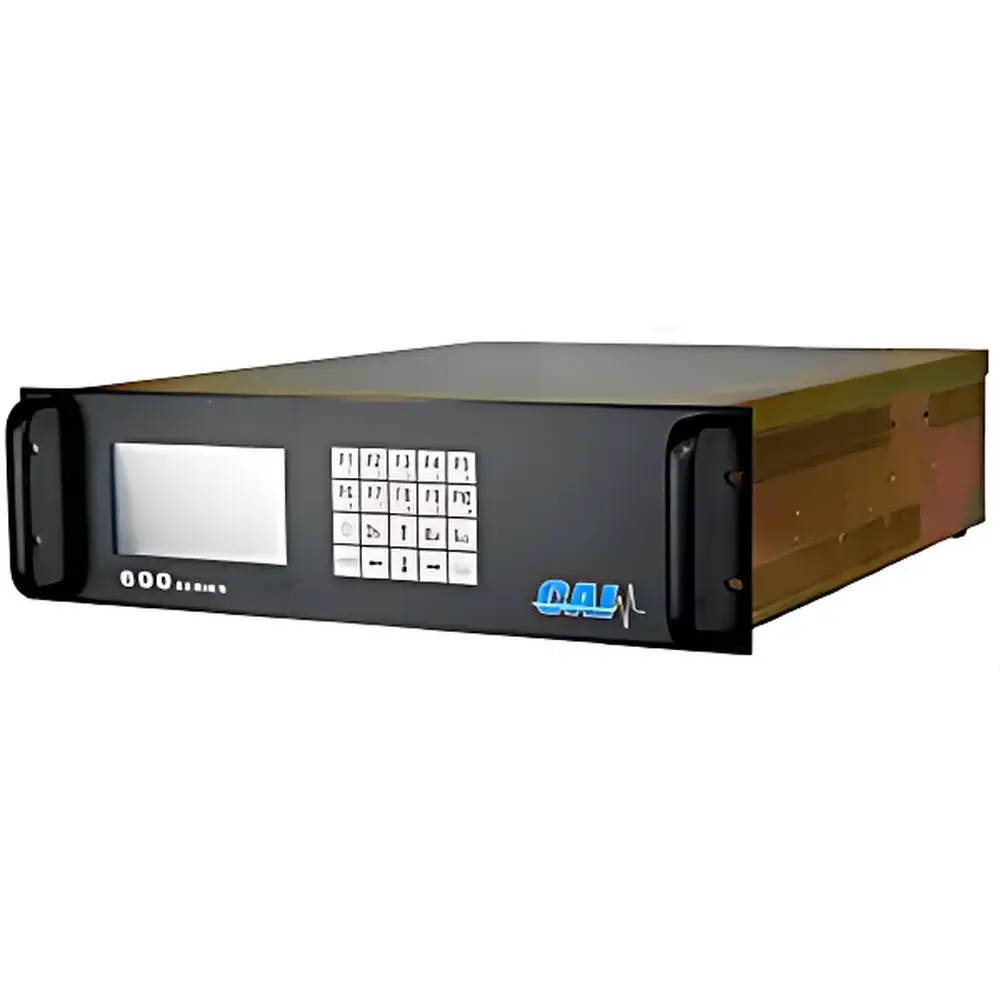
CAI 600CLD Chemiluminescence Nitrogen Oxides (NO/NO₂/NOₓ) Analyzer
| Brand | California Analytical Instruments (CAI) |
|---|---|
| Origin | USA |
| Model | 600CLD |
| Detection Principle | Chemiluminescence (CLD) |
| Detector | Peltier-cooled photodiode |
| O₃ Source | UV lamp |
| NO/NOₓ Range | 0–3 to 0–3,000 ppm (4 user-selectable ranges) |
| Response Time (T₉₀) | <2 s |
| Zero & Span Drift | <1% of full scale / 24 h |
| Measurement Chamber Temp. | 50°C (non-condensing) |
| HCLD Oven Temp. | 850°C (up to 1000°C optional) |
| NO₂ → NO Conversion Efficiency | >95% (glassy carbon converter @ 205°C) |
| Sample Flow | 2.0 L/min (standard), 0.6 L/min (optional low-flow) |
| Analog Outputs | 4 × 0–10 V / 4–20 mA |
| Digital Interfaces | RS-232, TCP/IP, Modbus |
| Compliance | CE, ETL Listed (UL 61010-1, CAN/CSA C22.2 No. 61010.1), EPA Method 1065 compliant |
| Optional Features | Heated CLD (HCLD), Paramagnetic O₂ channel, Internal zero/span/sample valve manifold, 19″ rack-mount kit, Integrated sample pump, Dry/Wet basis calculation (HCLD only) |
Overview
The CAI 600CLD is a high-precision, laboratory- and field-deployable chemiluminescence nitrogen oxides (NO/NO₂/NOₓ) analyzer engineered for continuous, trace-level gas concentration measurement in demanding environmental and industrial applications. It operates on the well-established chemiluminescence detection principle: gaseous nitric oxide (NO) reacts quantitatively with ozone (O₃) to form electronically excited nitrogen dioxide (NO₂*), which emits photons upon relaxation. This emitted light intensity—measured by a thermoelectrically cooled photodiode—is linearly proportional to the mass flow rate of NO entering the reaction chamber. For total NOₓ (NO + NO₂) analysis, sample gas first passes through a high-efficiency (>95%) glassy carbon thermal converter maintained at 205°C, where NO₂ is catalytically reduced to NO prior to reaction with ozone. The heated measurement chamber (50°C) ensures complete water vapor retention, eliminating condensation-induced NO₂ wall losses—a critical design feature for accurate wet-gas measurements. The system supports both standard CLD and heated CLD (HCLD) configurations, with the latter enabling robust operation under high-humidity or low-temperature sampling conditions.
Key Features
- Chemiluminescence detection with Peltier-stabilized photodiode for exceptional signal stability and low noise (<1% FS)
- Four programmable concentration ranges (0–3 ppm to 0–3,000 ppm), fully user-configurable via front panel or remote interface
- Fast T₉₀ response time of <2 seconds—optimized for dynamic emission profiling and real-time process control
- Integrated electronic flow control for both sample and ozone streams, ensuring stoichiometric reaction consistency
- Automated zero and span calibration routines scheduled via internal real-time clock; manual, remote, or cyclic execution modes supported
- Heated CLD option (HCLD) with oven temperature up to 850°C (1000°C optional), enabling stable NO₂ conversion and minimizing adsorption artifacts
- Comprehensive analog and digital I/O: four isolated 0–10 V / 4–20 mA outputs, plus RS-232, TCP/IP Ethernet, and Modbus RTU/TCP protocols for SCADA and DCS integration
- Paramagnetic O₂ measurement channel available as an integrated dual-gas option (0–25% or 0–100% O₂ range)
- Internal valve manifold for automated zero air, span gas, and sample switching—eliminating external plumbing complexity
Sample Compatibility & Compliance
The CAI 600CLD is validated for use with stack gases, ambient air, engine exhaust, and combustion effluents containing up to 100 ppm NH₃, SO₂, or HCN without significant interference. CO₂ cross-sensitivity is limited to <2.0% per 10% CO₂, while H₂O vapor contributes <1.0% error per 1% CO₂-equivalent humidity—verified per EPA Method 1065 validation criteria. The analyzer meets electromagnetic compatibility and safety requirements per CE marking and ETL listing under UL 61010-1 and CAN/CSA C22.2 No. 61010.1. Its architecture supports audit-ready data integrity: all calibrations, configuration changes, and alarm events are timestamped and logged locally or remotely, aligning with GLP/GMP documentation expectations. While not inherently 21 CFR Part 11 compliant, its TCP/IP and Modbus interfaces facilitate integration into validated systems where electronic record and signature controls are externally managed.
Software & Data Management
The 600CLD features embedded firmware supporting local configuration, diagnostics, and real-time data display on a 3″ × 5″ backlit LCD. Remote operation is enabled via ASCII-based AK protocol over RS-232 or industry-standard TCP/IP commands, allowing seamless integration with third-party SCADA platforms, LabVIEW-based test benches, or SQL Server/Oracle databases using custom middleware. Optional CAI-provided PC software (Windows-compatible) delivers graphical trend logging, calibration history tracking, and automated report generation—including compliance summaries aligned with EPA 40 CFR Part 60 and ISO 14064-3 verification workflows. All analog outputs maintain linearity within ±0.5% of full scale, and digital communication layers support configurable polling intervals, packet formatting, and error-checking redundancy.
Applications
- Continuous Emission Monitoring Systems (CEMS) for regulatory reporting under EPA, EU IED, or national air quality directives
- Combustion optimization studies in gas turbines, boilers, and industrial furnaces—correlating NOₓ formation with flame temperature and excess air ratio
- Engine and vehicle exhaust testing per ISO 8178, SAE J1930, and UN ECE R49 protocols
- R&D of selective catalytic reduction (SCR) and lean NOₓ trap (LNT) aftertreatment systems
- Process gas analysis in nitric acid production, ammonia oxidation, and semiconductor fabrication tool exhaust streams
- Stack testing for particulate control device efficiency evaluation (e.g., ESP or fabric filter performance vs. NOₓ co-emission)
FAQ
What is the difference between standard CLD and HCLD operation?
Standard CLD measures NO directly and NOₓ after thermal NO₂-to-NO conversion at 205°C. HCLD extends this by heating the entire reaction chamber and optics path to 850°C, preventing condensate formation and improving accuracy in high-moisture or low-temperature flue gas applications.
Does the 600CLD require external ozone generators or zero air sources?
No—the instrument includes an integrated UV-based ozone generator and accepts either bottled zero air (<0.01 ppm NOₓ) or compressed instrument air meeting ASTM D6166 specifications.
Can the analyzer operate unattended for extended periods?
Yes—its auto-calibration scheduler, drift-compensated electronics, and non-volatile memory for configuration and event logs support unattended operation for weeks, provided gas supplies and power remain stable.
Is the glassy carbon NO₂ converter replaceable in the field?
Yes—the converter is a modular, user-serviceable component with documented replacement procedures and lifetime validation data available in the technical manual.
How does the system handle cross-interference from sulfur dioxide or ammonia?
SO₂ and NH₃ concentrations ≤100 ppm introduce negligible bias in NOₓ measurement due to the chemical selectivity of the CLD reaction and the inertness of the gold-plated reaction chamber (volume <3 cm³).
Related Products







