
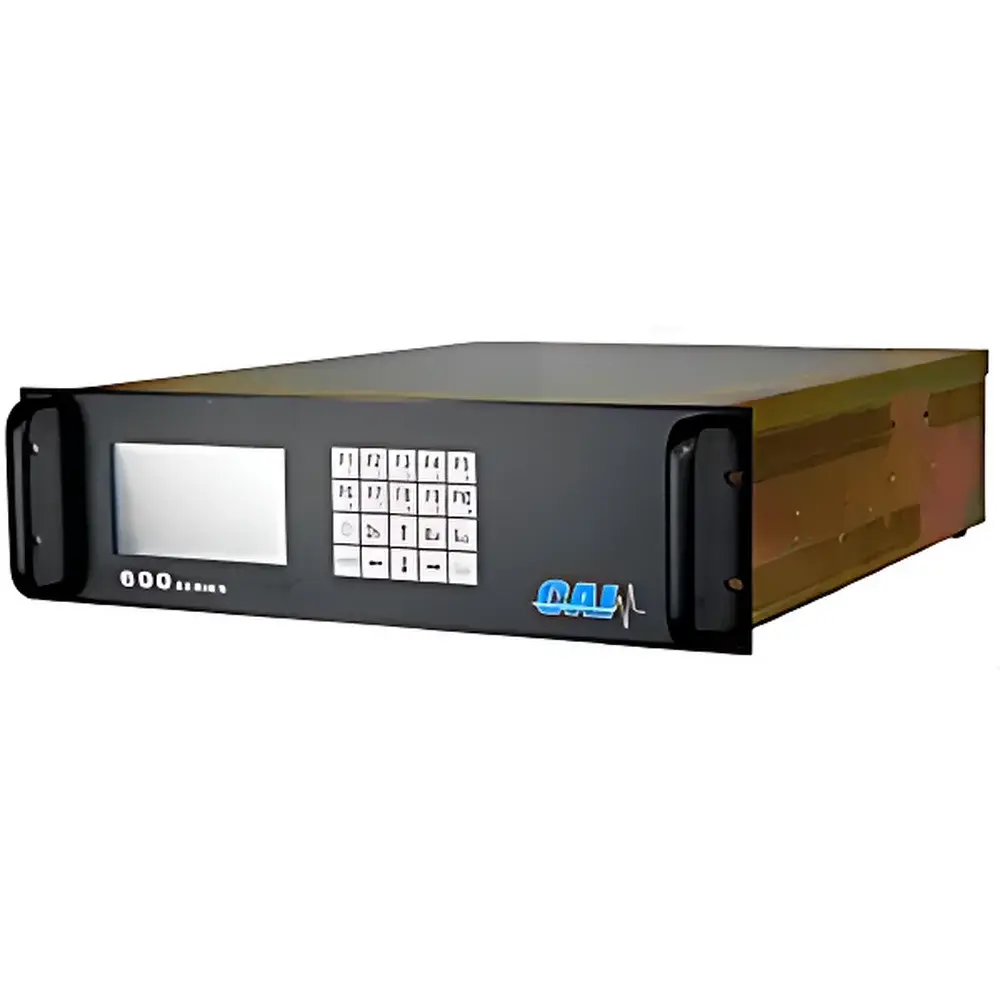
CAI 600HFID Heated Total Hydrocarbon Analyzer
| Brand | California Analytical Instruments (CAI) |
|---|---|
| Origin | USA |
| Model | 600HFID |
| Instrument Type | Portable FID-based Gas Analyzer |
| Detection Principle | Flame Ionization Detection (FID) |
| Detection Range | 4 user-selectable ranges, from 0–30 ppm to 30,000 ppm CH₄ (or equivalent C) |
| Resolution | 10 ppb C |
| Accuracy | ±1% of reading |
| Response Time (T₉₀) | <1.5 s |
| Operating Temperature | All critical components heated to prevent condensation |
| Fuel Gas | 40% H₂/60% He (120 mL/min) or 100% H₂ (60 mL/min) |
| Zero Air Requirement | <1 ppm carbon, 220–300 mL/min |
| Power | 115/230 VAC ±10%, 50/60 Hz, max 750 W |
| Dimensions | 5″ H × 19″ W × 23″ D |
| Weight | 50 lbs |
| Certifications | CE Marked |
Overview
The CAI 600HFID Heated Total Hydrocarbon Analyzer is a precision-engineered, portable flame ionization detector (FID) system designed for continuous, real-time quantification of total hydrocarbons (THC) in process and ambient gas streams. Unlike non-heated FID analyzers, the 600HFID maintains all sample path components—including the combustion chamber, detector electrodes, and sampling lines—at elevated, thermally stabilized temperatures (typically ≥180 °C) to eliminate condensation of high-boiling-point VOCs and ensure quantitative recovery across volatile organic compound classes—from methane and ethane to aromatic and oxygenated species. Its measurement principle relies on controlled pyrolysis of hydrocarbons in a hydrogen-fueled flame, followed by ionization and charge collection under a defined electrostatic field. The resulting ion current exhibits linear proportionality to carbon mass flow rate, enabling trace-level (ppb C) sensitivity and %-level dynamic range without hardware reconfiguration. This architecture meets the physical and metrological requirements of EPA Method 25A, EN 12619, and ISO 8573-5 for regulatory-grade THC monitoring in emissions compliance, process control, and safety-critical applications.
Key Features
- Heated sample path and detector assembly (up to 200 °C) ensures complete vaporization and prevents adsorption or condensation losses—critical for NMHC (non-methane hydrocarbon) and heavy VOC measurement.
- Four programmable concentration ranges (0–30 ppm to 0–30,000 ppm CH₄-equivalent), configurable via front-panel interface or remote TCP/IP command set.
- Integrated electronic pressure control (EPC) for fuel gas, zero air, and sample flow—enabling stable flame conditions and repeatable baseline performance.
- Automated calibration sequence with timed internal zero/ span valve actuation; supports scheduled auto-calibration per GLP/GMP audit trails.
- Dual communication architecture: RS-232 (ASCII protocol), Modbus RTU/TCP, and native Ethernet (TCP/IP) with configurable IP addressing and password-protected access levels (4-tier security).
- Real-time diagnostics including combustion chamber temperature, detector voltage, fuel/air pressure, flow rates, and EPC status—all accessible via LCD or network interface.
- Front-panel 3″ × 5″ backlit LCD with intuitive menu navigation, full-range analog output scaling, and firmware-upgradable configuration storage.
Sample Compatibility & Compliance
The 600HFID accommodates a broad spectrum of sample matrices—including hot, humid, and particulate-laden exhaust gases from internal combustion engines, thermal oxidizers, biogas digesters, and catalytic abatement systems. Its heated inlet (50 °C minimum sample temperature) and thermostatically regulated combustion zone mitigate water interference and suppress quenching effects common in high-CO₂ or high-O₂ streams. The analyzer complies with key international standards: EPA Method 25A for stationary source THC compliance testing; EN 15267-3 for certified emission monitoring systems (CEMS); and ISO 10156 for flammability classification support. It satisfies electrical safety requirements per UL 61010-1 and CAN/CSA C22.2 No. 61010-1, and carries CE marking for EMC and LVD directives. For regulated environments, optional audit-trail logging and user-access controls align with FDA 21 CFR Part 11 data integrity expectations.
Software & Data Management
The 600HFID operates with embedded firmware supporting both local and networked operation. Configuration, calibration history, and diagnostic logs are stored in non-volatile memory with timestamping and user ID tagging. Remote management is enabled via HTTP-based web interface or Modbus TCP register mapping—allowing integration into SCADA, DCS, or cloud-based environmental data platforms. Analog outputs (0–5 V, 0–10 V, or 4–20 mA) are fully scalable per range and include selectable linearization modes (CH₄, C₃H₈, or carbon-mass equivalent). Firmware updates are performed via USB or Ethernet using signed binaries to maintain system integrity. Optional data export formats include CSV and XML, compatible with LIMS and EPA ERT reporting tools.
Applications
- EPA Method 25A-compliant stack testing for THC emissions from boilers, incinerators, and industrial furnaces.
- Continuous emissions monitoring (CEM) for MACT and NSPS subpart JJJJ/JJJJJ compliance in chemical manufacturing and refining.
- VOC abatement system efficiency verification—e.g., thermal/catalytic oxidizer destruction efficiency (DE) and carbon bed breakthrough detection.
- Fermentation off-gas analysis in biofuel and pharmaceutical production, where real-time hydrocarbon tracking informs feedstock optimization.
- Diesel and natural gas engine exhaust characterization during transient dynamometer testing.
- Confined space entry safety monitoring for hydrocarbon accumulation in petrochemical facilities and wastewater treatment plants.
FAQ
What detection principle does the 600HFID employ?
It uses flame ionization detection (FID), wherein hydrocarbons are pyrolyzed in a hydrogen-air flame, generating ions proportional to carbon content.
Is the instrument suitable for measuring non-methane hydrocarbons (NMHC)?
Yes—its heated architecture and methane-specific calibration enable accurate NMHC calculation when used with a parallel methane analyzer or GC pre-separation.
Can the 600HFID operate unattended for extended periods?
Yes—its automated zero/span, thermal stability, and diagnostic self-monitoring support unattended 7×24 operation in fixed-site installations.
What fuel gas options are supported?
Either 40% H₂/60% He (120 mL/min) or pure H₂ (60 mL/min); zero air must contain <1 ppm total carbon.
Does the analyzer meet regulatory requirements for stack testing?
Yes—it is validated for EPA Method 25A and referenced in EN 12619 for combustion appliance emissions verification.
How is data integrity ensured in GxP environments?
Through configurable audit trails, role-based access control (4 privilege levels), electronic signature support, and tamper-evident calibration logs compliant with 21 CFR Part 11.
Related Products







