
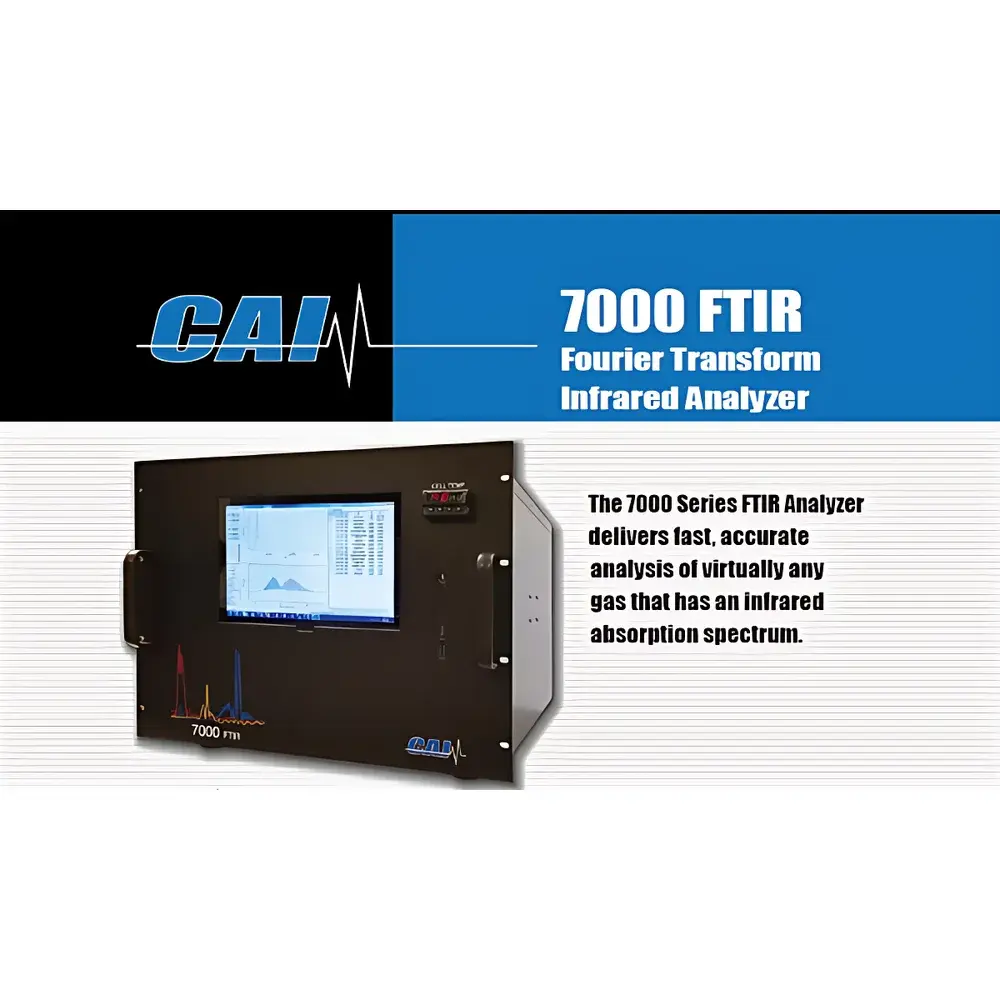
California Instruments 700 FTIR Gas Analyzer
| Brand | California Instruments |
|---|---|
| Origin | USA |
| Model | 700 |
| Spectral Resolution | 0.5 cm⁻¹ |
| Spectral Range | 305–7500 cm⁻¹ |
| Detector | MCT-A |
| Interferometer | RockSolid™ Cube Corner Retroreflector Design |
| Sample Cell Temperature | 50 °C or 191 °C (heated, 316 stainless steel) |
| Optical Path Length | 10.2 m |
| Data Output Rate | 1 Hz |
| Response Time | <1 s to 5 min (application-dependent) |
| Detection Range | ppb to % v/v |
| Sample Flow Rate | 0.2–5 LPM |
| Dimensions | 26.7 × 48.3 × 71.1 cm (H×W×D) |
| Weight | 57.6 kg |
| Environmental Operating Range | 5–40 °C, <90% RH (non-condensing) |
| Power Supply | 230 VAC / 50 Hz |
| Window Material | ZnSe (standard), optional alternatives available |
| Sealing | Parafluor O-rings |
| Inlet/Outlet Fittings | 3/8″ tubing |
| Purge Fitting | 1/4″ Swagelok® compression |
Overview
The California Instruments 700 FTIR Gas Analyzer is a purpose-engineered, benchtop Fourier Transform Infrared (FTIR) spectrometer designed for continuous, real-time quantitative analysis of multi-component gas mixtures in industrial and environmental monitoring applications. Unlike dispersive IR systems or single-gas electrochemical sensors, the 700 leverages Michelson interferometry with a RockSolid™ cube-corner retroreflector interferometer—ensuring passive alignment stability, minimal drift, and long-term calibration integrity without active recalibration or mechanical re-alignment. Its 10.2-meter effective optical path length within a heated, 316 stainless steel sample cell enables high sensitivity across trace (ppb-level) to bulk (%-level) concentration ranges. The system operates on the principle of broadband infrared absorption spectroscopy: incident IR radiation passes through the gas sample, where molecular vibrational modes absorb characteristic frequencies; the resulting interferogram is digitized and Fourier-transformed to yield a high-fidelity absorbance spectrum. This spectral fingerprint allows simultaneous identification and quantification of over 30 gases—including CO, CO₂, NO, NO₂, SO₂, N₂O, HCl, NH₃, CH₄, C₂H₆, C₂H₄, C₃H₈, H₂O, CH₃OH, C₂H₅OH, C₆H₆, C₂H₂, CHCl₃, CH₂Cl₂, C₆H₅CH₃, CH₃COCH₃, HCHO, SF₆, COCl₂, C₂H₃Cl, and R-134a—without cross-interference correction under properly configured chemometric models.
Key Features
- RockSolid™ interferometer architecture with gold-coated 316 stainless steel cube-corner reflectors and frictionless flexure bearings—engineered for zero-maintenance field operation and thermal/mechanical stability over >10 years.
- Real-time spectral acquisition at 1 Hz, supporting dynamic process monitoring and rapid transient detection (e.g., stack emission spikes or reactor off-gas events).
- Heated sample cell options: 50 °C standard or high-temperature 191 °C variant—prevents condensation, eliminates water vapor interference, and maintains analyte integrity for corrosive or thermally labile species (e.g., HCl, NH₃, formaldehyde).
- No cryogenic cooling required: Mercury Cadmium Telluride (MCT-A) detector operates thermoelectrically—eliminating liquid nitrogen dependency, Dewar logistics, and associated downtime.
- Integrated industrial-grade PC running Windows OS with preloaded OPUS software suite (Bruker) and Symbion control firmware—enabling autonomous operation, method storage, and embedded spectral library matching.
- Modular expansion support: Optional pressure compensation module, analog output interface (4–20 mA / 0–10 V), intelligent multi-point sampling manifold (up to 8 streams), and certified sample conditioning accessories (e.g., particulate filters, catalytic scrubbers, permeation dryers).
Sample Compatibility & Compliance
The 700 FTIR analyzer is validated for use with high-purity specialty gases (e.g., semiconductor-grade N₂, Ar, He, O₂), combustion exhaust streams, refinery process vents, biogas effluents, and ambient air quality monitoring networks. Its 316 stainless steel wetted path, Parafluor elastomer seals, and ZnSe optical windows ensure chemical compatibility with acidic, oxidizing, and organic vapors. The instrument meets electromagnetic compatibility (EMC) requirements per IEC 61326-1 and safety standards per IEC 61010-1. While not intrinsically safe by default, it may be deployed in Class I, Division 2 hazardous locations when installed with appropriate purge systems and documented per API RP 500. Data acquisition and reporting workflows support GLP/GMP compliance via audit-trail-enabled software logging, user-access controls, and electronic signature capability—fully compatible with FDA 21 CFR Part 11–compliant validation packages when implemented with qualified IT infrastructure.
Software & Data Management
Control and analysis are managed through a dual-layer software environment: Symbion firmware provides low-level hardware orchestration (interferometer synchronization, detector biasing, temperature regulation, flow control), while OPUS delivers chemometric modeling, spectral preprocessing (baseline correction, atmospheric subtraction, derivative filtering), and multivariate quantification using Partial Least Squares (PLS) or Classical Least Squares (CLS) algorithms. Calibration models are developed from NIST-traceable gas standards and validated per ISO 17025 principles. All raw interferograms, processed spectra, concentration time-series, and diagnostic logs are timestamped and stored in HDF5 format—ensuring interoperability with LIMS, SCADA, and enterprise data historians. Remote access is supported via secure HTTPS or VPN-tunneled VNC, enabling centralized fleet management across distributed monitoring sites.
Applications
- Environmental Monitoring: Continuous Emission Monitoring (CEM) for EPA Method 320 and EN 15267-3 compliance; fugitive VOC detection in landfill gas; ambient air quality networks measuring ozone precursors (NOₓ, VOCs) and greenhouse gases (CO₂, CH₄, N₂O).
- Industrial Process Control: Real-time purity verification in high-purity gas production (ASTM D7525); catalyst bed monitoring in petrochemical reformers; flare gas composition analysis for energy recovery optimization.
- Research & Development: Reaction kinetics studies in catalytic reactors; speciation of thermal decomposition products; breath analysis biomarker screening (e.g., acetone, isoprene, NO).
- Regulatory Compliance: Support for ISO 8573-5 compressed air purity testing; USP water-for-injection off-gas verification; pharmaceutical cleanroom environmental monitoring per ISO 14644-2.
FAQ
Does the 700 FTIR require liquid nitrogen or external cooling?
No. It uses a thermoelectrically cooled MCT-A detector, eliminating cryogen dependency and associated operational constraints.
Can the instrument measure moisture (H₂O) accurately in hot, humid samples?
Yes. The heated sample cell (50 °C or 191 °C) prevents condensation, and spectral water vapor bands are resolved and quantified independently using dedicated calibration models.
Is the system compliant with EPA or EU regulatory methods?
It supports implementation of EPA Methods 320 and 323, as well as EN 15267-3, when configured with validated methods, NIST-traceable standards, and documented uncertainty budgets.
What is the minimum detectable concentration for CO or NO?
Detection limits are application-specific and depend on path length, integration time, and spectral interference; typical MDLs range from 50–200 ppb for CO and 30–100 ppb for NO under standard 10.2 m path and 1-minute averaging.
Can the 700 be integrated into an existing DCS or PLC network?
Yes—via optional analog output modules (4–20 mA) or Modbus TCP/IP Ethernet communication, with configurable alarm thresholds and status reporting.







