
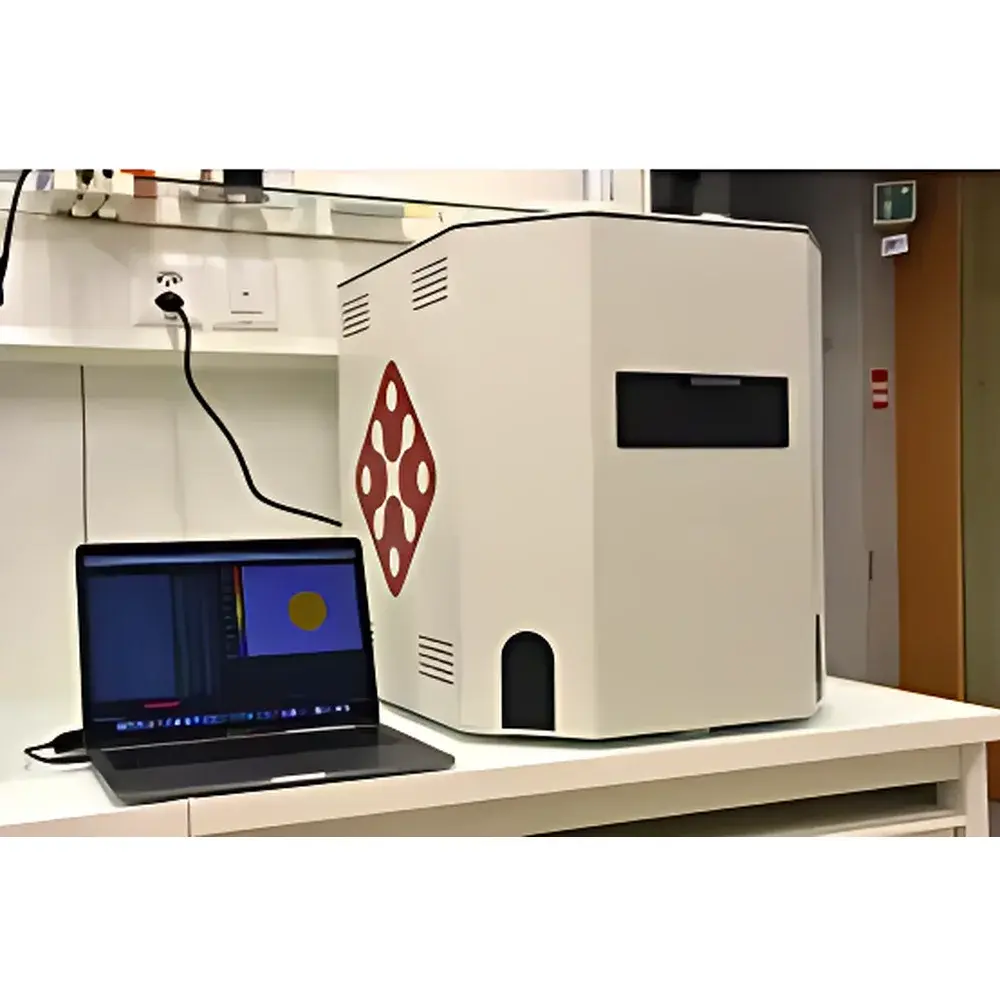
Calorsito Portable Nanoparticle and Cellular Analysis System
| Origin | Switzerland |
|---|---|
| Manufacturer Type | Authorized Distributor |
| Origin Category | Imported |
| Model | Calorsito |
| Price Range | USD 70,000–140,000 |
| Instrument Type | Portable |
| Application Domain | Academic & Research Laboratories (Universities, Institutes) |
| Operating Principle | Photothermal Infrared Imaging Spectroscopy |
| Wavelength Range | 400–950 nm (7 discrete LED wavelengths: 400, 460, 525, 660, 730, 840, 950 nm) |
| Scan Speed | 1 sample per minute |
| Data Sampling Interval | Not applicable (single-shot thermal transient acquisition) |
| Sample Mode | Contactless, non-contact reflective/transmissive mode |
| Chemometrics Software | Integrated Calorsito Analyze Suite (PCA, PLS regression, spectral unmixing) |
Overview
The Calorsito Portable Nanoparticle and Cellular Analysis System is a benchtop-to-field deployable photothermal infrared imaging spectrometer engineered for label-free, non-destructive quantification and spatial mapping of nanomaterials in complex biological and material matrices. Unlike conventional optical absorption or scattering-based methods, Calorsito employs a modulated photothermal excitation principle: pulsed visible–NIR light (at seven precisely selected wavelengths) induces localized heating in optically absorbing nanoparticles; the resulting transient thermal emission is captured via high-sensitivity infrared focal-plane array imaging. This dual-domain (optical excitation + thermal emission) approach enables selective detection of plasmonic metals (Au, Ag, Cu), transition metal oxides (TiO₂, Fe₃O₄), and carbon-based nanostructures (graphene, CNTs) with high specificity—even within heterogeneous tissue sections or multilayer thin films—without chemical labeling, vacuum requirements, or sample sectioning.
Key Features
- Seven discrete, narrow-band LED excitation sources (400, 460, 525, 660, 730, 840, 950 nm) enabling wavelength-resolved photothermal response profiling
- Non-contact, ambient-condition operation: no sample preparation, no vacuum, no conductive coating required
- Large-area analysis field: 20 mm diameter circular measurement zone with sub-100 µm effective spatial resolution
- Throughput-optimized workflow: full spectral-thermal acquisition completed in ≤60 seconds per sample
- Quantitative capability: calibrated thermal signal intensity correlates linearly with nanoparticle mass loading (validated against ICP-MS for metallic systems)
- Ruggedized portable enclosure (IP54 rated) with integrated battery support for on-site lab or cleanroom deployment
- Real-time thermal decay curve extraction for kinetic characterization of particle–matrix interactions
Sample Compatibility & Compliance
Calorsito accommodates diverse physical forms—including aqueous colloids, dried droplets, spin-coated thin films (10 nm–5 µm), cryosectioned tissue slices (5–20 µm), and polymer nanocomposites—without matrix-specific method revalidation. Its non-invasive nature ensures compliance with GLP-aligned sample integrity requirements. The system supports audit-ready data capture per FDA 21 CFR Part 11 (electronic signatures, immutable audit trails, user role-based access control). All spectral acquisition and thermal modeling routines are traceable to NIST-traceable blackbody calibration standards. Method documentation aligns with ISO/IEC 17025 clause 7.2.2 for measurement uncertainty estimation in nanoparticle quantification.
Software & Data Management
The Calorsito Analyze Suite is a Windows-based application built on Qt/C++ with Python backend integration (NumPy, SciPy, scikit-learn). It delivers automated spectral unmixing using constrained non-negative matrix factorization (cNMF), principal component analysis (PCA)-guided clustering of heterogeneous distributions, and partial least squares (PLS) regression models for concentration prediction. Raw thermal transients and hyperspectral stacks are stored in HDF5 format with embedded metadata (instrument settings, environmental logs, operator ID). Export options include CSV (time-series), TIFF (spatial maps), and MDF (MATLAB-compatible). Software validation documentation (IQ/OQ/PQ protocols) and electronic record retention policies are provided for regulated academic core facilities and contract research organizations.
Applications
- Quantitative mapping of gold nanoparticle uptake in 3D tumor spheroids and formalin-fixed paraffin-embedded (FFPE) tissue sections
- Batch-to-batch consistency assessment of carbon nanotube dispersions in polymer precursors
- In situ monitoring of TiO₂ nanoparticle agglomeration kinetics during solvent evaporation in inkjet-printed films
- Depth-resolved thermal signature comparison of surface-modified vs. bare iron oxide nanoparticles in hydrogel scaffolds
- High-throughput screening of plasmonic resonance shifts in combinatorial libraries of alloyed nanoparticles
- Correlative analysis with TEM/SEM: validating Calorsito-derived particle density against electron microscopy counts in cross-sectioned membranes
FAQ
What sample thickness limits apply for solid-state measurements?
For transmission-mode analysis, maximum thickness is 150 µm (e.g., cryosections); for reflection-mode, no upper limit—tested up to 2 mm opaque composites.
Can Calorsito distinguish between aggregated and monodisperse nanoparticles of the same composition?
Yes—aggregation alters photothermal relaxation time constants and spatial signal heterogeneity; these features are extracted from the full thermal decay curve (0–500 ms window).
Is spectral library matching supported for unknown nanomaterial identification?
The software includes a curated reference library (n = 42 certified nanomaterials per JRC Nanomaterials Repository), with optional user-defined library expansion under version-controlled governance.
Does the system require external calibration standards for routine use?
Factory calibration is stable for 12 months; quarterly verification using NIST SRM 1860a (gold nanoparticle suspension) is recommended for quantitative workflows.
How is data security managed in multi-user institutional environments?
Role-based permissions (admin, analyst, reviewer), encrypted local storage (AES-256), and optional LDAP/Active Directory integration ensure compliance with FISMA and GDPR data handling requirements.





