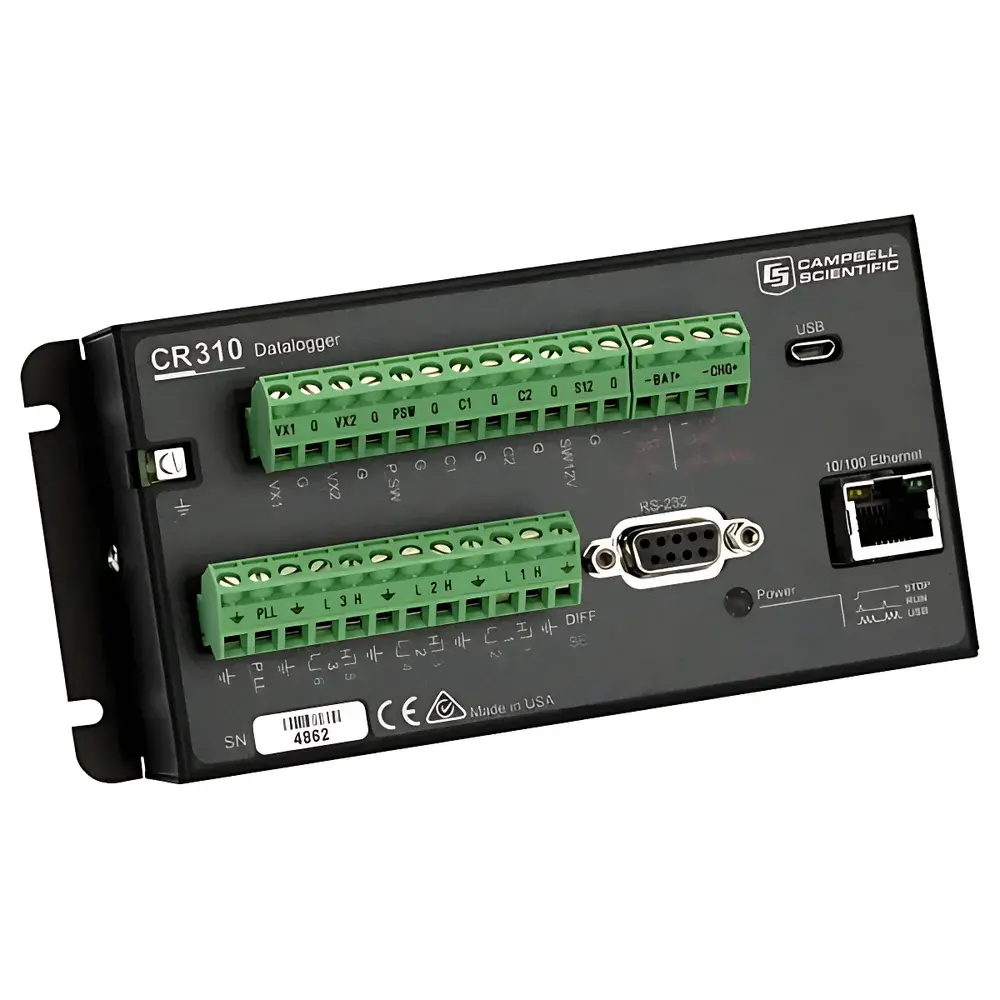
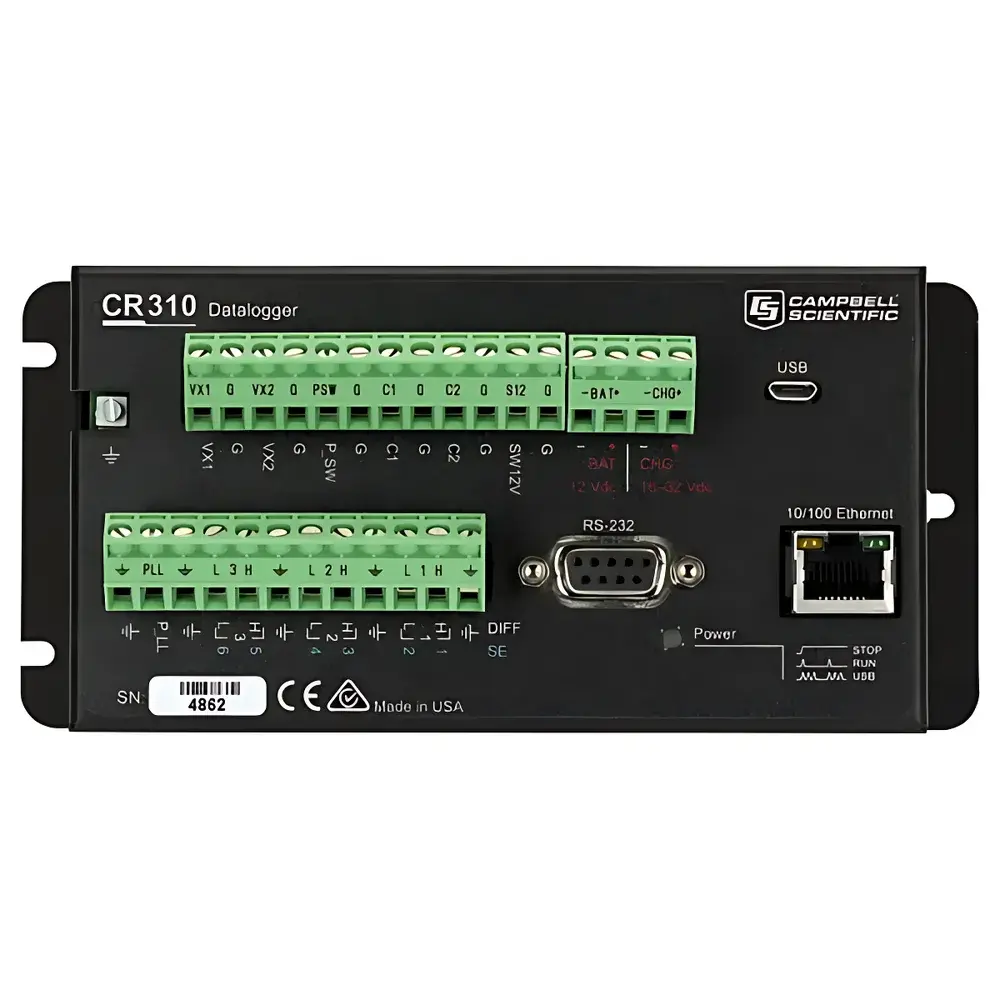
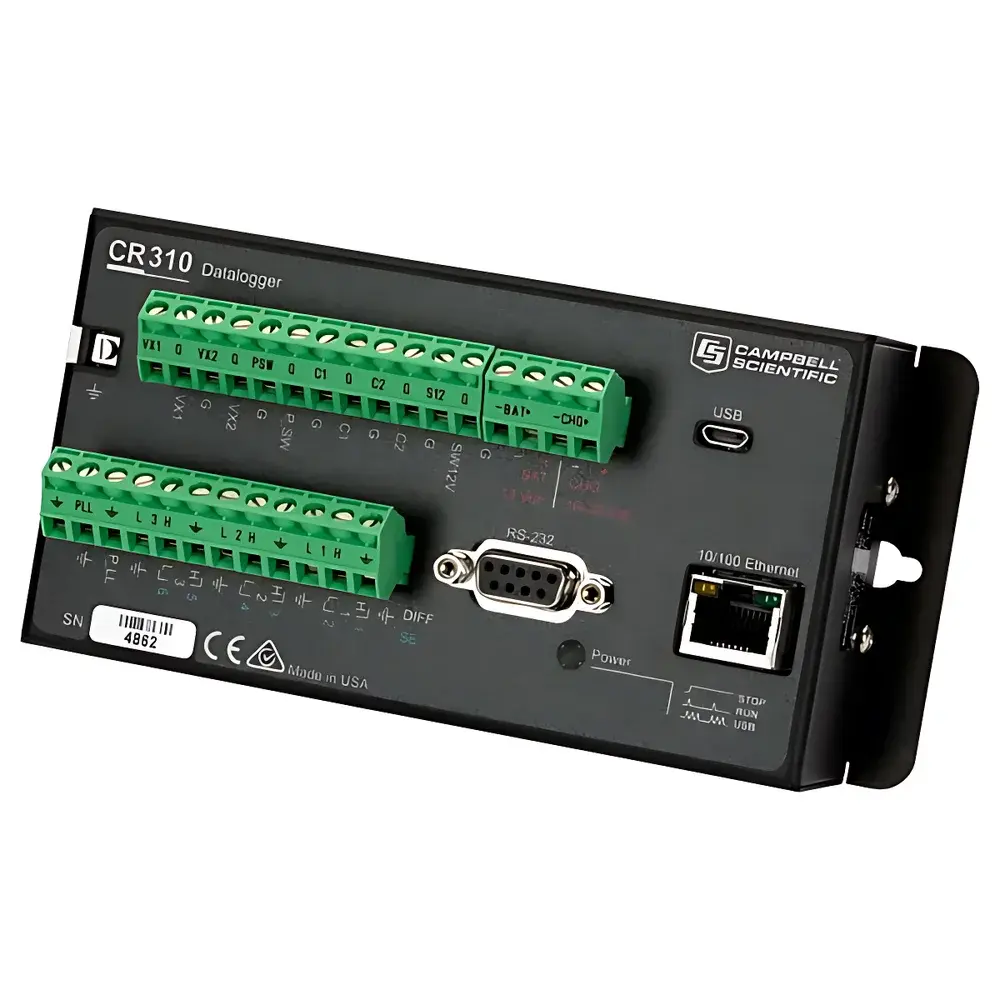
Campbell Scientific CR310 Data Acquisition Unit
| Brand | CAMPBELL |
|---|---|
| Origin | USA |
| Model | CR310 |
| Operating Temperature | -40 to +70°C (standard, non-condensing) |
| Scan Rate | Up to 10 Hz |
| Analog Inputs | 6 single-ended or 3 differential (user-configurable) |
| Pulse Counters | 8 (P_SW, P_LL, C1, C2, SE1–SE4) |
| Excitation Outputs | 2 (VX1, VX2) |
| Communication Interfaces | USB Micro-B, RS-232, 10/100 Base-T Ethernet (RJ45) |
| Digital I/O | 7 configurable terminals (C1, C2, P_SW, SE1–SE4 |
| ADC Resolution | 24-bit |
| Analog Accuracy | ±(0.04% of reading + offset) at 0–40°C |
| Power Input | 16–32 Vdc (CHG), 10–18 Vdc (BAT) |
| Typical Idle Current | 10 mA @ 12 Vdc (Ethernet link idle) |
| Active Current | 56 mA @ 12 Vdc (Ethernet active, CPU always on) |
| Enclosure | Powder-coated aluminum |
| Dimensions | 16.26 × 7.62 × 5.68 cm (6.4 × 3.0 × 2.2 in.) |
| Weight | 288–306 g (0.64–0.68 lb) |
| Onboard Memory | 80 MB flash for OS/program, 30 MB for data storage |
| Protocols | PakBus, Modbus RTU/TCP, DNP3, SDI-12, TCP/IP, UDP, TLS 1.2, HTTP(S), FTP(S), SMTP/TLS, POP3/TLS, NTP, DHCP, SLAAC, ICMP, Telnet, PPP, RNDIS, Auto-IP |
| Real-Time Clock Accuracy | ±1 minute per month |
Overview
The Campbell Scientific CR310 is a compact, low-cost, industrial-grade data acquisition unit engineered for long-term, unattended environmental and industrial monitoring applications. Built around a deterministic real-time operating system and a robust 32-bit ARM Cortex-M4 processor, the CR310 performs synchronized sensor measurements, conditional logic execution, and autonomous decision-making at the edge. Its measurement architecture employs precision 24-bit analog-to-digital conversion with programmable gain and filtering, supporting both single-ended and differential analog inputs—enabling high-fidelity acquisition from thermistors, RTDs, strain gauges, pressure transducers, and analog-output gas sensors. Integrated surge and ESD protection on all I/O lines ensures operational reliability in harsh outdoor deployments, including remote weather stations, watershed monitoring networks, and distributed infrastructure telemetry systems. Unlike PC-based DAQ solutions, the CR310 operates independently without host dependency, executing user-defined programs stored in non-volatile flash memory and maintaining time-synchronized data logging even during network outages.
Key Features
- Integrated 10/100 Base-T Ethernet port with full TCP/IP stack support—including TLS 1.2 encryption, HTTP(S), FTP(S), SMTP/TLS, and NTP synchronization—eliminating the need for external communication gateways.
- Removable screw-terminal block simplifies field wiring, maintenance, and sensor reconfiguration without soldering or crimping tools.
- Dual-purpose digital I/O terminals (C1, C2, P_SW, SE1–SE4) support configurable functions: digital input (state high/low), pulse counting, PWM output, external interrupt (except SE4), and serial communication (RS-232 or SDI-12).
- Built-in 12 V battery charging regulator compatible with solar panels or AC/DC power supplies—automatically manages charge voltage and current limits (max 0.9 A input) while protecting against overvoltage and deep discharge.
- Comprehensive protocol support: native PakBus networking for seamless integration into Campbell Scientific sensor arrays; Modbus RTU/TCP and DNP3 for SCADA interoperability; SDI-12 for smart environmental sensors.
- Onboard 30 MB of dedicated data storage (FAT32-formatted) with automatic rollover, timestamped binary or ASCII file output, and optional microSD expansion (via external adapter).
Sample Compatibility & Compliance
The CR310 interfaces with a broad spectrum of analog and digital sensors used across hydrological, meteorological, geotechnical, and industrial process monitoring domains. It natively supports voltage-output sensors (0–5 V, ±5 V, 0–2.5 V), current-loop transmitters (4–20 mA with shunt resistor), thermocouples (with cold-junction compensation), and SDI-12 digital sensors—including Campbell’s own CS451, CS650, and ATMOS 41 series. All analog input channels feature programmable excitation (VX1/VX2), enabling precise resistive bridge measurements and active sensor powering. The device complies with IEC 61000-4 electromagnetic immunity standards (ESD, EFT, surge), meets UL 61010-1 safety requirements for industrial equipment, and operates within the temperature and humidity specifications defined in ASTM D4169 and ISO 9001-compliant manufacturing processes. While not certified for SIL or hazardous location use, its design aligns with common practices for Class 1, Division 2 environments when installed per NEC Article 501 guidelines.
Software & Data Management
Configuration and program development are performed using Campbell Scientific’s industry-standard LoggerNet software (Windows only) or the cross-platform Short Cut utility for rapid setup of common sensor types. Programs are written in CRBasic—a deterministic, compiled language supporting nested loops, array operations, statistical calculations (e.g., min/max/avg/stddev), and conditional branching based on sensor thresholds or time-of-day rules. All firmware updates, program uploads, and data retrieval can be conducted locally via USB or remotely over Ethernet using secure protocols (HTTPS, SFTP). Audit-trail functionality is supported through LoggerNet’s automated log archiving, which records operator actions, configuration changes, and firmware version history—facilitating GLP/GMP-aligned documentation where required. Data files adhere to CFMetadata-compliant naming conventions and include embedded metadata headers, ensuring traceability and compatibility with third-party analysis platforms such as MATLAB, Python (via CR1000X/CR310 Python drivers), and cloud ingestion pipelines (e.g., AWS IoT Core, Azure IoT Hub).
Applications
- Remote hydrometric monitoring: stage, flow, turbidity, and water quality (pH, conductivity, DO) in streams, reservoirs, and stormwater systems.
- Automated weather stations: wind speed/direction, solar radiation, precipitation, air temperature/humidity, and soil moisture profiles.
- Industrial asset health monitoring: vibration, temperature, pressure, and power consumption logging for predictive maintenance workflows.
- Smart agriculture: irrigation control logic triggered by soil moisture thresholds, combined with evapotranspiration modeling and wireless valve actuation.
- Distributed structural monitoring: tilt, strain, and crack-width measurement in bridges, dams, and landslide-prone slopes using MEMS and vibrating-wire sensors.
FAQ
Can the CR310 function as a PakBus router in large sensor networks?
While the CR310 supports PakBus peer-to-peer communication and can route data between devices, Campbell Scientific explicitly advises against deploying it as a primary PakBus router in networks exceeding 50 nodes due to memory and throughput constraints. For scalable routing, the CR1000X or CR6 is recommended.
Does the CR310 support TLS 1.3 or only TLS 1.2?
The CR310 implements TLS 1.2 exclusively. TLS 1.3 is not supported due to cryptographic library limitations inherent to its embedded firmware architecture.
What is the maximum sustainable scan rate for simultaneous analog measurements?
The CR310 achieves up to 10 Hz aggregate scan rate; however, individual channel sampling rates depend on measurement type, filter settings, and number of active channels. High-accuracy thermistor measurements, for example, typically operate at ≤1 Hz to ensure thermal equilibrium and noise rejection.
Is there a built-in GPS receiver or time synchronization capability beyond NTP?
No internal GPS module is included. Time synchronization relies solely on NTP over Ethernet or optional external GPS receivers connected via RS-232 (e.g., u-blox NEO-M8N), with parsed UTC timestamps injected via serial command.
Can the CR310 execute control algorithms in real time, such as PID loops?
Yes—the CRBasic language includes native PID instruction support with user-configurable proportional, integral, and derivative gains, sample time, and output saturation limits. Control outputs may be routed to digital I/O or analog voltage channels (via external DAC modules).