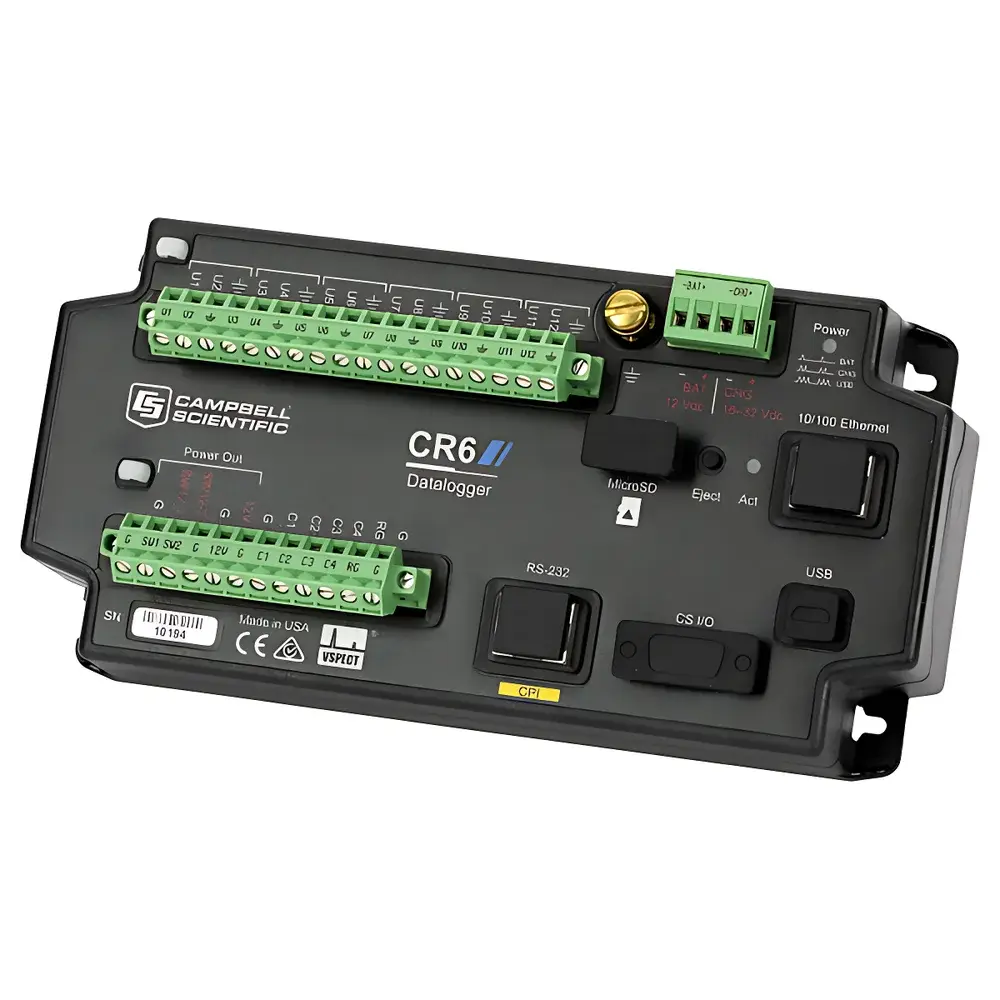
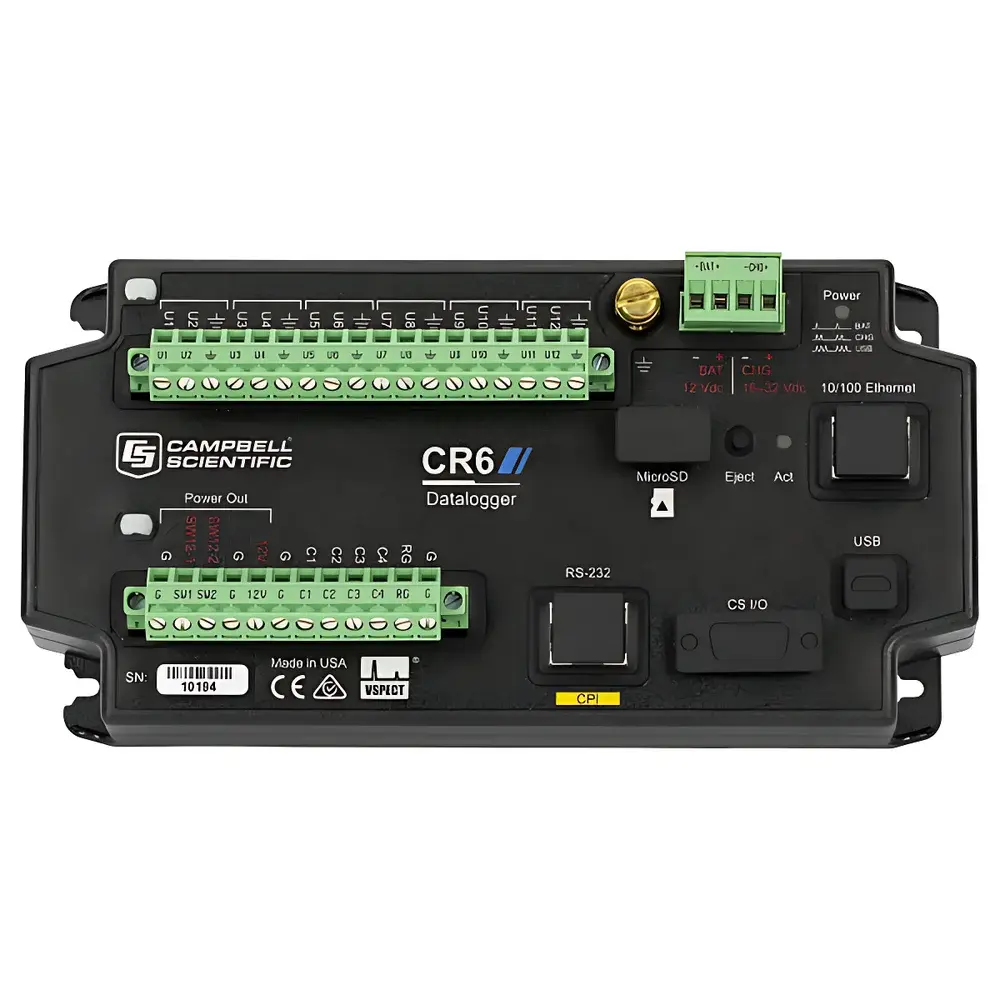
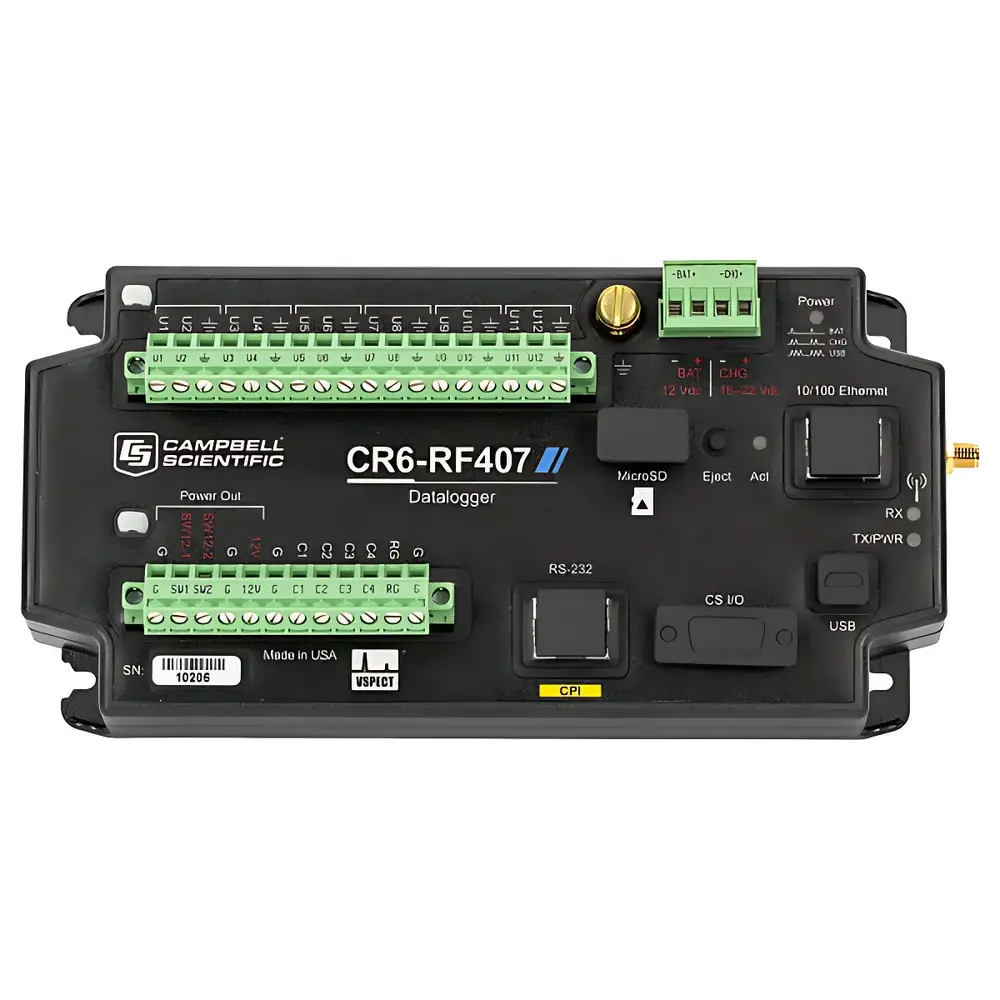
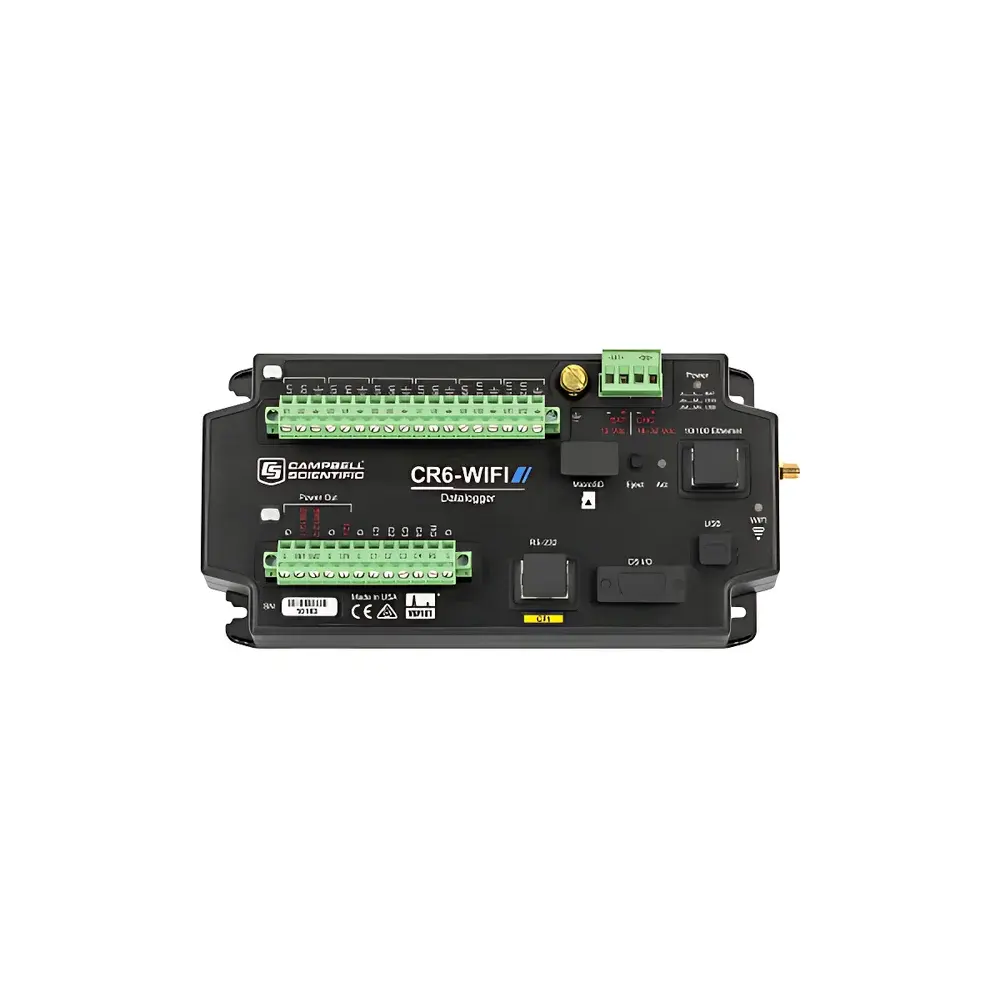
Campbell Scientific CR6 Measurement and Control Data Acquisition System
| Brand | Campbell Scientific |
|---|---|
| Origin | USA |
| Model | CR6 |
| Operating Temperature Range | -40 to +70°C (standard), -55 to +85°C (extended) |
| Analog Input Resolution | 24-bit ADC |
| Analog Voltage Accuracy | ±(0.04% of reading + offset) at 0–40°C |
| Input Channels | Up to 12 single-ended or 6 differential analog inputs |
| Communication Interfaces | Ethernet (10/100 RJ-45), USB Micro-B (virtual Ethernet & serial), RS-485, RS-422, SDI-12, CPI, CS I/O |
| Data Storage | 4 MB SRAM + 72 MB flash + microSD slot (up to 16 GB) |
| Power Supply | 10–18 Vdc (BAT), 16–32 Vdc (CHG) |
| Real-Time Clock Accuracy | ±3 min/year (GPS optional: ±10 µs) |
| Vibration Compensation | VSECT® spectral analysis for static vibrating-wire measurements |
| Enclosure | UV-stabilized TPE over impact-resistant polycarbonate (Recycling Code 7) |
| Dimensions | 21.0 × 10.2 × 5.6 cm |
| Weight | 0.42–0.52 kg |
Overview
The Campbell Scientific CR6 Measurement and Control Data Acquisition System is a field-deployable, low-power, high-precision embedded controller engineered for long-term environmental, geotechnical, infrastructure, and industrial monitoring applications. Built upon a deterministic real-time operating system, the CR6 executes user-defined measurement sequences with microsecond-level timing resolution and maintains strict temporal integrity across distributed sensor networks. Its core architecture integrates a 32-bit ARM Cortex-M4 processor, 24-bit sigma-delta analog-to-digital converters (ADCs), and hardware-accelerated spectral analysis logic for vibrating-wire sensor demodulation via the proprietary VSECT® algorithm. Unlike general-purpose data loggers, the CR6 implements native support for industry-standard communication protocols—including PakBus mesh networking, Modbus TCP/RTU, DNP3, NMEA 0183, and MQTT—enabling seamless integration into SCADA systems, cloud telemetry platforms, and regulatory-compliant data workflows. Designed for unattended operation in harsh outdoor environments, it meets IEC 60529 IP67-equivalent ingress protection when properly housed and operates reliably across extreme thermal gradients without active cooling.
Key Features
- 24-bit analog input resolution with programmable gain and filtering; voltage accuracy of ±(0.04% of reading + offset) within 0–40°C ambient range
- 12 independently configurable universal (U) terminals supporting analog input/output, digital I/O, pulse counting (16 total), switched excitation, and SDI-12 communication
- Dedicated CPI (Campbell Peripheral Interface) port for high-speed synchronization with CDM-series distributed modules (e.g., CDM-A116, CDM-VW300)
- VSECT® spectral analysis engine enabling robust static vibrating-wire sensor measurements under variable temperature and electromagnetic noise conditions
- Onboard Ethernet (10/100 Mbps) with full TCP/IP stack including TLS 1.2, SFTP, HTTPS, SNMPv3, and NTP client/server support for secure, auditable data transmission
- Embedded web server accessible via standard browser; supports dynamic configuration, real-time data visualization, and firmware updates without proprietary software
- MicroSD card interface supporting hot-swappable storage expansion up to 16 GB; internal non-volatile memory includes 4 MB battery-backed SRAM and 72 MB flash
- Ultra-low quiescent current draw (<1 mA at 12 Vdc on BAT terminal), optimized for solar-recharged battery systems in remote deployments
Sample Compatibility & Compliance
The CR6 interfaces natively with a broad spectrum of analog and digital sensors—ranging from thermistors, strain gauges, and load cells to smart transducers compliant with SDI-12, Modbus RTU, or NMEA 0183. Its universal terminal architecture permits direct connection of vibrating-wire piezometers, tiltmeters, and crackmeters without external signal conditioners. For regulated environments, the CR6 supports audit-trail-capable data logging through timestamped, cryptographically signed data packets and optional GPS-synchronized real-time clock (±10 µs accuracy). While not certified as medical or safety-critical equipment, its firmware and communication stack are architected to align with principles outlined in ISO/IEC 17025 (for testing laboratories), ASTM D4753 (for geotechnical instrumentation), and FDA 21 CFR Part 11 when deployed with appropriate validation documentation and access controls. The device complies with FCC Part 15 Class B and CE RED directives for electromagnetic compatibility.
Software & Data Management
Configuration, programming, and diagnostics are performed using Campbell Scientific’s LoggerNet (Windows) or PC400 legacy tools—or via modern RESTful API endpoints exposed through the embedded web server. The CR6 supports CRBasic, a deterministic, event-driven programming language with built-in functions for statistical summarization (e.g., mean, standard deviation, min/max, FFT), conditional control logic, and alarm-triggered actions. All data files adhere to Campbell’s standardized TOA5 format, ensuring interoperability with third-party analysis platforms such as MATLAB, Python (via pycampbellcr1000), and R. Secure data export is enabled through TLS-encrypted SFTP or HTTPS POST to cloud endpoints, while local retrieval occurs via USB mass-storage mode or microSD card extraction. Firmware updates are validated via SHA-256 signature verification prior to installation, preserving system integrity during remote maintenance cycles.
Applications
- Environmental monitoring networks: soil moisture, precipitation, air temperature/humidity, water level, turbidity, and dissolved oxygen profiling
- Geotechnical instrumentation: settlement arrays, inclinometer casings, vibrating-wire strain gauges in dams, tunnels, and retaining structures
- Structural health monitoring: bridge deflection, wind loading, seismic acceleration, and corrosion potential tracking
- Agricultural research stations: canopy temperature mapping, lysimeter flux measurement, and automated irrigation control
- Renewable energy sites: photovoltaic panel performance validation, wind turbine SCADA interfacing, and battery bank state-of-charge logging
- Industrial process monitoring: HVAC system efficiency, tank level telemetry, and pump station status reporting with Modbus gateway functionality
FAQ
Does the CR6 support IEEE 1588 Precision Time Protocol (PTP)?
No—the CR6 does not implement PTP. It relies on NTP for network time synchronization and offers optional GPS discipline for sub-10 µs real-time clock accuracy.
Can the CR6 operate as a Modbus TCP server?
Yes—it supports both Modbus TCP client and server modes, allowing bidirectional communication with PLCs, HMIs, and supervisory control systems.
Is SDI-12 communication supported on all universal terminals?
SDI-12 is supported on U1–U12 terminals, but only one SDI-12 bus can be active at a time; multiple sensors may share the same bus using unique addresses.
What is the maximum sampling rate for analog inputs?
The CR6 supports up to 100 Hz aggregate scan rate across all enabled analog channels; individual channel rates depend on filter settings, settling time, and multiplexing configuration.
How is firmware updated in the field?
Firmware updates are delivered via USB, Ethernet, or microSD card; each update package includes cryptographic signatures verified before installation to prevent unauthorized modification.
Does the CR6 meet UL or CSA safety certification requirements?
The CR6 is not UL- or CSA-listed as an end-product; however, its power input circuitry complies with IEC 62368-1 for limited power sources, and it is routinely deployed in UL-classified enclosures per application-specific risk assessments.