
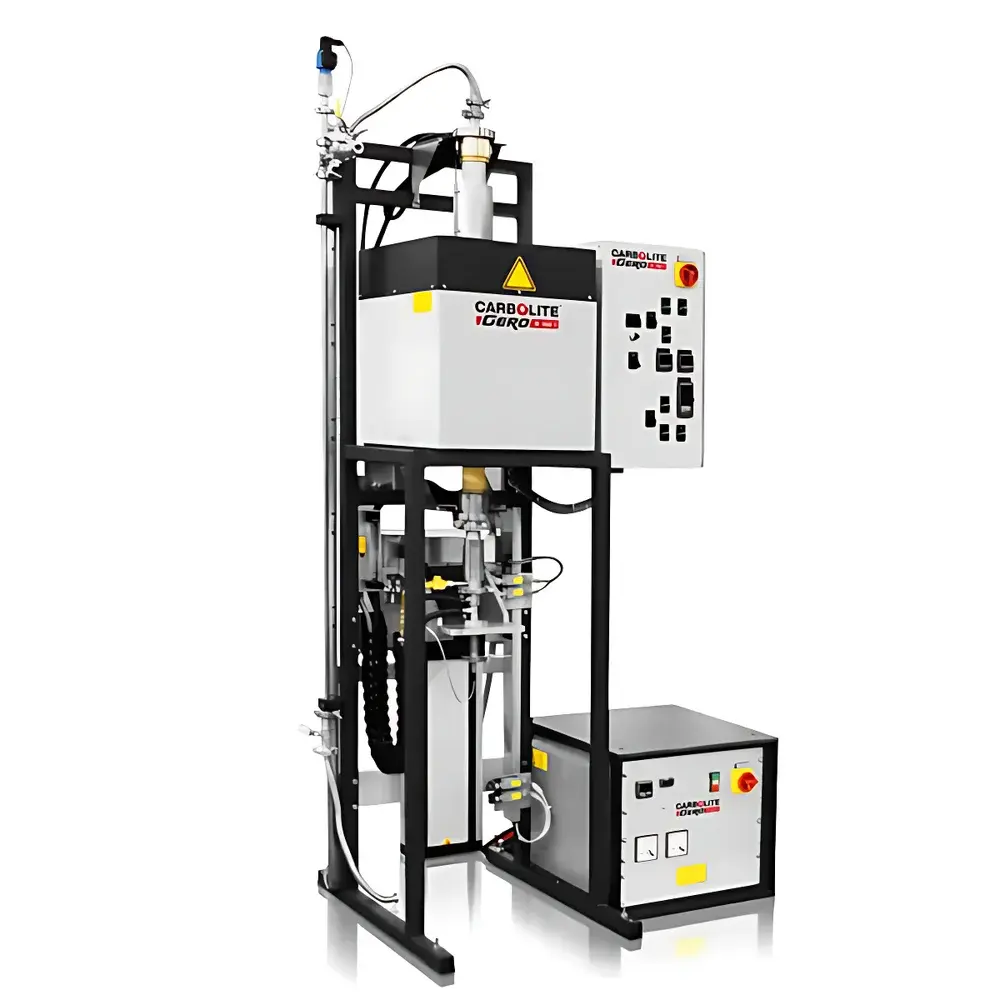
Carbolite Gero BV-HTRV Bridgman Crystal Growth Furnace
| Brand | Carbolite Gero |
|---|---|
| Origin | Germany |
| Instrument Type | Vertical Tube Furnace (Bridgman Configuration) |
| Model | BV-HTRV |
| Maximum Operating Temperature | 1600 °C / 1700 °C / 1800 °C |
| Heating Element | Molybdenum Disilicide (MoSi₂) |
| Temperature Gradient Control | Precision Vertical Thermal Profile |
| Lift Mechanism | Dual-Motor Driven, Adjustable Speed (10 nm/s to 10 mm/s) |
| Chamber Atmosphere | High-Vacuum (≤10⁻³ mbar) or Inert Gas (Ar/N₂) |
| Cooling | Water-Cooled Double Flanges |
| Thermocouple Type | Type B (Pt/Rh) |
| Compliance | Designed for GLP/GMP-aligned crystal growth workflows |
| Data Logging | PC-Interface Enabled (Position, Temp, Time, Vacuum, Flow) |
Overview
The Carbolite Gero BV-HTRV is a purpose-engineered vertical tube furnace optimized for controlled Bridgman crystal growth under high-temperature, high-purity thermal environments. Unlike conventional muffle furnaces, the BV-HTRV implements the directional solidification principle of the Bridgman method: a polycrystalline charge is uniformly melted within a sealed quartz or ceramic crucible, then slowly translated downward through a precisely defined axial temperature gradient—enabling single-crystal nucleation and progressive solidification from a seed interface. The furnace’s core architecture integrates a vertically oriented MoSi₂ heating zone with vacuum-formed ceramic fiber insulation, water-cooled end flanges, and a computer-synchronized lift mechanism—all aligned to sustain thermal stability, reproducible gradient profiles (dT/dz), and long-duration unattended operation. It operates in either high vacuum (via piezoresistive vacuum gauge and manual gate valve) or inert gas atmosphere (with rotameter-controlled Ar/N₂ flow), supporting oxide, semiconductor, and refractory crystal systems requiring thermal stability up to 1800 °C.
Key Features
- Vertical Bridgman configuration with dual-motor lift system offering speed range from 0.00001 mm/s (10 nm/s) to 10 mm/s—programmable for precise crystal pull rates matching material-specific solidification kinetics.
- MoSi₂ heating elements mounted vertically for uniform axial heat distribution; optimized short hot zone (250 mm) to generate steep, stable thermal gradients essential for defect-free single-crystal growth.
- Water-cooled double-flange design with hermetic sealing: top flange fixed, bottom flange threaded to accommodate telescoping motion during sample descent—even under full vacuum conditions.
- Dual thermocouple strategy: Type B control thermocouple embedded near the hot zone center; separate Type B sample thermocouple mounted directly adjacent to the crucible base for real-time, localized melt/solid interface monitoring.
- Robust thermal insulation using vacuum-formed high-purity alumina-silica fiber boards; external convection cooling ports integrated into the rectangular steel housing to manage surface temperature and extend component lifetime.
- Integrated safety architecture including optional overtemperature protection (recommended for multi-day无人值守 runs), emergency stop circuitry, and fail-safe power cutoff on vacuum loss or coolant interruption.
Sample Compatibility & Compliance
The BV-HTRV accommodates standard cylindrical crucibles (e.g., Ir, Pt, W, or high-purity graphite) housed within quartz or recrystallized alumina work tubes (ID 70 mm or 100 mm). Its design conforms to fundamental requirements for materials synthesis under ISO/IEC 17025–aligned laboratories and supports process validation per ASTM F1934 (Standard Guide for Crystal Growth by the Bridgman Method) and USP particulate matter guidance where applicable. Vacuum integrity meets ISO 2859–1 sampling standards for leak rate verification (<1×10⁻⁶ mbar·L/s). All electrical and thermal subsystems comply with IEC 61000-6-2 (immunity) and IEC 61000-6-4 (emission) directives. Optional 21 CFR Part 11–compliant data logging firmware enables audit-trail generation for regulated R&D and pilot-scale production environments.
Software & Data Management
The BV-HTRV interfaces via RS485 or Ethernet to Carbolite Gero’s proprietary FurnaceControl Suite (v4.2+), enabling synchronized acquisition of position (encoder feedback), dual thermocouple temperatures, vacuum pressure, gas flow rate, and power consumption. Raw time-series datasets are exported in CSV or HDF5 format for post-processing in MATLAB, Python (NumPy/Pandas), or JMP. The software supports script-based ramp-soak profiles, conditional logic triggers (e.g., pause on vacuum threshold breach), and real-time overlay of thermal gradient evolution. All operational parameters—including motor calibration offsets and thermocouple cold-junction compensation—are stored with timestamped metadata and user authentication logs to satisfy GLP documentation requirements.
Applications
- Growth of high-melting-point single crystals: sapphire (Al₂O₃), yttrium aluminum garnet (YAG), lithium niobate (LiNbO₃), and rare-earth orthosilicates (e.g., Y₂SiO₅).
- Development of scintillator materials (LuAG:Ce, GAGG:Ce) for radiation detection, requiring stoichiometric control and low dislocation density.
- Research on directionally solidified eutectics (e.g., Al-Al₃Ni, Ni-Ni₃Si) for high-temperature structural composites.
- Process optimization studies for III–V semiconductor precursors (e.g., GaSb, InSb) under controlled redox atmospheres.
- Thermal history simulation for nuclear fuel matrix materials (UO₂–ZrO₂) under inert or reducing gas conditions.
FAQ
What maximum temperature options are available for the BV-HTRV?
The BV-HTRV is offered in three standard maximum temperature configurations: 1600 °C, 1700 °C, and 1800 °C—selected based on heating element grade, insulation density, and thermocouple calibration range.
Can the furnace operate under high vacuum without compromising mechanical integrity during sample translation?
Yes. The telescoping bottom flange assembly and O-ring-sealed water-cooling lines maintain vacuum integrity down to 10⁻³ mbar throughout full-range vertical motion, verified per ISO 10648-2 leakage testing protocols.
Is remote monitoring and automated data export supported?
Yes. The integrated controller provides OPC UA and Modbus TCP interfaces. Full dataset streaming—including encoder position, dual thermocouple readings, and vacuum pressure—is enabled via optional Ethernet module with TLS-secured API access.
What safety provisions exist for extended unattended operation?
Standard equipment includes hardware interlocks for coolant flow, vacuum level, and overtemperature. Optional redundant B-type thermocouple monitoring and programmable thermal runaway shutdown further enhance reliability for 72+ hour growth cycles.
Are custom work tube geometries or multi-zone heating variants available?
Carbolite Gero offers engineered adaptations including triple-zone gradient furnaces (HTRV-Z3), RF-heated variants for conductive crucibles, and bespoke quartz/ceramic liner designs—subject to feasibility review and ASME BPVC Section VIII compliance assessment.



