
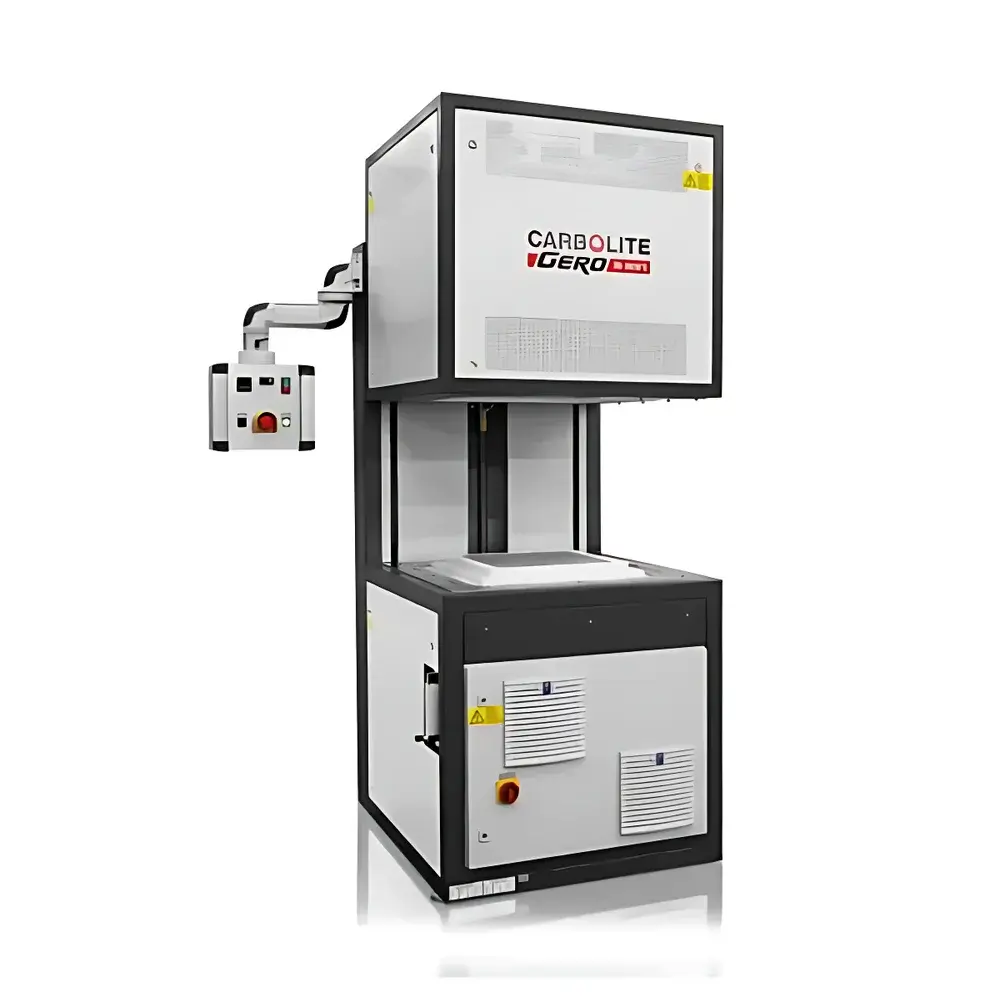
Carbolite Gero HB Series Vertical Lift-Style Bell Annealing Furnace
| Brand | Carbolite Gero |
|---|---|
| Origin | Germany |
| Model | HB |
| Instrument Type | Box-Type Bell Furnace |
| Maximum Operating Temperatures | 1300°C, 1600°C, 1700°C, 1800°C |
| Heating Elements | FeCrAl (up to 1300°C) or MoSi₂ (up to 1800°C) |
| Chamber Volume Range | 80–560 L |
| Control System | EPC3016P1 Programmable Controller |
| Safety Features | Overtemperature Protection |
| Communication Interface | Ethernet |
| Optional Configurations | Preheated Air Circulation Fan, Catalytic Oxidizer, Propane Afterburner |
| Structural Design | Vertically lifting bell hood (standard), bottom-loading variants (HB-BL) |
Overview
The Carbolite Gero HB Series is a precision-engineered vertical lift-style bell annealing furnace designed for high-reliability thermal processing in research laboratories and advanced manufacturing environments. Unlike conventional box furnaces, the HB employs a pneumatically or motor-driven vertically retractable bell-shaped outer casing—enabling full three-sided access to the hot zone during loading and unloading. This architecture minimizes thermal shock to samples, reduces ambient heat loss, and supports repeatable process control under inert, oxidizing, or controlled-atmosphere conditions. The furnace operates on fundamental principles of radiant and convective heat transfer, with heating elements strategically embedded within high-purity, low-thermal-mass insulation layers to ensure uniform temperature distribution (±2°C at setpoint across working volume per ISO 9001-compliant calibration protocols). Available in four maximum temperature classes—1300°C, 1600°C, 1700°C, and 1800°C—the HB series accommodates diverse material science workflows including sintering, debinding, annealing, calcination, and controlled oxidation of technical ceramics, refractory metals, and battery electrode materials.
Key Features
- Vertically actuated bell hood as standard configuration—enables rapid, ergonomic sample handling without horizontal chamber intrusion
- Dual-element compatibility: FeCrAl resistance wire (rated to 1300°C) for cost-efficient mid-temperature applications; MoSi₂ heating elements (rated to 1800°C) for ultra-high-temperature stability and lower specific energy consumption
- Lightweight, low-conductivity ceramic fiber insulation—reduces standby power demand and accelerates ramp rates while maintaining structural integrity at peak temperatures
- EPC3016P1 programmable controller with 16-segment ramp/soak profiles, real-time data logging, and user-accessible PID parameter tuning
- Integrated overtemperature protection circuitry compliant with IEC 61508 SIL 2 functional safety requirements
- Ethernet (TCP/IP) interface supporting Modbus TCP and OPC UA protocols for integration into centralized lab automation systems and MES platforms
Sample Compatibility & Compliance
The HB furnace accommodates irregularly shaped components, large-area substrates, and multi-tiered fixtures due to its open-top loading geometry and configurable hearth dimensions. It is routinely deployed in GLP- and GMP-regulated settings for thermal validation of ceramic green bodies, metal injection molded (MIM) parts, and solid oxide fuel cell (SOFC) assemblies. Optional atmospheric management modules—including preheated air circulation fans, catalytic oxidizers (EN 13543-certified), and propane-fueled afterburners (compliant with DIN EN 652)—enable safe thermal debinding of polymer binders in technical ceramics, meeting ASTM C1171 and ISO 17873 requirements for off-gas treatment. All HB models are CE-marked and conform to EN 60519-2 (safety of industrial electroheating equipment) and EN 61000-6-4 (EMC emission standards).
Software & Data Management
The EPC3016P1 controller supports local HMI operation via a high-contrast color touchscreen with multilingual UI (English, German, French, Chinese). Logged temperature, power, and alarm data are exportable in CSV format via USB or Ethernet. For regulated environments, optional firmware upgrade enables 21 CFR Part 11-compliant electronic signatures, audit trails, and role-based user permissions. Data synchronization with LabArchives, DeltaV, or custom LIMS is achievable through native REST API endpoints or third-party middleware such as Ignition SCADA. Process recipes can be archived, version-controlled, and recalled with timestamped metadata—including operator ID, environmental sensor readings, and chamber pressure logs where integrated.
Applications
- Controlled-atmosphere sintering of SiC, Al₂O₃, ZrO₂, and WC-Co composites
- Thermal debinding of MIM and ceramic injection molding (CIM) components using staged air flow and catalytic oxidation
- High-temperature annealing of semiconductor substrates and optical crystals
- Heat treatment qualification per AMS 2750E (Pyrometry) and BAC 5622 (aerospace thermal processing)
- Research-scale pyrolysis and carbonization of bio-derived precursors
- Calibration reference furnace service for thermocouple and RTD verification labs
FAQ
What distinguishes the HB from traditional muffle furnaces?
The HB’s vertically lifting bell design eliminates door seals and lateral thermal gradients associated with front-loading muffle furnaces—resulting in superior temperature uniformity and reduced maintenance downtime.
Can the HB operate under vacuum or inert gas?
Yes—optional gas-tight sealing kits and flanged feedthroughs support N₂, Ar, or forming gas atmospheres; vacuum operation requires supplementary pumping systems and is not natively integrated.
Is remote monitoring supported out-of-the-box?
Ethernet connectivity is standard; remote supervision via web browser or SCADA is enabled immediately upon network configuration—no additional license required.
How is temperature uniformity validated?
Carbolite Gero provides factory-as-tested uniformity maps per AMS 2750E Zone Classification, with optional on-site verification using 9-point thermocouple mapping per customer SOP.
What maintenance intervals are recommended for MoSi₂ elements?
Under continuous operation at 1700°C, MoSi₂ elements typically retain functional integrity for ≥2,000 hours; annual visual inspection and resistance measurement are advised per maintenance logbook protocol.



