
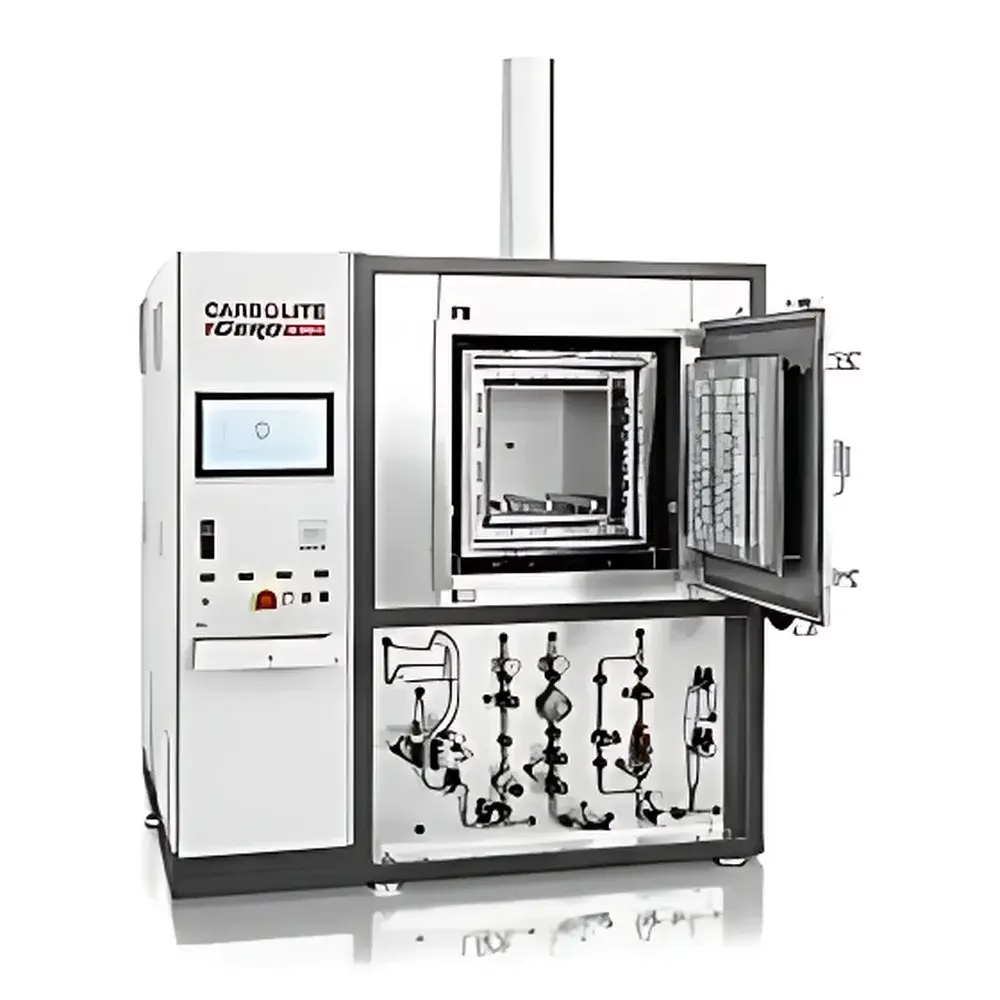
Carbolite Gero HTK Series Metal-Cased High-Temperature Box Furnace
| Brand | Carbolite Gero |
|---|---|
| Origin | Germany |
| Model | HTK |
| Type | Metal-Cased Box Furnace |
| Max Temperature | 1600–2200 °C (HTK MO: up to 1600 °C |
| HTK W | up to 2200 °C) |
| Chamber Volume Options | 8 L, 25 L, 80 L, 120 L |
| Heating Element & Insulation Material | Molybdenum (HTK MO) or Tungsten (HTK W) |
| Atmosphere Compatibility | Inert (N₂, Ar), Reducing (H₂), Vacuum (standard high vacuum upgrade available) |
| Control Zones | 1 zone (HTK 8/25), 4 zones (HTK 80/120) |
| Debinding Options | Integrated tail-gas combustion torch or condensate collection system |
| Compliance | Designed for GLP/GMP-aligned thermal processing environments |
| Data Logging | CC-TP1200 Smart, CC-TP1900, or CC-IPC1900 controllers with audit-trail capability per FDA 21 CFR Part 11 requirements |
Overview
The Carbolite Gero HTK Series is a family of high-temperature, metal-cased box furnaces engineered for precision thermal processing under controlled inert, reducing, or high-vacuum atmospheres. Built on a robust all-metal construction using molybdenum (HTK MO) or tungsten (HTK W) for both heating elements and thermal insulation, the HTK platform delivers exceptional thermal stability, long-term dimensional integrity, and ultra-low outgassing rates—critical for applications demanding atmosphere purity and process repeatability. Unlike ceramic-fiber insulated furnaces, the HTK’s metallic architecture eliminates fiber shedding, volatile binder decomposition, and contamination risks during high-temperature cycles—making it especially suitable for clean sintering, metal injection molding (MIM), thermal debinding, and high-purity synthesis. The front-loading configuration ensures ergonomic sample handling and seamless integration into automated lab or pilot-scale workflows. With maximum operating temperatures ranging from 1450 °C (HTK 120 MO) to 2200 °C (HTK W variants), the series supports a broad spectrum of advanced materials R&D and production-scale thermal treatments.
Key Features
- Metallic construction using either molybdenum (HTK MO) or tungsten (HTK W) for heating elements, radiation shields, and insulation—enabling ultra-high purity atmosphere control and vacuum compatibility down to 10⁻⁵ mbar (with optional high-vacuum upgrade)
- Four chamber volume options: 8 L and 25 L models optimized for laboratory R&D and small-batch optimization; 80 L and 120 L configurations designed for pilot-line debinding, pre-sintering, and small-series production
- Zoned temperature control: single-zone regulation for compact models (HTK 8/25); four independent heating zones for larger chambers (HTK 80/120), enhancing axial and radial temperature uniformity across large loads
- Integrated atmosphere management: compatible with N₂, Ar, H₂, and custom gas mixtures; optional hydrogen partial pressure control for carburization or reduction-sensitive processes
- Dedicated debinding support: configurable tail-gas combustion torches or condensate collection systems for safe, compliant thermal removal of organic binders in MIM and ceramic green-body processing
- Fail-safe thermal protection: redundant overtemperature cutoffs, power-loss cooling protocols, and emergency water-cooling interlocks aligned with IEC 61000-6-2 and EN 60519-2 safety standards
Sample Compatibility & Compliance
The HTK series accommodates diverse sample geometries—from crucibles and graphite boats to multi-layer stacked trays—without compromising thermal homogeneity or atmosphere integrity. Its all-metal hot zone eliminates carbon contamination pathways, making it ideal for processing oxygen-sensitive alloys (e.g., Ti, Zr), refractory metals, and high-performance ceramics. All models comply with ISO 9001 manufacturing practices and are configured to support GLP and GMP documentation requirements. Optional CC-TP1200 Smart, CC-TP1900, or CC-IPC1900 controllers provide electronic signature-capable data logging, real-time deviation alerts, and full audit trails compliant with FDA 21 CFR Part 11. CE marking confirms conformity with EU Machinery Directive 2006/42/EC and Electromagnetic Compatibility Directive 2014/30/EU.
Software & Data Management
Carbolite Gero’s proprietary furnace control software—integrated via CC-series controllers—enables programmable multi-step thermal profiles with ramp rate precision ±0.1 °C/min and soak stability ±1 °C over extended durations. Process parameters (temperature, gas flow, vacuum level, time) are timestamped and stored with user ID attribution. Export formats include CSV and PDF reports with embedded calibration certificates. Remote monitoring via Ethernet/IP is supported, allowing secure access through institutional firewalls for centralized lab management systems. All data archives are encrypted and version-controlled, supporting retrospective validation and regulatory inspection readiness.
Applications
- Metal Injection Molding (MIM): Controlled thermal debinding and pre-sintering under H₂/N₂ atmospheres
- Advanced Ceramics Processing: Binder burnout, sintering, and crystallization of SiC, AlN, and ZrO₂ components
- Refractory Metal Heat Treatment: Annealing, stress relief, and recrystallization of Mo, W, Nb, and Ta alloys
- Carbon-Free Thermal Synthesis: Solid-state reactions and precursor decomposition in ultra-pure Ar or vacuum
- High-Temperature Calibration: Reference furnace applications traceable to national metrology institutes (e.g., PTB, NIST)
- Pilot-Scale Thermal Processing: Scalable debinding, pyrolysis, and heat treatment for aerospace and medical device component qualification
FAQ
What atmosphere gases are compatible with the HTK series?
Nitrogen (N₂), argon (Ar), hydrogen (H₂), and custom binary or ternary mixtures—including H₂/N₂ for controlled reduction—are fully supported. Hydrogen partial pressure control is available as an option.
Can the HTK operate under high vacuum conditions?
Yes—standard configuration supports rough vacuum (≤10⁻² mbar); optional high-vacuum upgrade enables operation down to 10⁻⁵ mbar using turbomolecular pumping systems.
Is the HTK suitable for carbon-free processing?
Absolutely—the all-metal hot zone contains no graphite or ceramic fibers, eliminating carbon contamination sources essential for processing reactive metals and high-purity oxides.
How many temperature control zones does each model have?
HTK 8 and HTK 25 feature single-zone control; HTK 80 and HTK 120 incorporate four independently regulated heating zones for improved thermal uniformity across large workspaces.
What data integrity features are included for regulated environments?
CC-series controllers offer 21 CFR Part 11-compliant audit trails, electronic signatures, password-protected parameter modification, and encrypted long-term data archiving.



