
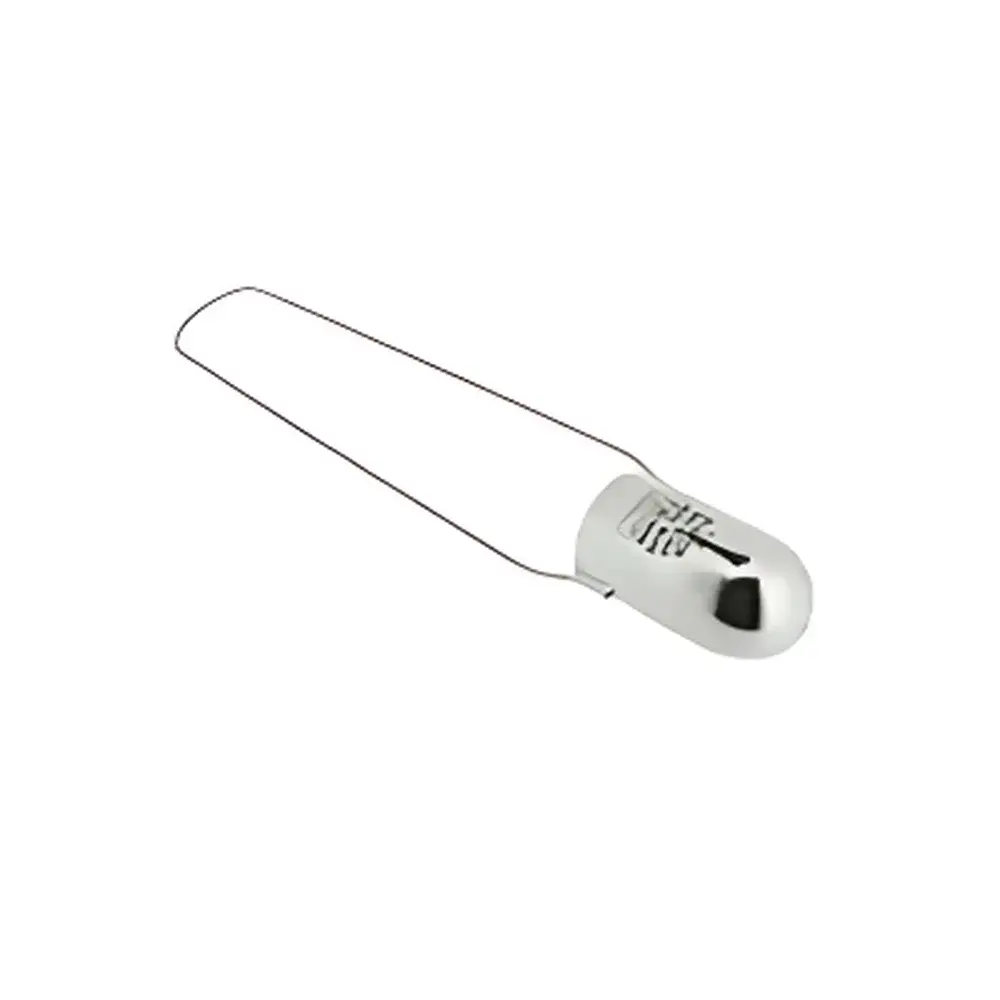
TQC Zahn Cup Viscometer
| Brand | TQC |
|---|---|
| Origin | Guangdong, China |
| Manufacturer Type | Authorized Distributor |
| Country of Origin | China |
| Model | Zahn Cup No. 1 |
| Viscosity Range | 0.1–1000 mPa·s |
| Compliance | ASTM D1084, ASTM D4212 |
| Temperature Control Requirement | 25 °C ±0.2 °C |
| Calibration Certificate Option | DIN 55350 Class M (VF2231) |
| Included Accessories | Rigid Plastic Carrying Case with Foam Liner |
Overview
The TQC Zahn Cup Viscometer is a precision-engineered efflux cup designed for rapid, field- and laboratory-based kinematic viscosity assessment of low-to-medium viscosity liquids—primarily coatings, inks, adhesives, and solvent-based formulations. Operating on the principle of gravity-driven efflux time measurement, the instrument determines kinematic viscosity (in centistokes, cSt) by timing the duration required for a fixed volume of liquid to drain through a standardized orifice under controlled temperature conditions. Unlike rotational rheometers that quantify dynamic viscosity (mPa·s) via torque and shear rate, the Zahn Cup delivers empirically correlated kinematic viscosity values based on internationally recognized calibration protocols. Its simplicity, portability, and minimal maintenance requirements make it ideal for QC checkpoints on production lines, incoming material inspection, and routine batch verification where high-throughput, repeatable screening is prioritized over full rheological profiling.
Key Features
- Stainless steel construction with precision-machined orifice—resistant to corrosion and dimensional drift across repeated thermal cycles.
- Ergonomic extended handle enabling full immersion without finger contact with test fluid, minimizing contamination and operator variability.
- Smooth internal cup geometry and chamfered orifice exit—eliminating dead zones and facilitating complete, residue-free cleaning with non-abrasive lint-free cloths and compatible solvents.
- Individually laser-engraved serial number for traceability and calibration record linkage—supporting ISO/IEC 17025-compliant documentation workflows.
- Rigid protective carrying case with custom-cut EVA foam insert—ensuring mechanical stability during transport and storage.
- Manufactured under TQC’s integrated quality control system, including post-machining dimensional verification and orifice flow validation against master reference cups.
Sample Compatibility & Compliance
The Zahn Cup No. 1 is validated for Newtonian and near-Newtonian fluids within the 0.1–1000 mPa·s dynamic viscosity range at 25 °C. It complies strictly with ASTM D1084 (Standard Test Method for Viscosity of Adhesives Using Efflux Viscometers) and ASTM D4212 (Standard Test Method for Viscosity of Paints, Varnishes, Lacquers, and Related Products by Dip-Type Viscometers). Testing must be conducted at 25 °C ±0.2 °C using a calibrated thermometer traceable to NIST or equivalent national metrology institutes. The cup is not suitable for highly thixotropic, shear-thinning, or particulate-laden suspensions where efflux time fails to correlate reliably with kinematic viscosity. For regulatory environments governed by GLP or GMP, users may obtain optional DIN 55350 Class M certification (VF2231), which includes uncertainty reporting and metrological traceability documentation.
Software & Data Management
As a manual efflux device, the TQC Zahn Cup does not incorporate embedded electronics or software interfaces. However, it integrates seamlessly into digital QA/QC ecosystems via external timing instrumentation—such as the DI0076 LCD stopwatch (9h 59m 59.99s resolution, 0.01 s display granularity)—and companion tools like the VF2053 viscosity conversion scale. Raw efflux time data (in seconds) is manually entered into validated spreadsheets or LIMS platforms where automated cSt conversion algorithms—based on manufacturer-provided calibration curves or ASTM D1084 Annex A correlation tables—are applied. When paired with audit-trail-enabled electronic notebooks or 21 CFR Part 11-compliant systems, all measurements—including operator ID, ambient temperature, cup serial number, and calibration certificate expiry—can be archived with full version control and electronic signature capability.
Applications
- Coating formulation QC: Rapid verification of resin-solvent blends prior to spray application or dip coating.
- Ink manufacturing: Consistency checks across pigment dispersion batches in gravure and flexographic ink lines.
- Adhesive pre-screening: Detection of solvent evaporation or polymer degradation before rheometric validation.
- Raw material acceptance testing: On-site verification of solvent or monomer viscosity against supplier COA specifications.
- Educational laboratories: Demonstrating Newtonian fluid behavior, temperature–viscosity relationships, and empirical calibration principles.
FAQ
What is the difference between kinematic and dynamic viscosity in Zahn Cup measurements?
The Zahn Cup measures efflux time (seconds), which correlates to kinematic viscosity (cSt) via standardized conversion charts. Dynamic viscosity (mPa·s) can be derived only if fluid density is known: η = ν × ρ. For most organic solvents and coatings, approximate density values are used—but absolute dynamic viscosity requires separate densitometry.
Can I use the same Zahn Cup for water and high-solids paint?
No. Each Zahn Cup number (e.g., #1, #2, #3) corresponds to a specific orifice diameter optimized for a defined viscosity range. Using an inappropriate cup introduces laminar/turbulent flow transition errors and invalidates ASTM correlation. Always select the cup whose expected efflux time falls between 25–100 seconds per ASTM D1084.
How often should I recalibrate or recertify my Zahn Cup?
Recertification is recommended annually or after any physical impact, abrasive cleaning, or suspected orifice deformation. DIN 55350 Class M certification (VF2231) includes uncertainty evaluation at multiple flow points and is valid for 12 months from issuance date.
Why is temperature control stricter than ±0.5 °C?
Viscosity of organic liquids typically changes by ~2–3% per °C. A ±0.2 °C tolerance ensures measurement repeatability ≤1.5% RSD across operators and shifts—meeting ASTM D1084’s requirement for “temperature-controlled environment” and supporting ISO 9001 clause 7.1.5.
Is the Zahn Cup suitable for FDA-regulated pharmaceutical excipients?
Only if validated per USP for efflux viscometry and included in the product’s approved analytical method. Most pharmaceutical applications require rotational viscometry (e.g., Brookfield) due to non-Newtonian behavior; Zahn Cups serve best as release-testing surrogates when fully correlated and justified in validation protocols.



