
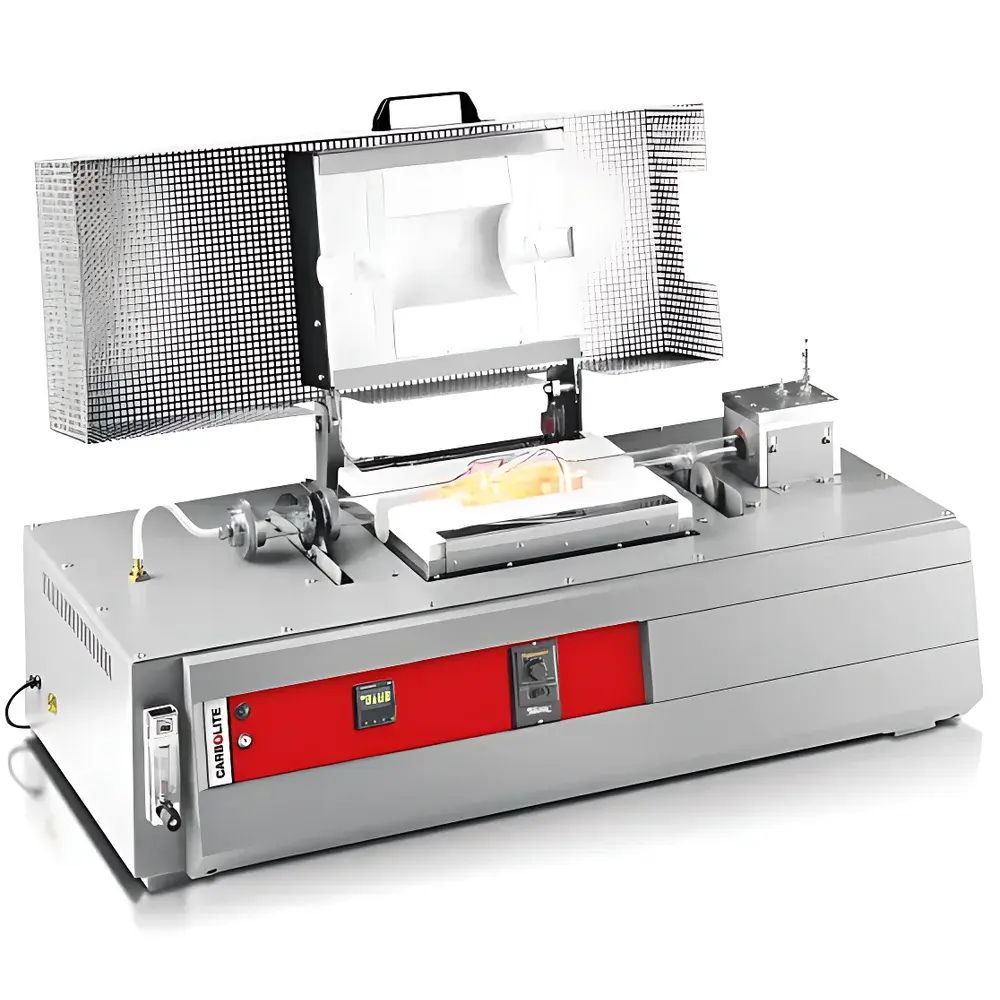
Carbolite Gero HTR 11/75 Rotating Reaction Furnace
| Brand | Carbolite Gero |
|---|---|
| Origin | United Kingdom |
| Model | HTR 11/75 |
| Instrument Type | Tube Furnace |
| Max Temperature | 1100 °C |
| Temperature Control Accuracy | ±5 °C |
| Max Power | 3000 W |
| Heating Time to Max Temp | 21 min |
| Heating Method | Resistance Wire |
| Internal Dimensions | 540 × 1300 × 900 mm |
Overview
The Carbolite Gero HTR 11/75 Rotating Reaction Furnace is a precision-engineered high-temperature thermal processing system designed for dynamic solid-state reactions under controlled atmospheres. Unlike static tube furnaces or conventional muffle furnaces, the HTR series integrates rotational motion with axial gas flow to emulate fluidized-bed and rotary kiln principles—enabling uniform heat transfer, continuous particle agitation, and enhanced mass transport during thermal treatment. The furnace operates on resistive heating via robust embedded resistance wire elements, housed within vacuum-formed semi-cylindrical insulation for thermal efficiency and structural integrity. Its core architecture supports reproducible reaction kinetics in air, inert (N₂, Ar), reducing (H₂, CO), or oxidizing atmospheres—making it suitable for metallurgical assays, mineral decomposition studies, catalyst activation, and thermal gravimetric process development.
Key Features
- Rotating quartz reaction tube (fused silica) driven by a variable-speed motor, ensuring homogeneous mixing of powders and granular solids during heating
- PID-based digital temperature controller with ±5 °C accuracy across the full 100–1100 °C operating range
- Integrated safety interlock: automatic power cutoff to heating elements upon door opening
- Gas inlet system with calibrated 30-mm scale nitrogen flowmeter (standard); compatible with regulated multi-gas manifolds
- Airtight connection between reaction tube and stainless steel exhaust manifold, enabling safe venting to external fume extraction systems
- Vacuum-formed ceramic fiber insulation and mechanically stabilized heating elements for long service life and rapid ramp rates (reaches 1100 °C in ≤21 minutes)
- Front-access design with reinforced viewing window and ergonomic loading geometry for routine sample handling
Sample Compatibility & Compliance
The HTR 11/75 accommodates bulk powders, crushed ores, catalyst pellets, and composite ceramics up to 1300 mm in length and 900 mm in height—optimized for batch sizes ranging from 50 g to 5 kg depending on density and thermal mass. Its fused silica reaction boat resists thermal shock and chemical attack from sulfides, arsenides, and alkaline fluxes common in metallurgical assay protocols. The system complies with IEC 61000-6-3 (EMC) and IEC 61000-6-4 (industrial emission) standards. When equipped with optional overtemperature protection and gas safety modules (e.g., H₂ detectors), it meets functional safety requirements aligned with IEC 61508 SIL 2 for unattended operation. Data logging configurations with timestamped audit trails support GLP/GMP-aligned workflows per FDA 21 CFR Part 11 when paired with compliant software.
Software & Data Management
While the base unit features analog/digital PID control, optional RS232 serial interface enables integration with LabVIEW, MATLAB, or custom SCADA platforms for real-time temperature profiling and event-triggered data capture. Optional 8- or 20-segment programmable controllers allow complex thermal cycles—including dwell periods, ramp rate modulation, and atmosphere switching sequences—stored with non-volatile memory. Graphical chart recorders (optional) provide hard-copy traceability for method validation. All firmware updates are delivered via secure USB firmware loader; configuration files support version-controlled backup and cross-instrument replication.
Applications
- Roasting of arsenic-bearing gold concentrates to volatilize sulfur and arsenic prior to cyanidation
- Quantitative sulfur determination in metallurgical slags via controlled oxidative calcination
- Low-temperature (≤600 °C) solvent removal from oxide pigments using inert rotation
- Oxidative decomposition of metal sulfides (e.g., pyrite, chalcopyrite) for phase transformation analysis
- Silica quantification in agricultural biomass (e.g., rice husk ash) via controlled combustion
- Calcination of limestone and dolomite for lime activity testing in cement feedstock evaluation
- Thermal stabilization of coal waste residues at up to 1000 °C for ash composition mapping
FAQ
Can the HTR 11/75 operate under hydrogen atmosphere?
Yes—when configured with optional hydrogen detection, purge interlocks, and explosion-proof electrical components, the furnace is certified for Class I, Division 1 hazardous area use per ATEX Directive 2014/34/EU.
Is the fused silica reaction tube replaceable as a consumable?
Yes—the standard 1300 mm × 90 mm OD quartz tube is field-replaceable; Carbolite Gero supplies certified replacement tubes with full thermal shock certification and dimensional QA reports.
What maintenance intervals are recommended for the drive motor and gas seals?
Motor lubrication is specified at 12-month intervals under continuous operation; silicone O-rings at gas ports require inspection every 200 operational hours and replacement after 1000 hours or visible compression set.
Does the system support automated atmosphere switching during a single run?
With the optional multi-gas control module and programmable controller, up to four gases can be sequenced with timed valve actuation synchronized to temperature segments.
How is temperature uniformity validated across the heated zone?
Carbolite Gero provides a factory calibration certificate documenting axial and radial uniformity (±8 °C over 600 mm hot zone at 1100 °C), measured per ASTM E220-19 using NIST-traceable thermocouples.



