
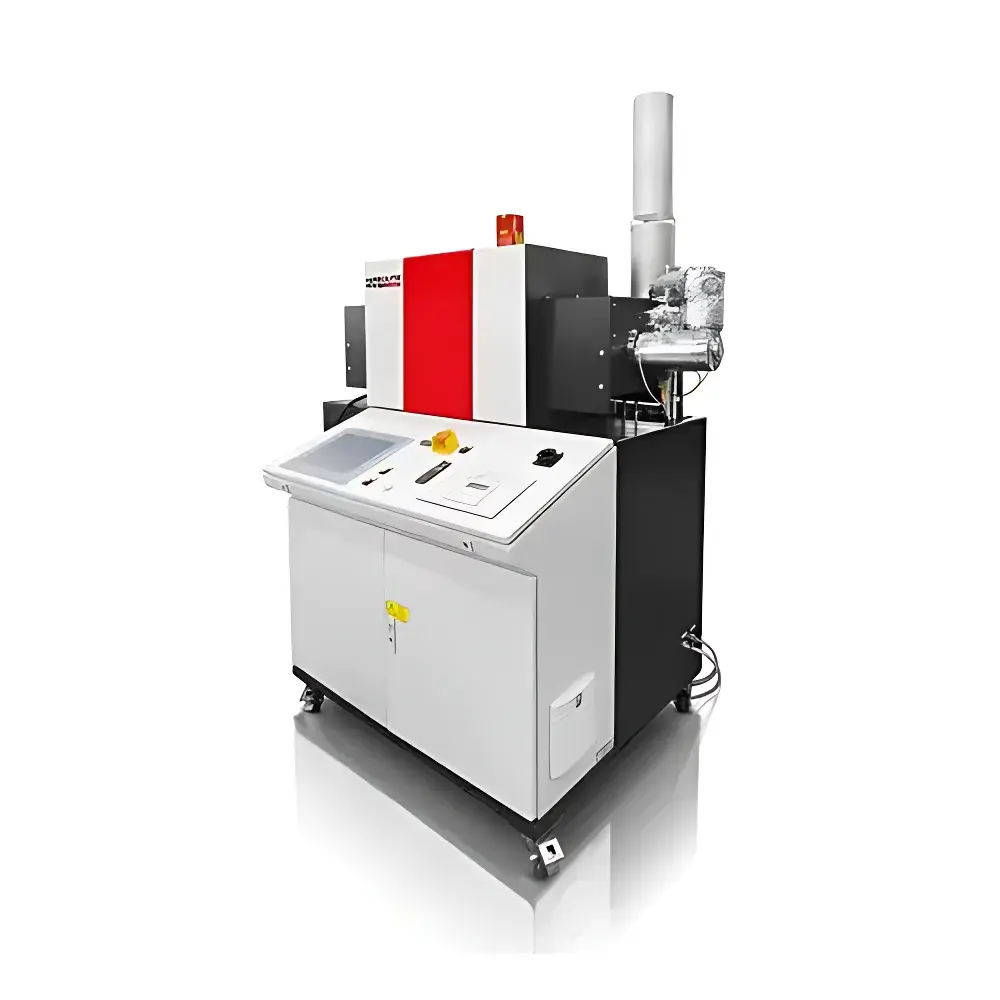
Carbolite Gero HTRH-H2 Hydrogen-Compatible High-Temperature Tube Furnace
| Brand | Carbolite Gero |
|---|---|
| Origin | Germany |
| Model | HTRH-H2 |
| Maximum Temperature | 1600 °C |
| Gas Compatibility | 100% H₂ (certified) |
| Safety Certification | SIL2-compliant |
| Cooling | Water-cooled ceramic tube ends with leak-tight flanges |
| Purge System | Automated inert gas (N₂ or Ar) pre-purge via mass flow controllers |
| Exhaust Treatment | Heated catalytic tail-gas burner (propane + compressed air) |
| Control Interface | Touchscreen HMI with full automation and audit trail |
| Compliance | Meets DIN EN 60204-1, ATEX Zone 2 / IECEx Zone 2, and ISO 15085-2 for hydrogen handling systems |
| Optional | Turbo-molecular pump integration, rapid cooling module, custom tube materials (quartz, SiC, molybdenum, tungsten) |
Overview
The Carbolite Gero HTRH-H2 is a purpose-engineered hydrogen-compatible high-temperature tube furnace designed for controlled thermal processing under pure hydrogen atmospheres up to 1600 °C. Unlike standard tube furnaces retrofitted for H₂ use, the HTRH-H2 is fundamentally engineered from the ground up to meet stringent international safety and operational requirements for hydrogen service—including ISO 27001-aligned process safety management, ATEX/IECEx Zone 2 classification, and SIL2 functional safety integrity per IEC 61508. Its core architecture integrates a water-cooled ceramic tube assembly with double-sealed, pressure-rated flanges, eliminating cold spots and condensation risks in critical sealing zones. The furnace operates on a closed-loop gas management principle: prior to H₂ introduction, an automated inert gas (N₂ or Ar) purge—monitored by real-time mass flow control—reduces residual O₂ concentration to <100 ppm, mitigating explosive mixture formation. All gas sequences, temperature ramps, and fault responses are governed by a deterministic PLC-based controller with non-volatile event logging.
Key Features
- Full hydrogen compatibility certified for continuous operation at 1600 °C under 100% H₂ atmosphere
- SIL2-certified safety architecture with redundant monitoring: integrated H₂ sensors (catalytic bead type, 0–100% LEL), overtemperature cutoffs, and pressure-differential interlocks
- Heated tail-gas combustion system operating at >300 °C to prevent condensate formation and ensure complete oxidation of H₂ and organic volatiles (e.g., binder pyrolysis products)
- Automated inert gas purge cycle with programmable duration, flow rate, and endpoint verification via O₂ sensor feedback
- Water-cooled ceramic tube terminations with graphite gaskets and dual-flange design ensuring zero leakage at elevated temperatures
- Touchscreen HMI with recipe-based operation, real-time parameter visualization, and configurable alarm thresholds
- Built-in data logging compliant with FDA 21 CFR Part 11 requirements: electronic signatures, audit trails, and exportable CSV/TXT files
Sample Compatibility & Compliance
The HTRH-H2 accommodates a broad range of sample geometries and chemistries, including metal powders (Fe, Ni, Co, Ti alloys), ceramic precursors (Al₂O₃, SiC, ZrO₂), polymer-derived ceramics, MIM/CIM feedstocks, and refractory metals. Its tube configuration supports both horizontal and vertical orientation setups, with optional custom-length tubes (up to 1200 mm hot zone) and material variants—quartz (≤1100 °C), high-purity alumina (≤1600 °C), silicon carbide (≤1700 °C), and molybdenum (≤1800 °C, with water-jacketed housing). All configurations comply with ASTM E1112 (laboratory furnace performance), ISO 9001:2015 (quality management), and EN 13445-3 (unfired pressure vessels) where applicable. For GMP/GLP environments, optional IQ/OQ documentation packages and calibration certificates traceable to PTB (Physikalisch-Technische Bundesanstalt) standards are available.
Software & Data Management
The embedded control firmware supports fully automated thermal profiles with up to 32 segments per program, including dwell times, ramp rates (0.1–50 °C/min), and conditional branching (e.g., “hold until H₂ concentration stabilizes”). Data acquisition records temperature (±0.5 °C), gas flows (±1% FS), pressure differentials, and safety events at user-defined intervals (1 s to 10 min). Export formats include timestamped CSV and XML for integration into LIMS or MES platforms. Remote monitoring is enabled via Ethernet (Modbus TCP) or optional Wi-Fi module; no cloud dependency or proprietary software installation required. Audit trails capture operator ID, parameter changes, manual overrides, and emergency stops—fully aligned with ALCOA+ principles for data integrity.
Applications
This furnace serves as a critical tool in advanced materials R&D and production-scale thermal processing, including: hydrogen reduction of metal oxides (WO₃ → W, NiO → Ni), carbothermal synthesis of ultra-high-purity carbides and nitrides, low-oxygen sintering of titanium and zirconium alloys, debinding and sintering of MIM/CIM components, high-temperature annealing of graphene substrates, thermal desorption spectroscopy (TDS) sample preparation, and catalyst activation under reducing atmospheres. It is widely deployed in university materials science labs, national metrology institutes (e.g., NIST, NPL), and Tier-1 aerospace and medical device manufacturers requiring validated hydrogen processing capability.
FAQ
What safety certifications does the HTRH-H2 hold?
The system complies with SIL2 per IEC 61508, ATEX Directive 2014/34/EU (Zone 2), IECEx Scheme, and EN 60204-1 for electrical safety. Full certification documentation is provided with each unit.
Can the furnace be integrated with vacuum systems?
Yes—optional turbomolecular or two-stage rotary vane pump interfaces are available with integrated pressure control and interlocked venting logic.
Is rapid cooling supported?
An active forced-air or nitrogen quench option can be factory-installed, enabling cooling rates up to 150 °C/min from 1600 °C to 400 °C.
How is hydrogen leak detection implemented?
Three independent catalytic H₂ sensors (top-mounted, flange-integrated, exhaust line) trigger immediate inert gas purge, power cutoff, and audible/visual alarms upon detection exceeding 25% LEL.
What tube materials are compatible at 1600 °C under H₂?
High-purity recrystallized alumina (99.8% Al₂O₃) and silicon carbide (SiC) tubes are rated for continuous use at 1600 °C in hydrogen; molybdenum tubes require water-jacketed support and are limited to ≤1800 °C under strict dew point control.



