
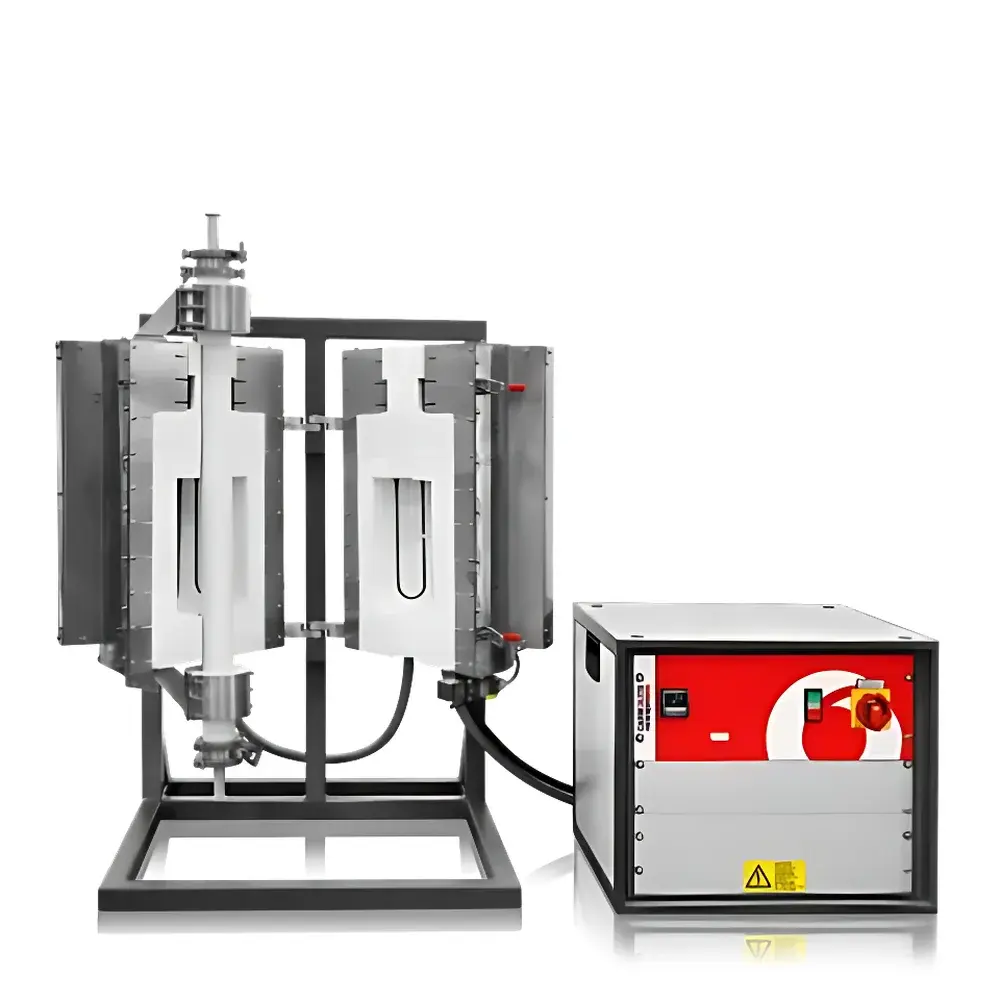
Carbolite Gero HTRV-A 1700°C Vertical Split-Type Tube Furnace
| Brand | Carbolite Gero |
|---|---|
| Origin | Germany |
| Model | HTRV-A |
| Instrument Type | Tube Furnace |
| Max Operating Temperature | 1700°C |
| Controller | EPC3016P1 Programmable |
| Heating Zone Lengths | 120 / 250 / 500 / 700 mm |
| Maximum Tube OD | 100 mm |
| Atmosphere Options | Controlled, Inert, Vacuum (optional mechanical or turbo-molecular pump) |
| Thermocouple Type | High-Precision Type B |
| Insulation | Low-thermal-mass ceramic fiber |
| Heating Element | Molybdenum Disilicide (MoSi₂), vertically suspended |
| Control Cabinet | Separate unit with 6 m cable |
| Communication Interface | Ethernet (optional), digital I/O, RS485 |
Overview
The Carbolite Gero HTRV-A is a high-temperature vertical split-type tube furnace engineered for precision thermal processing in research and industrial laboratories. Designed around the fundamental principle of resistive heating via molybdenum disilicide (MoSi₂) elements operating in oxidizing or inert atmospheres, the HTRV-A delivers stable, repeatable temperature profiles up to 1700°C—making it suitable for applications demanding rigorous thermal control, such as crystal growth, sintering of advanced ceramics, metal injection molding (MIM) debinding and sintering cycles, and high-temperature pyrolysis under controlled gas environments. Its vertical split configuration enables rapid, non-invasive access to the hot zone without disturbing furnace alignment or insulation integrity—a critical advantage for process development, sample loading/unloading, and maintenance of thermal uniformity across repeated thermal cycles.
Key Features
- Vertical split design with dual hinged doors for unobstructed axial access to the heated zone—minimizing thermal shock during sample insertion and enabling compatibility with long or fragile specimens.
- High-purity MoSi₂ heating elements mounted in vertical suspension, ensuring uniform radial heat distribution and extended service life at temperatures up to 1700°C in air or inert gas.
- Multi-layer low-thermal-mass ceramic fiber insulation system—including front-end, lateral, and internal layers—optimized to reduce energy consumption while maintaining ±1°C temperature stability at setpoint over extended dwell periods.
- Integrated Type B thermocouple with cold-junction compensation, calibrated to NIST-traceable standards, providing accurate real-time monitoring within the working zone.
- Separate control cabinet (EPC3016P1 programmable controller) located up to 6 meters from the furnace body, minimizing electromagnetic interference and facilitating integration into centralized lab automation systems.
- Standard Ethernet interface (optional) supporting Modbus TCP and OPC UA protocols for remote monitoring, data logging, and compliance with FDA 21 CFR Part 11 requirements when paired with validated software environments.
Sample Compatibility & Compliance
The HTRV-A accommodates quartz, alumina, silicon carbide, and molybdenum tubes up to 100 mm outer diameter, with standard heating lengths of 120 mm, 250 mm, 500 mm, or 700 mm—allowing flexibility for small-scale R&D or larger batch processing. Optional vacuum components—including rotary vane pumps (for rough vacuum down to 10⁻² mbar) or turbo-molecular pumping stations (for high vacuum ≤10⁻⁶ mbar)—enable degassing, carburization, and reactive sintering under ultra-low partial pressures. The furnace complies with IEC 61000-6-3 (EMC emissions), IEC 61000-6-2 (immunity), and meets CE marking requirements for laboratory equipment. When operated with certified calibration procedures and audit-trail-enabled controllers, it supports GLP and GMP workflows per ISO/IEC 17025 and ASTM E1112 guidelines.
Software & Data Management
The EPC3016P1 controller supports up to 16 programmable ramp-soak segments, with user-defined rate limits (0.1–50°C/min), hold times (0–999 h 59 min), and event-triggered outputs (e.g., gas flow activation, vacuum start). Data logging occurs at configurable intervals (1 s–60 min) to internal memory (10,000 points) or external USB storage. Optional Carbolite Gero LabManager™ software provides real-time visualization, CSV export, alarm history, and electronic signature support for 21 CFR Part 11 compliance. All logged data includes timestamp, thermocouple ID, setpoint, actual temperature, power output, and controller status flags—ensuring full traceability for quality audits.
Applications
- Thermal treatment of advanced ceramics (e.g., Si₃N₄, ZrO₂) requiring precise sintering profiles between 1400–1700°C.
- Controlled-atmosphere annealing of semiconductor substrates and thin-film precursors.
- Carbonization of polymer-derived ceramics and pyrolytic carbon coatings.
- Debinding and sintering of MIM and powder metallurgy compacts under nitrogen or hydrogen.
- Growth of single-crystal oxides using vertical Bridgman or gradient freeze techniques.
- Thermogravimetric analysis (TGA) coupling via integrated mass flow controllers and residual gas analyzers (RGA).
FAQ
What atmosphere options are supported by the HTRV-A?
The furnace operates in air, inert gases (N₂, Ar), reducing atmospheres (H₂/N₂ mixtures), and vacuum—via optional mechanical or turbo-molecular pumping systems.
Is the furnace compatible with vacuum-tight quartz tubing?
Yes—when used with appropriate flange kits, O-rings, and vacuum-rated end caps, the HTRV-A maintains leak rates <1×10⁻⁷ mbar·L/s with fused silica tubes.
Can multiple HTRV-A units be synchronized via network control?
Yes—using the optional Ethernet interface and LabManager™ software, up to 32 furnaces can be monitored and programmed simultaneously with synchronized data timestamps.
What is the typical temperature uniformity across the hot zone?
At 1600°C, radial uniformity is ±5°C over 90% of the specified heating length; axial uniformity is ±8°C over the central 60% of the zone—verified per ASTM E220 calibration practice.
Does Carbolite Gero provide IQ/OQ documentation packages?
Yes—factory-validated Installation Qualification (IQ) and Operational Qualification (OQ) protocols are available upon request, including calibration certificates, sensor traceability records, and functional test reports.



