
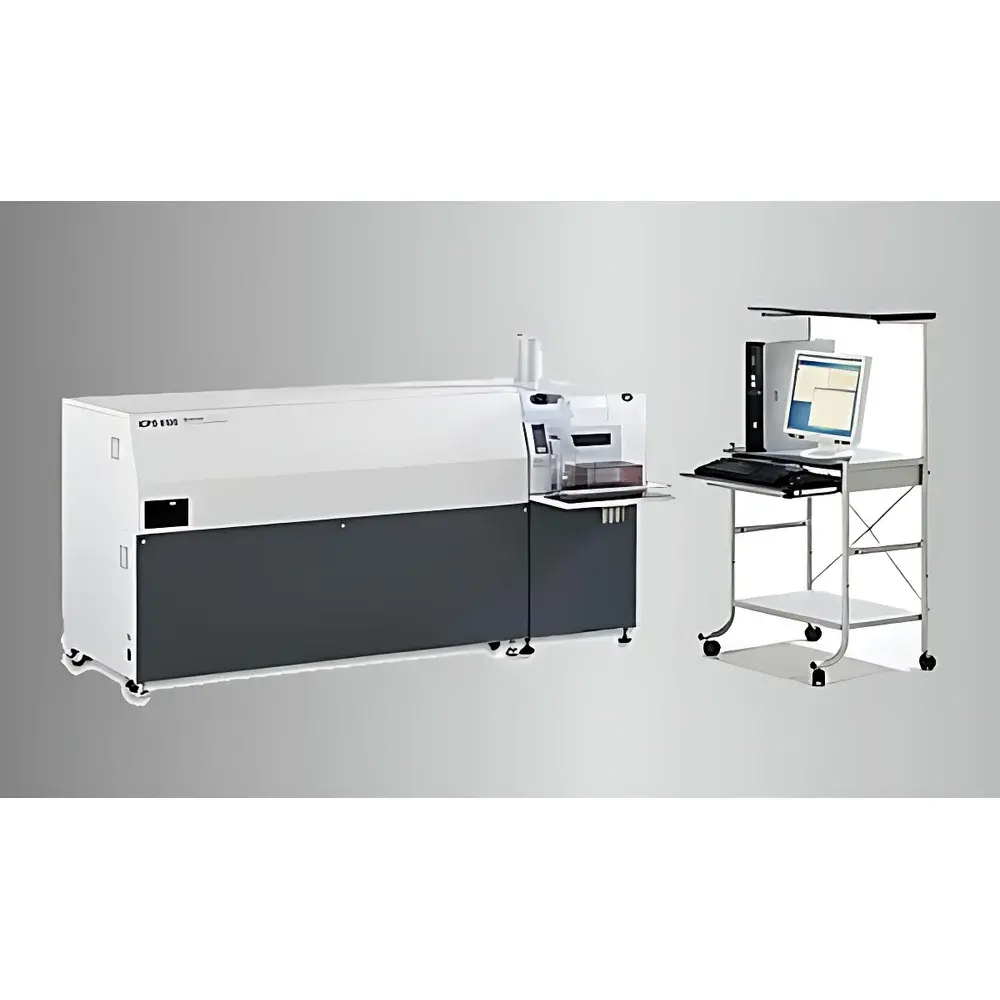
Shimadzu ICPS-8100 Sequential Scanning Inductively Coupled Plasma Optical Emission Spectrometer
| Brand | Shimadzu |
|---|---|
| Origin | Japan |
| Model | ICPS-8100 |
| Instrument Type | Sequential Scanning ICP-OES |
| Wavelength Range | 160–850 nm |
| Optical Resolution | 0.0045 nm |
| Optical System | Vacuum-Enclosed Double Monochromator |
| Sample Introduction | Modular Peristaltic Pump + Optional Autosampler, Nebulizer, and Spray Chamber Configurations |
| Compliance | Designed for GLP/GMP environments |
Overview
The Shimadzu ICPS-8100 is a high-performance sequential scanning inductively coupled plasma optical emission spectrometer (ICP-OES) engineered for trace-element quantification in complex matrices. It operates on the principle of atomic emission spectroscopy: liquid samples are nebulized into an argon plasma at ~6,000–10,000 K, where analyte elements are atomized and electronically excited. Upon relaxation, they emit characteristic wavelengths within the ultraviolet–visible spectrum (160–850 nm), which are resolved and measured by the instrument’s optical system. The ICPS-8100 employs a vacuum-sealed double monochromator architecture—comprising two serially aligned Czerny–Turner gratings—to achieve exceptional spectral purity and long-term photometric stability. This design eliminates atmospheric absorption (especially critical below 190 nm) and suppresses stray light, enabling reliable detection of low-energy resonance lines for sulfur (S 180.731 nm), boron (B 182.629 nm), iodine (I 178.279 nm), and aluminum (Al 167.079 nm) without requiring continuous purge gas flow.
Key Features
- Vacuum optical chamber: Maintains <10 Pa pressure to ensure stable transmission across the full 160–850 nm range, eliminating O2 and H2O vapor absorption bands and enabling reproducible VUV analysis.
- Double monochromator configuration: Provides effective optical resolution of ≤0.0045 nm (measured at 200 nm, FWHM), minimizing spectral overlap in multi-element analysis of high-background matrices such as rare-earth concentrates, tungsten alloys, and geological digests.
- Sequential wavelength scanning: Optimized for method flexibility and interference management—users define dwell times, integration windows, and background correction points per line, supporting rigorous interference correction protocols (e.g., adjacent-line or multi-point background subtraction).
- Modular sample introduction: Compatible with standard concentric glass nebulizers, PFA microflow systems, and cyclonic spray chambers; supports optional autosamplers (e.g., Shimadzu AS-8100) for unattended operation in QC laboratories.
- Robust plasma control: Integrated RF generator with automatic impedance matching ensures stable torch operation across variable acid concentrations and organic solvent loads (up to 20% v/v ethanol/methanol with appropriate accessories).
Sample Compatibility & Compliance
The ICPS-8100 accommodates aqueous solutions, acid-digested environmental and metallurgical samples (e.g., EPA Method 200.7, ISO 11885), and diluted organic extracts following appropriate matrix-matching and internal standardization (e.g., Sc, Y, or In). Its high-resolution capability meets ASTM D5185 (lubricating oils), ISO 17294-2 (water), and JIS K0121 (metals) requirements for multi-element screening. The system architecture supports GLP-compliant workflows: electronic signatures, user-level access controls, and audit-trail logging are implemented via Shimadzu LabSolutions ICP software when deployed on validated Windows platforms adhering to 21 CFR Part 11 Annex 11 principles.
Software & Data Management
LabSolutions ICP provides method development, sequence scheduling, real-time spectral visualization, and quantitative reporting. All measurement parameters—including grating position, slit width, detector voltage, and background correction strategy—are stored as metadata with each analysis. Raw intensity data (cps), corrected net intensities, calibration curves (linear/logarithmic), and uncertainty estimates (based on replicate RSD and calibration fit residuals) are exportable in CSV, XML, or PDF formats. Data integrity safeguards include write-protected raw data folders, timestamped operator logs, and configurable retention policies aligned with ISO/IEC 17025 documentation requirements.
Applications
- Trace rare-earth element profiling in bastnäsite and monazite ores, resolving Eu II 211.887 nm from Fe II 211.870 nm (Δλ = 0.017 nm).
- Multi-acid digestion analysis of stainless steel (Ni–Cr–Mo alloys), quantifying B, P, S, and trace Co at sub-ppb levels with minimal polyatomic interference.
- Soil and sediment testing per ISO 11466: simultaneous determination of Al, Ca, Mg, Mn, Fe, and heavy metals (Cd, Pb, As) after HF–HNO3–HClO4 digestion.
- High-purity chemical certification: detection of metallic impurities in electronic-grade phosphoric acid (SEMI F57) and lithium hexafluorophosphate electrolytes.
FAQ
What distinguishes the ICPS-8100’s double monochromator from single-monochromator ICP-OES systems?
It delivers superior stray-light rejection and narrower effective bandwidth—critical for resolving adjacent emission lines in complex spectra, especially below 200 nm where atmospheric absorption compromises sensitivity.
Can the ICPS-8100 analyze samples containing hydrofluoric acid (HF)?
Yes, when equipped with a quartz torch and PFA nebulizer/spray chamber; however, complete dissolution of silicates requires post-digestion boric acid complexation to neutralize residual HF prior to introduction.
Is vacuum pump maintenance required during routine operation?
The turbomolecular vacuum system operates continuously with no consumables; typical service intervals exceed 10,000 hours, and vacuum integrity is monitored in real time via integrated Pirani and cold-cathode gauges.
How does the ICPS-8100 handle spectral interferences from molecular bands (e.g., N2+, OH)?
Through high-resolution line selection, multi-point background correction, and optional mathematical interference correction models embedded in LabSolutions ICP—validated against certified reference materials with known interference profiles.
Does the system support internal standardization with multiple elements simultaneously?
Yes; up to four internal standards (e.g., Sc, Y, In, Bi) can be monitored per analysis, with drift correction applied independently to each analyte channel based on real-time IS response.





