
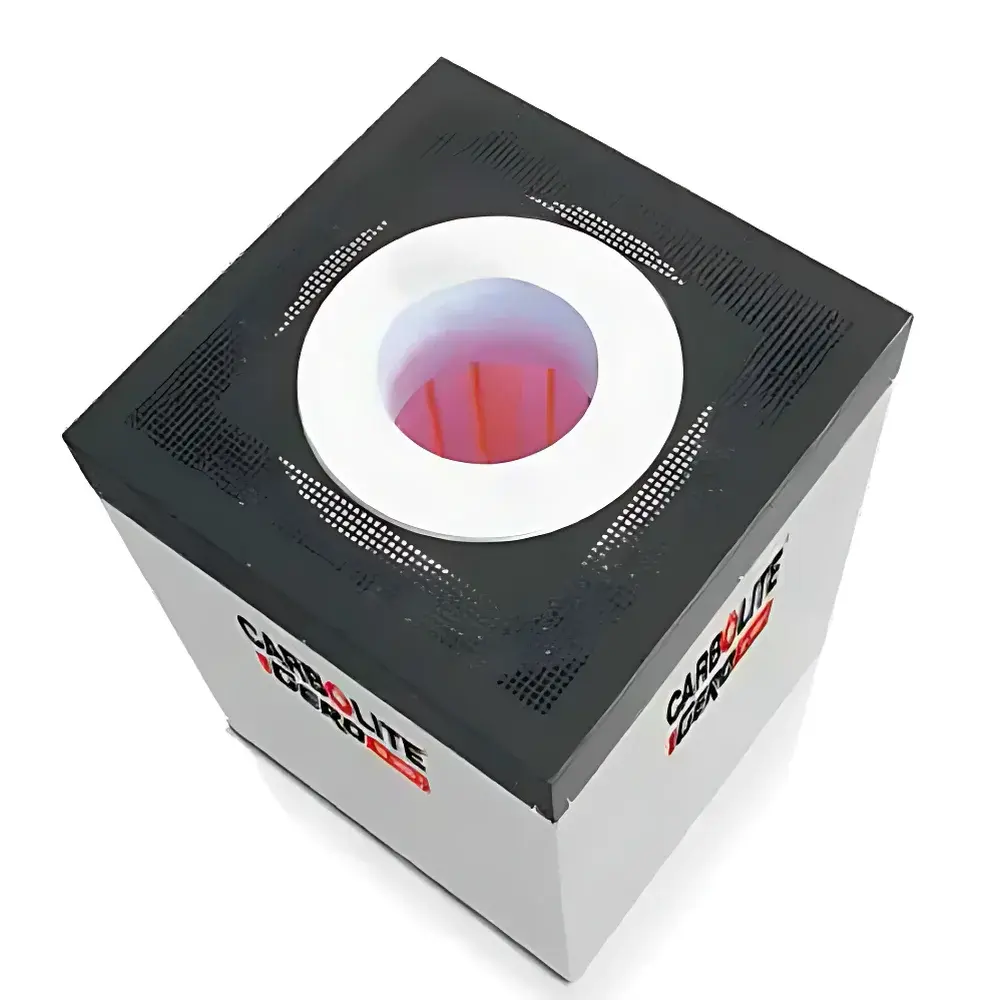
Carbolite Gero HTRV Vertical Tube Furnace
| Brand | Carbolite Gero |
|---|---|
| Origin | Germany |
| Instrument Type | Vertical Tube Furnace |
| Maximum Operating Temperature | 1800 °C |
| Heating Element | MoSi₂ (Molybdenum Disilicide) |
| Insulation Material | High-Purity Vacuum-Formed Ceramic Fiber Board |
| Standard Tube Material | High-Purity Al₂O₃ or Al₂O₃/SiO₂ |
| Flange Type | Water-Cooled Stainless Steel |
| Atmosphere Compatibility | Vacuum, Inert, Oxidizing, Reducing (with optional gas handling systems) |
| Modular Configuration | Fully Customizable (furnace body, tube, flanges, supports, gas inlets, vacuum interfaces) |
| Compliance | Designed for GLP/GMP-aligned lab environments |
Overview
The Carbolite Gero HTRV Vertical Tube Furnace is an engineered high-temperature thermal processing system designed for precision-controlled heat treatment under vacuum or controlled atmospheres. Based on the fundamental principle of resistive heating via MoSi₂ elements operating in oxidizing or inert environments up to 1800 °C, the HTRV integrates a vertically oriented cylindrical hot zone within a rigid square-section outer casing. Its architecture follows a dual-wall design: inner high-density ceramic fiber insulation minimizes radial heat loss while enabling rapid thermal response and energy efficiency; outer structural housing ensures mechanical stability and operator safety. The vertical orientation facilitates gravity-assisted sample loading/unloading, uniform axial temperature gradients, and compatibility with crystal growth techniques requiring directional solidification—such as Bridgman, zone melting, and chemical vapor transport. All critical components—including heating elements, insulation, and furnace core—are manufactured in Germany to stringent DIN EN ISO 9001 standards.
Key Features
- MoSi₂ heating elements suspended independently inside the hot zone—enabling tool-free replacement without disassembling insulation or casing
- Vacuum-formed ceramic fiber insulation with thermal conductivity < 0.15 W/m·K at 1000 °C, ensuring low standby power consumption and high thermal efficiency
- Modular flange interface supporting water-cooled stainless steel end plates, integrated thermocouple feedthroughs, and multi-port gas/vacuum connections
- Standard high-purity alumina (Al₂O₃) or alumina-silica (Al₂O₃/SiO₂) working tubes rated for continuous operation at 1750 °C and transient peaks to 1800 °C
- Optional integrated vacuum train: two-stage rotary vane pump (base pressure ≤10⁻² mbar) or turbomolecular pumping system (≤10⁻⁶ mbar) with Pirani and cold cathode gauges
- Gas handling options include manual rotameters (N₂, Ar, H₂, forming gas) or mass flow controllers (MFCs) compliant with ISO 8573-1 Class 2 for trace moisture/oil control
Sample Compatibility & Compliance
The HTRV accommodates diverse sample geometries—including crucibles, boats, rods, wafers, and powder compacts—within its vertically aligned hot zone. Its design supports both batch and semi-continuous processing protocols. For regulatory-sensitive applications, the furnace meets essential requirements for Good Laboratory Practice (GLP) and pre-GMP environments: full audit trail capability via optional data logging software (compliant with FDA 21 CFR Part 11 when paired with validated PC systems), NIST-traceable temperature calibration certificates, and CE marking per Machinery Directive 2006/42/EC and Electromagnetic Compatibility Directive 2014/30/EU. Optional pyrometry integration (two-color or single-wavelength) enables non-contact temperature validation per ASTM E2550 for thermal stability assessment.
Software & Data Management
Carbolite Gero’s proprietary TouchControl™ software provides graphical configuration of multi-step temperature ramps, dwell times, atmosphere switching sequences, and vacuum hold profiles. Real-time monitoring includes dual-channel thermocouple inputs (Type S or B), pressure readings, gas flow rates, and power consumption. All operational parameters are timestamped and exportable in CSV or XML format for traceability. When deployed with optional Ethernet-enabled controllers, the system supports remote access via secure HTTPS, role-based user permissions, and automated report generation aligned with ISO/IEC 17025 documentation frameworks.
Applications
- Crystal growth of II–VI compounds (e.g., ZnSe, CdTe), optical fluorides (CaF₂, BaF₂), and refractory oxides using vertical Bridgman or gradient freeze methods
- High-temperature sintering of advanced ceramics (SiC, Si₃N₄, Y₂O₃-stabilized ZrO₂) under reducing or inert atmospheres
- Thermal annealing of semiconductor substrates and thin-film precursors (e.g., metal-organic decomposition, sol-gel calcination)
- Thermogravimetric analysis (TGA) coupling with mass spectrometry or FTIR gas analysis via side-arm sampling ports
- Material synthesis via chemical vapor transport (CVT), sublimation purification, and reactive gas-phase nitridation/carburization
FAQ
What is the standard temperature uniformity specification across the hot zone?
Typical axial uniformity is ±5 °C over a 100 mm length at 1600 °C; radial uniformity is ±8 °C—both values verified per ASTM E2550 Annex A2 using calibrated miniature thermocouples.
Can the HTRV be configured for hydrogen atmosphere operation?
Yes—hydrogen-compatible versions feature leak-tested stainless steel gas manifolds, explosion-proof electrical enclosures (ATEX Zone 2), and optional H₂ sensors with automatic purge interlocks.
Is third-party calibration support available?
Carbolite Gero partners with accredited metrology laboratories in the EU and North America to provide on-site or benchtop calibration services traceable to national standards (e.g., PTB, NIST).
How is cooling managed after high-temperature runs?
Passive air cooling is standard; forced-air or water-jacketed cooling modules are available to reduce cooldown time by up to 40% without compromising insulation integrity.
What maintenance intervals are recommended for MoSi₂ elements?
Under continuous operation at ≤1750 °C in air, MoSi₂ elements typically exceed 2,000 hours of service life; visual inspection and resistance measurement are advised every 500 hours.



