
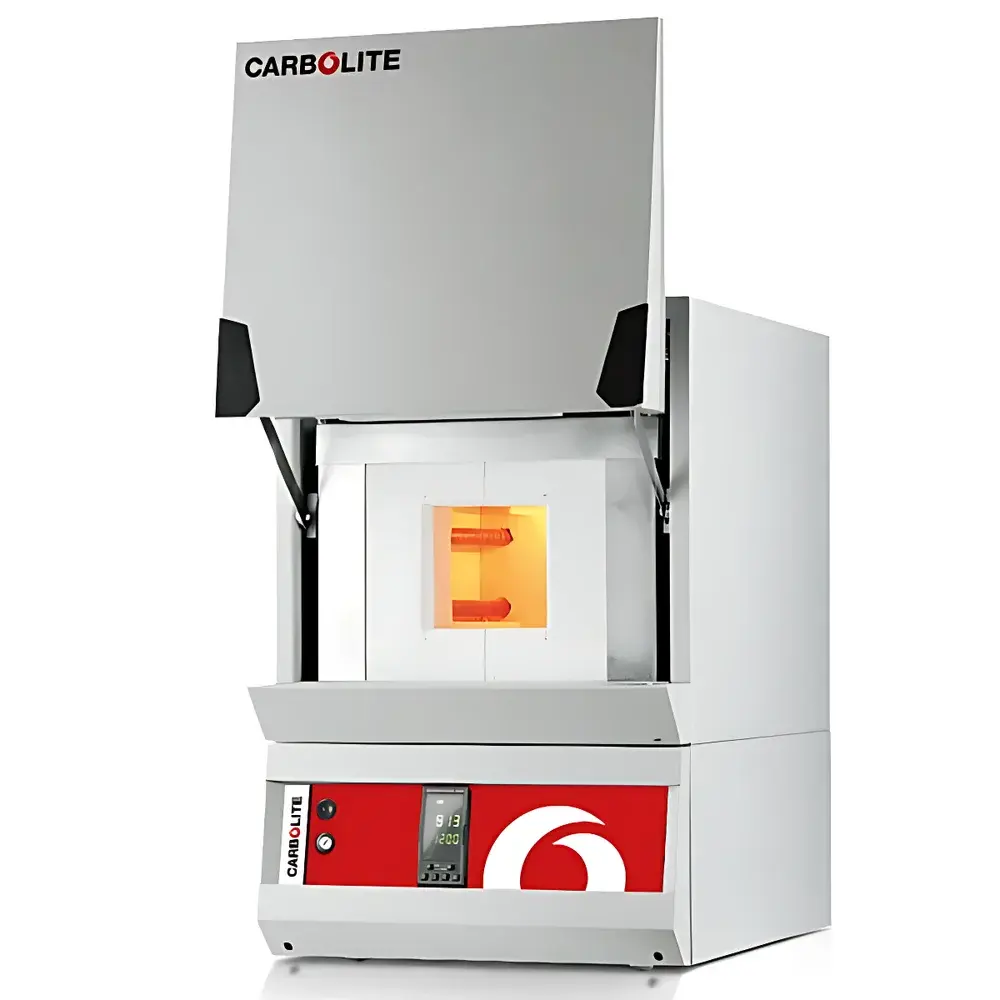
Carbolite Gero RHF 16/3/3508P1 High-Temperature Box Furnace
| Brand | Carbolite Gero |
|---|---|
| Origin | United Kingdom |
| Model | RHF 16/3/3508P1 |
| Maximum Temperature | 1600 °C |
| Temperature Uniformity | ±5 °C |
| Heating Power | 6200 W |
| Time to Max Temperature | 46 min |
| Heating Element | Silicon Carbide (SiC) Rods |
| Internal Chamber Dimensions | 250 × 300 × 465 mm (L × W × H) |
| Chamber Volume | 35 L |
| Control System | PID301 Single-Stage Programmable Controller |
| Optional Upgrades | 8- or 20-Stage Program Controller, RS232/RS485 Interface, Over-Temperature Protection, Floor Stand, Dual-Phase Power Supply (for select models) |
Overview
The Carbolite Gero RHF 16/3/3508P1 is a high-temperature box furnace engineered for precision thermal processing in research laboratories and quality control environments. Designed around a robust refractory architecture and silicon carbide (SiC) heating elements, it delivers stable, repeatable operation up to 1600 °C—making it suitable for sintering, ashing, calcination, heat treatment of ceramics and advanced materials, and controlled atmosphere pre-treatment protocols. Its thermally optimized chamber—lined with low-conductivity, lightweight insulating refractories—enables rapid heating (reaching maximum temperature in 46 minutes) and efficient cooling, while minimizing thermal lag and energy consumption. The furnace conforms to IEC 61000-6-3 (EMC) and IEC 61000-6-2 (immunity) standards, and its mechanical and electrical design aligns with EN 61000-1-2 for laboratory-grade safety and reliability.
Key Features
- High-stability silicon carbide rod heating system rated for continuous operation at 1600 °C, offering extended service life under cyclic thermal loading
- PID301 single-stage programmable temperature controller with auto-tuning capability and real-time power compensation for improved thermal response
- Refractory-lined chamber with hard-wearing firebrick door and hearth, resistant to thermal shock and mechanical abrasion during repeated sample loading/unloading
- Energy-efficient insulation package using low-density, low-thermal-conductivity ceramic fiber modules—reducing standby losses and supporting GLP-compliant thermal stability
- Integrated over-temperature protection circuit (independent of main controller) compliant with EN 60519-2 for unattended operation and sample integrity assurance
- Modular mounting options including floor-standing frames and adjustable-height workbenches for ergonomic integration into ISO 17025-accredited lab workflows
Sample Compatibility & Compliance
The RHF 16/3/3508P1 accommodates standard crucibles (alumina, silica, graphite), ceramic setters, and metallic trays up to 250 mm × 300 mm footprint within its 35-liter chamber. Its uniform temperature distribution (±5 °C across the working zone at 1600 °C, per ASTM E220 calibration methodology) supports reproducible thermal treatments required for ASTM C20, ISO 5659-2, and USP heavy metal residue testing. The furnace’s construction and documentation support traceability under ISO/IEC 17025:2017 clause 6.4.7 (equipment verification), and optional 20-stage programming enables compliance with FDA 21 CFR Part 11–aligned audit trails when paired with validated data acquisition software.
Software & Data Management
While the base PID301 controller operates independently, the optional RS232/RS485 serial interface permits bidirectional communication with external SCADA systems or LIMS platforms. When equipped with the 20-stage program controller (RHF-P20), users gain configurable ramp/soak profiles, event-triggered logging, and password-protected parameter locking—features aligned with GMP Annex 11 and EU GMP Chapter 4 requirements. Data export is supported in CSV format; time-stamped temperature logs include controller ID, setpoint, actual reading, and power output—enabling full traceability for internal audits or regulatory submissions.
Applications
- Sintering of oxide and non-oxide ceramics (e.g., Al2O3, SiC, ZrO2) under air or inert gas purge
- Thermal gravimetric analysis (TGA) sample pre-conditioning and residue quantification per ISO 11358
- Ash content determination in polymers, pharmaceutical excipients, and environmental samples (ASTM D2866, ISO 1171)
- Heat treatment of metallurgical specimens prior to microstructural evaluation (e.g., annealing, homogenization)
- Calibration of thermocouples and reference materials in metrology labs accredited to ISO/IEC 17025
- Pre-firing of catalyst supports and battery electrode materials in R&D settings
FAQ
What is the recommended maintenance interval for the silicon carbide heating elements?
Silicon carbide rods typically require visual inspection every 200 operational hours above 1400 °C; replacement is advised when resistance increases by >15% or visible cracking occurs.
Can this furnace be operated under inert or reducing atmospheres?
Yes—when fitted with optional gas inlet/outlet ports and sealed door gaskets, it supports N2, Ar, or forming gas (5% H2/95% N2) atmospheres up to 1500 °C; consult Carbolite Gero’s RHF Atmosphere Compatibility Guide before installation.
Is the temperature uniformity specification verified per a recognized standard?
Yes—uniformity data is obtained per ASTM E220 Annex A3 using nine-point thermocouple mapping at 1600 °C, with results documented in the factory calibration certificate supplied with each unit.
Does the PID301 controller support remote monitoring via Ethernet or Wi-Fi?
No—the base controller lacks network connectivity; however, third-party PLC gateways with RS485-to-Ethernet conversion may be deployed in validated environments following risk assessment per ICH Q9.
What safety certifications does the RHF 16/3/3508P1 hold?
It carries CE marking per Machinery Directive 2006/42/EC and Low Voltage Directive 2014/35/EU, and complies with EN 60519-2 for industrial electroheating equipment safety.



