
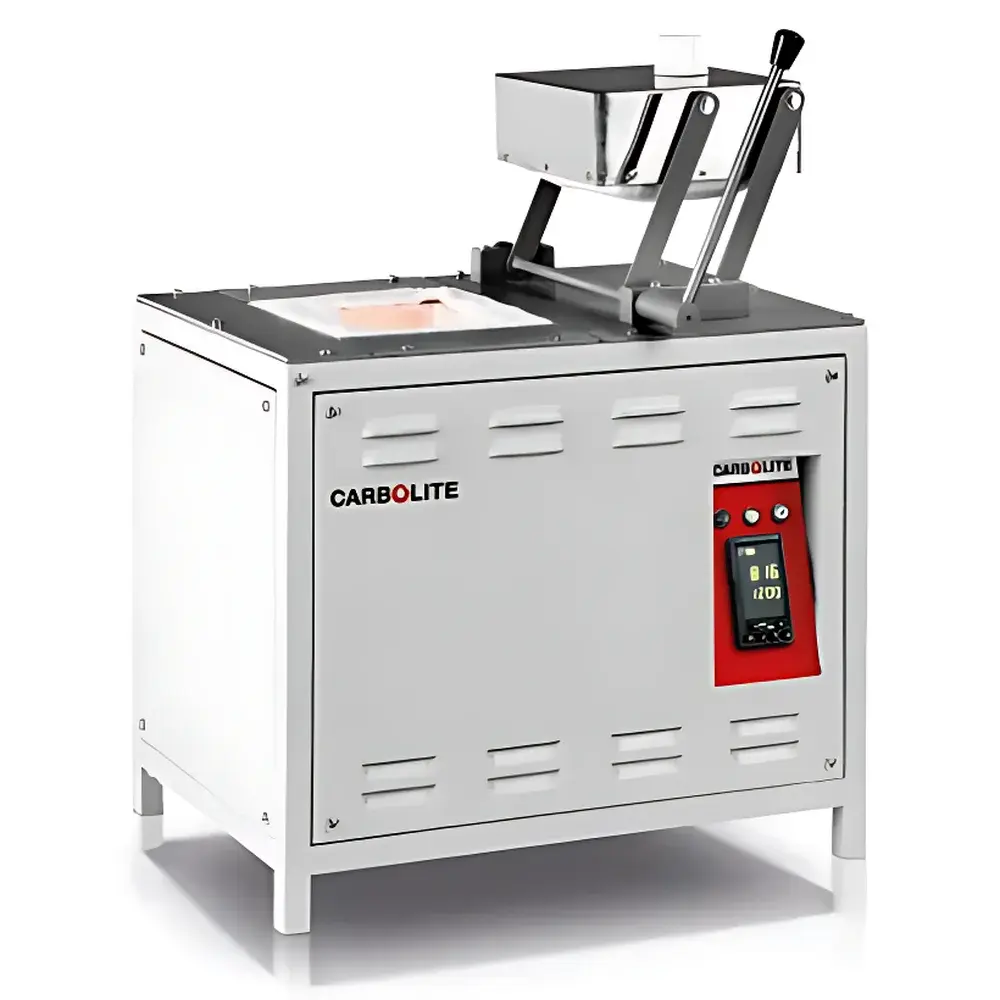
Carbolite Gero VCF 12/5/3508/P10 Top-Loading Box Muffle Furnace
| Brand | Carbolite Gero |
|---|---|
| Origin | United Kingdom |
| Model | VCF 12/5/3508/P10 |
| Type | Top-Loading Box Muffle Furnace |
| Max Operating Temperature | 1200 °C |
| Temperature Uniformity | ±5 °C (at setpoint, at center of chamber) |
| Chamber Internal Dimensions | 600 × 410 × 410 mm (L × W × H) |
| Chamber Volume | ~100 L |
| Heating Method | Radiant resistance wire (quadrilateral heating configuration) |
| Max Power Rating | 15 kW |
| Ramp Time to 1100 °C (no load) | ≤150 min |
| Standard Controller | PID301 single-segment programmable controller |
| Thermocouple Type | Ceramic-sheathed Type S (Pt/Pt–10% Rh) |
| Door Operation | Vertically hinged top-opening lid with counterbalanced mechanism |
| Panel Orientation | Tilt-adjustable front control panel |
Overview
The Carbolite Gero VCF 12/5/3508/P10 is a high-performance, top-loading box muffle furnace engineered for precision thermal processing in research laboratories, quality control environments, and industrial R&D settings. Designed around a robust refractory ceramic chamber and quadrilateral radiant heating architecture, it delivers exceptional temperature uniformity and long-term thermal stability across its full operating range up to 1200 °C. Unlike front-loading furnaces, the vertical top-hinged door enables unobstructed access to the entire chamber—critical when handling tall crucibles, heavy sintering fixtures, or large-volume ashing samples. The furnace complies with IEC 61000-6-3 (EMC) and IEC 61000-6-2 (immunity), and its structural design meets ISO 9001-aligned manufacturing protocols. It is not intended for vacuum or controlled-atmosphere operation unless externally interfaced with compatible gas manifolds and purge systems.
Key Features
- Top-hinged, counterbalanced lid with integrated safety interlock—ensures immediate power cutoff upon door opening and facilitates ergonomic sample loading/unloading.
- Quadrilateral heating system using high-purity Kanthal A1 resistance wire embedded in low-thermal-mass ceramic fiber insulation—minimizes thermal lag and improves energy efficiency during ramp-hold-cool cycles.
- Tilt-adjustable front control panel housing the PID301 digital controller—enables intuitive parameter entry and real-time monitoring under varying bench-height conditions.
- Ceramic-sheathed Type S thermocouple (Pt/Pt–10% Rh) mounted in a protected axial position—provides traceable calibration, extended service life (>2000 h at 1100 °C), and immunity to metal vapor contamination.
- Refractory chamber lined with alumina-silica ceramic fiber board (density ≥128 kg/m³)—resists thermal shock, maintains dimensional stability at repeated cycling, and minimizes particulate shedding.
- Standard overtemperature cut-off (optional configurable limit) compliant with EN 60519-2 for electrical safety in heating equipment.
Sample Compatibility & Compliance
The VCF 12/5/3508/P10 accommodates standard ASTM E1137 platinum, alumina, and silicon carbide crucibles (up to 150 mm height), as well as custom fixtures used in ash content determination (AOAC 942.05, ISO 2171), loss-on-ignition (LOI) analysis (ASTM C114), and pre-sintering of ceramic green bodies. Its chamber geometry supports uniform heat distribution per ISO 8501-3 Annex B requirements for thermal uniformity mapping. The furnace meets general laboratory safety standards per EN 61010-1 and is suitable for GLP-compliant workflows when paired with validated calibration procedures and audit-trail-capable data loggers. Note: For applications requiring regulatory traceability (e.g., pharmacopeial residue testing per USP ), optional 20-segment programming and RS232 interface enable integration into LIMS or electronic lab notebook (ELN) platforms.
Software & Data Management
While the standard PID301 controller operates independently, the optional RS232 serial interface allows bidirectional communication with external PCs running terminal-emulation software or custom SCADA interfaces. When equipped with the 20-segment programmable upgrade, users can define complex thermal profiles—including dwell times, ramp rates (0.1–30 °C/min), and conditional hold triggers—with timestamped execution logging. All temperature setpoints, actual readings, and alarm events are recordable at user-defined intervals (1–60 s). For FDA 21 CFR Part 11 compliance, third-party validation packages—including IQ/OQ documentation templates and electronic signature modules—are available through Carbolite Gero’s certified application engineers.
Applications
- Gravimetric ash analysis in food, feed, and environmental matrices (e.g., EPA Method 1650, ISO 1171).
- Thermal decomposition studies of polymers and composites under inert or oxidative atmospheres.
- Pre-firing of catalyst supports and ceramic substrates prior to coating or impregnation.
- Heat treatment of metallurgical samples for microstructural homogenization (e.g., ASTM E112 grain size standardization).
- Calibration reference source for secondary thermocouple verification (per ISO/IEC 17025 Clause 6.4.10).
- Residue quantification in pharmaceutical excipients per Ph. Eur. 2.2.34.
FAQ
What is the recommended maximum continuous operating temperature?
For optimal thermal element longevity and chamber integrity, continuous operation should be limited to ≤1100 °C—i.e., at least 100 °C below the rated maximum.
Can this furnace be used under inert gas purging?
Yes—provided appropriate inlet/outlet ports are added via optional flanged fittings and flow-controlled gas delivery systems are installed externally; the base unit is not gas-tight by default.
Is NIST-traceable calibration documentation included?
Factory calibration certificates (as-found/as-left) are supplied with each unit; full NIST-traceable calibration with uncertainty budgets requires optional on-site service or accredited third-party verification.
How often should the thermocouple be recalibrated?
Annual verification is recommended for GLP/GMP environments; more frequent checks (e.g., quarterly) are advised when processing high-value samples or operating near maximum temperature limits.
What maintenance is required for the heating elements?
No routine element replacement is needed under normal use; however, visual inspection for sagging or discoloration is advised every 500 operational hours, and ceramic fiber insulation integrity should be verified during scheduled chamber cleaning.



