
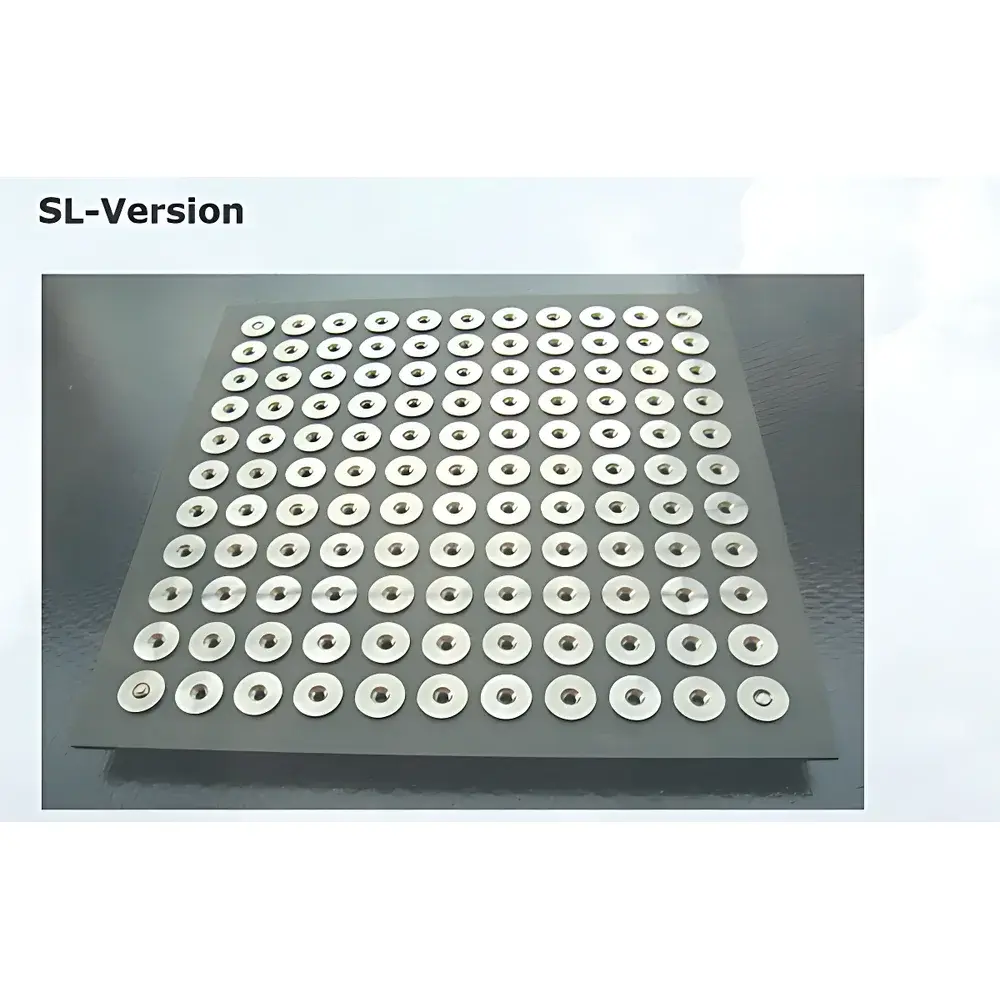
Carbon Vision SL-Series Carbon Fiber Optical Breadboard
| Brand | Carbon Vision |
|---|---|
| Origin | Germany |
| Model | SL-Version |
| Material | Full Carbon Fiber Composite |
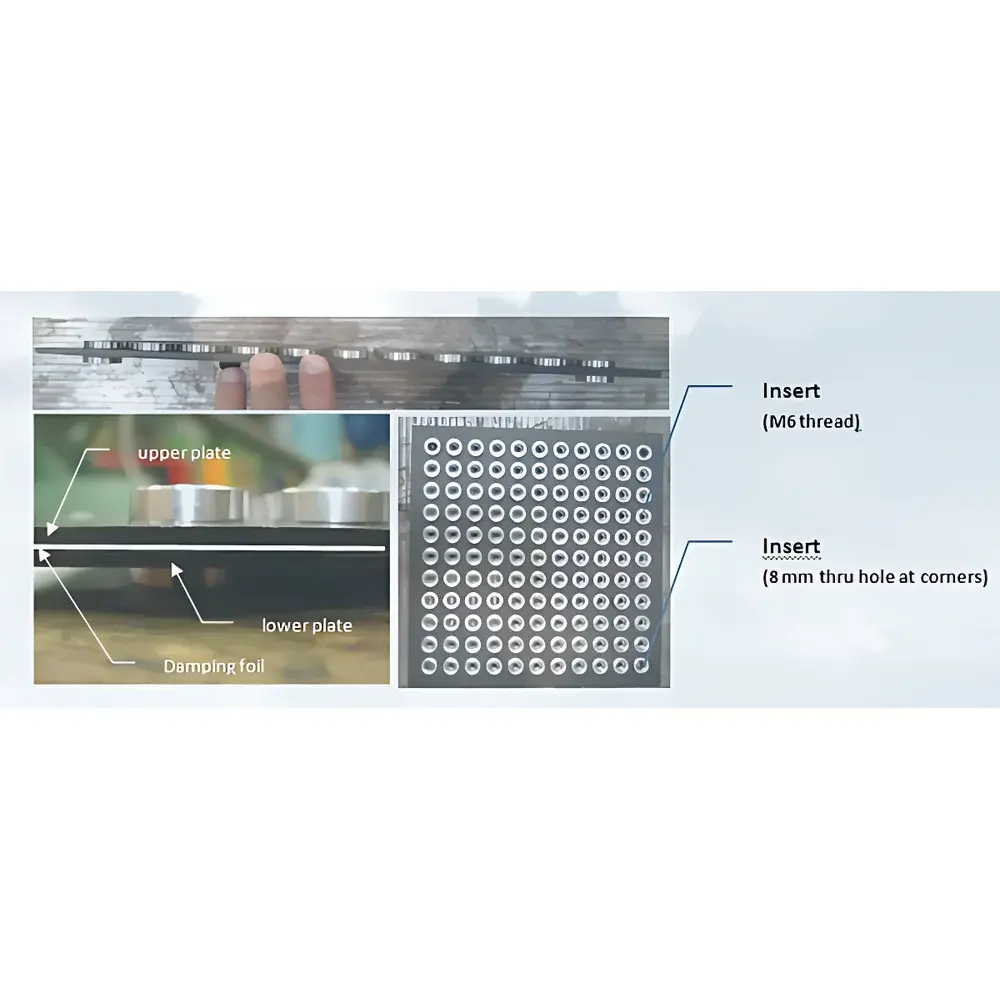
| Construction | Dual-Skin Top/Bottom Plates with Interlayer Damping Foil |
| Mounting Grid | M6 Threaded Inserts, 25 mm Pitch (Top Side) |
| Standard Thickness | 5 mm |
| Compliance | Non-Magnetic, Vacuum-Compatible, Corrosion-Resistant, Humidity-Independent |
Overview
The Carbon Vision SL-Series Carbon Fiber Optical Breadboard is an engineered platform solution designed for ultra-stable optical and precision metrology applications where mechanical damping, dimensional stability, and environmental resilience are critical. Unlike conventional aluminum or steel breadboards, the SL-Series employs a monolithic carbon fiber composite architecture—comprising top and bottom structural skins separated by a proprietary viscoelastic damping foil layer—to achieve intrinsic broadband vibration attenuation without compromising rigidity. Its operational principle relies on constrained-layer damping: kinetic energy from structural vibrations is dissipated as heat within the interlaminar foil, significantly reducing resonant amplification across 10 Hz–2 kHz. This makes the SL-Series particularly suited for quantum optics experiments, laser interferometry, vacuum-based nanoscale imaging, and space-qualified instrumentation where thermal drift, magnetic interference, or mass penalties must be minimized.
Key Features
- Ultra-low coefficient of thermal expansion (CTE ≈ 0.2 × 10⁻⁶ /K), <10% that of steel and ~25% that of aluminum—ensuring sub-micron positional stability over ±10 °C ambient fluctuations
- Specific stiffness (modulus/density) >3× higher than 6061-T6 aluminum—enabling high rigidity at only 25% of the mass of equivalent aluminum breadboards
- Structural damping ratio (η) ≥ 0.015 across fundamental bending modes—delivering up to 60% greater vibration suppression compared to standard steel optical tables under identical excitation conditions
- Non-magnetic, non-corroding, and insensitive to ambient humidity—certified for use in MRI-compatible labs, ultra-high vacuum (UHV) chambers (<10⁻⁹ mbar), and cleanroom environments (ISO Class 5)
- Integrated M6 threaded inserts on 25 mm grid—compatible with standard optomechanical components (e.g., kinematic mounts, post holders, translation stages) without requiring secondary adapters
Sample Compatibility & Compliance
The SL-Series is compatible with all standard optical and photonic components used in laboratory-scale setups—including HeNe and diode-pumped solid-state lasers, piezo-driven nanopositioners, CMOS/EMCCD cameras, and fiber-coupled detectors. It meets mechanical interface requirements per ISO 10360-2 (coordinate measuring machines) and supports traceable alignment in accordance with ISO/IEC 17025 calibration workflows. The carbon fiber substrate is inert to common solvents (IPA, acetone, ethanol) and exhibits no outgassing per ASTM E595—making it suitable for NASA- and ESA-approved vacuum applications. While not certified to a single harmonized standard, its material properties align with functional requirements specified in ISO 140-7 (vibration isolation), ISO 10137 (serviceability of sensitive equipment), and EU Directive 2014/30/EU (EMC immunity in low-interference environments).
Software & Data Management
No embedded firmware or proprietary software is required—the SL-Series operates as a passive mechanical platform. However, its dimensional stability and repeatable mounting geometry support high-fidelity integration into automated alignment systems using third-party motion controllers (e.g., Thorlabs Kinesis, Newport APT) and metrology software suites (e.g., MATLAB-based optical alignment algorithms, Zemax OpticStudio tolerance analysis). For GLP/GMP-regulated environments, batch-specific material certification (including CTE, flexural modulus, and damping loss factor test reports) can be supplied upon request to support audit trails and instrument qualification protocols (IQ/OQ/PQ).
Applications
- Aerospace-grade instrument mounting structures for satellite-borne interferometers and free-space quantum communication terminals
- Baseplates for ultra-stable laser cavities in frequency comb stabilization and optical clock development
- Vacuum-compatible optical benches in cryogenic scanning probe microscopy (SPM) and time-resolved photoemission electron microscopy (TR-PEEM)
- Local damping platforms mounted atop large granite or active isolation tables to isolate sensitive subsystems (e.g., single-photon detectors, superconducting nanowire arrays)
- Interferometric measurement systems requiring sub-nanoradian angular stability over 8-hour acquisition windows
FAQ
Is the SL-Series compatible with active vibration cancellation systems?
Yes—the low mass and high modal density of the SL-Series prevent coupling with low-frequency actuators; it functions effectively as a secondary isolation stage when mounted on active systems such as STACIS or Minus K platforms.
Can custom threading (e.g., M4 or 8-32 UNC) be specified?
Yes—custom insert patterns, thread types, and grid pitches are available under engineering consultation; lead time increases by 4–6 weeks.
What surface flatness tolerances are maintained across standard sizes?
Standard SL-series boards exhibit ≤15 µm peak-to-valley flatness over 300 × 300 mm areas, measured per ISO 10791-6 using a Zygo Verifire™ interferometer.
Does Carbon Vision provide finite element models for structural simulation?
Yes—validated ANSYS APDL and COMSOL Multiphysics® material property files (orthotropic elastic constants, damping matrix, thermal expansion tensor) are supplied with OEM orders.
Are there restrictions on maximum operating temperature?
Continuous operation is rated to +80 °C; short-term exposure up to +120 °C is permissible for ≤30 minutes without degradation of damping performance or dimensional integrity.




