
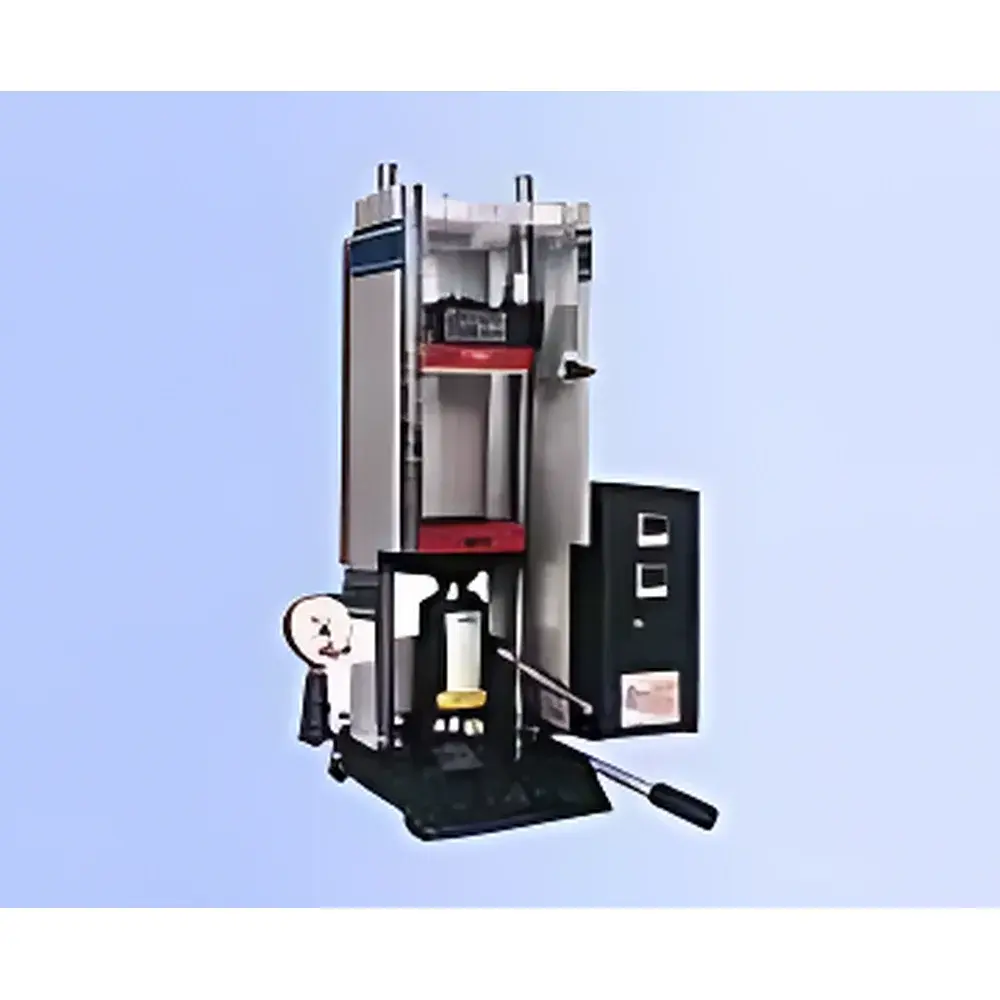
Carver 4386 CH Manual Hydraulic Heated Pellet Press
| Brand | Carver |
|---|---|
| Origin | USA |
| Model | 4386 CH |
| Type | Manual Hydraulic Pellet Press |
| Maximum Pressure | 12 tons (24,000 lbf) |
| Heating Capability | Electrically heated platens up to 343 °C |
| Platen Size | 6 in × 6 in |
| Platen Spacing | 0–15 in |
Overview
The Carver 4386 CH Manual Hydraulic Heated Pellet Press is a precision-engineered laboratory press designed for reproducible sample compaction under controlled thermal and mechanical conditions. Operating on the principle of hydraulic force transmission via hand-pumped oil displacement, it delivers consistent, calibrated pressure without reliance on external power sources for actuation—ideal for environments requiring operational simplicity, intrinsic safety, and minimal infrastructure dependency. Its integrated electric heating system enables precise, programmable thermal conditioning of samples during compression, supporting applications where thermomechanical coupling is critical—such as infrared (IR) spectroscopy pellet preparation, ceramic green-body formation, polymer composite consolidation, and pharmaceutical tablet prototyping. The press features a rigid dual-column cast-iron architecture, ensuring minimal frame deflection and high dimensional stability across repeated loading cycles. A certified safety viewing window allows real-time observation of sample deformation without compromising operator protection or thermal integrity.
Key Features
- Manual hydraulic operation with hand-lever pump—no electrical power required for pressure generation, eliminating risk of voltage-induced interference in sensitive analytical workflows
- Programmable digital temperature controller for independent platen heating, with setpoint accuracy ±2 °C and ramp/soak capability
- Electrically heated platens rated to 343 °C (650 °F), compatible with standard K-type thermocouples and traceable calibration protocols
- Dual-scale analog pressure gauge (psi and MPa) with vernier-style resolution for accurate manual pressure monitoring and documentation
- Adjustable platen spacing from 0 to 15 inches (381 mm), accommodating thick substrates, multi-layer assemblies, or custom tooling fixtures
- Reinforced cast-iron base and crosshead structure engineered for long-term rigidity and minimal creep under sustained load
- Integrated safety viewing window constructed from heat-resistant borosilicate glass with ASTM F2739-compliant impact rating
- Modular design supports optional accessories including water-cooled platens, vacuum-assisted die cavities, and ISO 17025-traceable load cell retrofit kits
Sample Compatibility & Compliance
The 4386 CH accommodates a broad range of solid and powdered materials—including metal oxides, geological specimens, polymers, pharmaceutical excipients, battery cathode precursors, and catalytic powders—without requiring solvent-based binders in many cases. Its uniform platen parallelism (±0.002 in over full surface) ensures homogeneous density distribution across pressed pellets, meeting ASTM E112, ISO 3252, and USP <1051> requirements for physical testing consistency. All heating components comply with UL 508A industrial control panel standards and CE marking directives for low-voltage equipment. Temperature controllers support NIST-traceable calibration logs, and the system’s mechanical design conforms to ANSI B11.19 machine safeguarding guidelines. When used in GLP/GMP-regulated laboratories, the press can be validated per IQ/OQ protocols using documented torque-pressure correlation curves and thermal mapping reports.
Software & Data Management
While the 4386 CH operates manually, its programmable temperature module includes RS-232 and optional USB interfaces for integration with laboratory information management systems (LIMS) or data acquisition platforms such as LabVIEW, MATLAB, or Python-based control scripts. Temperature profiles (setpoint, actual, ramp rate, dwell time) are timestamped and exportable in CSV format. For audit-ready environments, optional firmware upgrades enable 21 CFR Part 11-compliant electronic signatures, user access levels, and immutable audit trails for all thermal parameter changes. Calibration records—including pressure gauge verification certificates and thermocouple drift assessments—are stored within the controller’s non-volatile memory and retrievable via secure FTP.
Applications
- Preparation of KBr and polyethylene pellets for FTIR spectroscopic analysis per ASTM E1252 and ISO 18384
- Consolidation of ceramic and refractory powders into green bodies for sintering studies (ASTM C773)
- Compression testing of pharmaceutical powder blends under variable temperature conditions per USP <1217>
- Layered composite fabrication for battery electrode R&D, including solid-state electrolyte pressing
- Geological core sample encapsulation prior to XRF or XRD analysis
- Calibration standard production for hardness testers and densitometers requiring geometrically defined reference discs
- Thermoplastic and thermoset resin molding trials under isothermal or gradient thermal profiles
FAQ
Is the 4386 CH suitable for GMP-compliant manufacturing environments?
Yes—when equipped with optional audit-trail firmware and operated with documented calibration and maintenance procedures, it meets foundational requirements for equipment qualification in pharmaceutical and medical device labs.
Can I retrofit a load cell for digital pressure readout?
Carver offers factory-installed, ISO/IEC 17025-certified load cell kits compatible with the 4386 CH frame, providing traceable force measurement with ±0.5% full-scale accuracy.
What is the maximum recommended continuous operating temperature for the heating platens?
343 °C is the standard maximum for sustained operation; higher temperatures (up to 826 °C) require specialized platens (e.g., Carver 4128 variants) and are not supported on the 4386 CH model.
Does the safety viewing window obstruct infrared transmission for in-situ monitoring?
No—the borosilicate glass transmits >85% of mid-IR radiation between 2.5–5.0 µm, enabling real-time spectral observation during pressing when paired with appropriate FTIR accessories.
How often does the hydraulic oil require replacement?
Under normal laboratory use (≤50 cycles/week), Carver recommends oil replacement every 24 months or after 5,000 operating hours, per ISO 4406 cleanliness code monitoring.



