
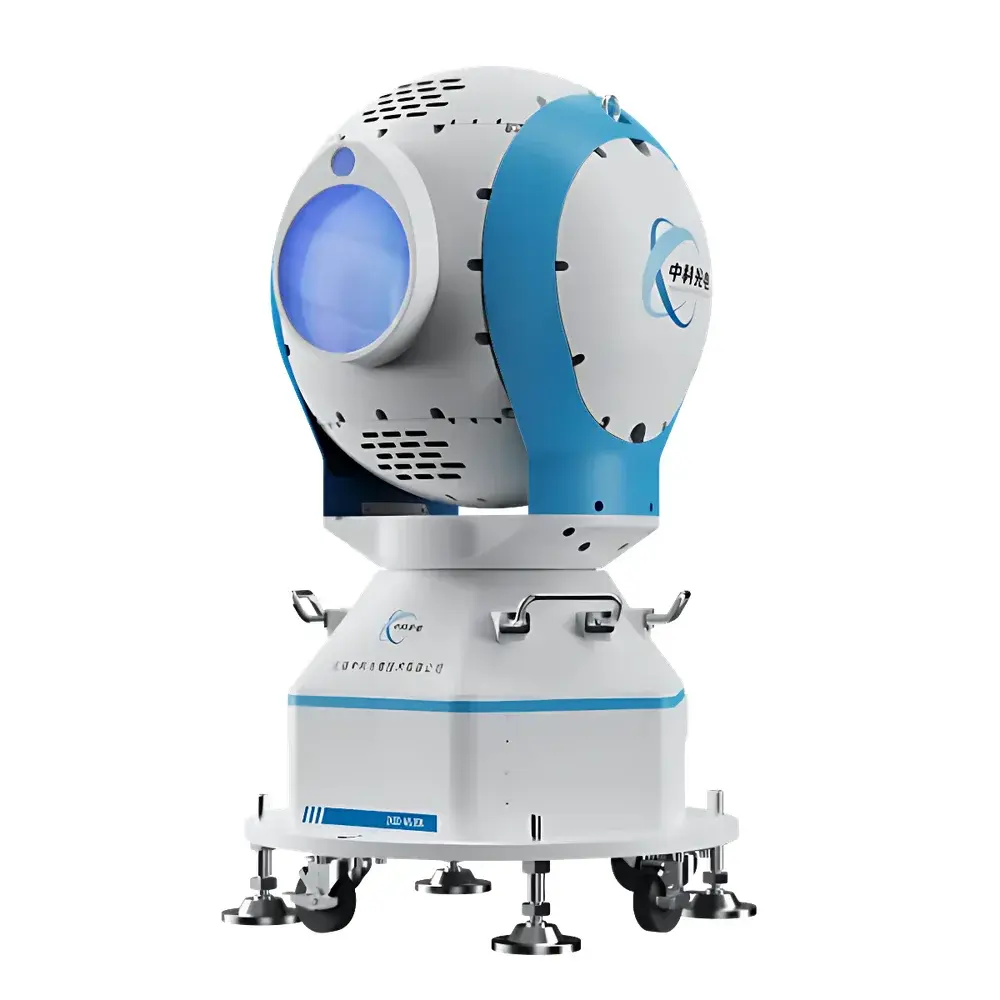
CASP ZKGD-WL-6000 Long-Range Wind Profiling Lidar
| Brand | CASP |
|---|---|
| Origin | Jiangsu, China |
| Manufacturer Type | Original Equipment Manufacturer (OEM) |
| Country of Origin | China |
| Model | ZKGD-WL-6000 |
| Pricing | Upon Request |
| Operating Wavelength | 1550 nm |
| Maximum Detection Altitude | ≥5 km (vertical), ≥20 km (horizontal) |
| Range Resolution | 15 m |
| Temporal Resolution | ≤1 s |
| Deployment Platforms | Ground-based fixed, vehicle-mounted, trailer-mounted |
| IP Rating | IP65 (enclosure), full environmental hardening for sandstorm, rain, snow, and icing conditions |
Overview
The CASP ZKGD-WL-6000 is a coherent Doppler wind lidar engineered for high-fidelity, long-range atmospheric wind profiling. Based on heterodyne detection of backscattered laser radiation at 1550 nm—within the eye-safe Class 1M spectral band—it measures radial velocity of atmospheric aerosols via the Doppler shift principle. Its design follows established atmospheric remote sensing standards, including ISO 21348 (space environment definitions) and IEC 60825-1 (laser safety), and complies with national meteorological observation specifications (QX/T 319–2016) for wind lidar performance validation. The system delivers vertical wind profiles up to 5 km and horizontal line-of-sight measurements beyond 20 km, supporting continuous, unattended operation under extreme ambient conditions—enabling quantitative wind vector reconstruction across mesoscale domains critical for operational meteorology and industrial risk mitigation.
Key Features
- Coherent Doppler detection architecture with 1550 nm single-frequency fiber laser source, optimized for atmospheric aerosol backscatter and minimal solar background interference
- High spatial resolution: 15 m range gate spacing, configurable vertical/horizontal binning for trade-off between signal-to-noise ratio and vertical resolution
- Sub-second temporal resolution: Capable of 1 Hz full-profile acquisition; configurable averaging modes support 0.1–10 Hz output rates for turbulence or gust analysis
- Multi-mode scanning capability: Predefined conical, vertical stare, RHI (range-height indicator), PPI (plan position indicator), and sector-scan patterns—fully programmable via embedded task scheduler
- Compact monolithic optical bench with active thermal stabilization and vibration-damped mounting; total system mass < 120 kg, footprint < 0.8 m²
- Environmental resilience: IP65-rated enclosure with internal dehumidification, heater-cooler subsystems, and anti-icing optics coating—validated for continuous operation at –25 °C to +50 °C and >95% RH
Sample Compatibility & Compliance
The ZKGD-WL-6000 requires no sample preparation: it operates on naturally occurring atmospheric particulates (PM10, sea salt, dust, smoke) as scattering targets. Its measurement traceability aligns with WMO Guide to Meteorological Instruments and Methods of Observation (CIMO Guide, Chapter 12) and supports data interoperability with global upper-air networks (e.g., E-PROFILE, GAW). All firmware and calibration procedures adhere to GLP-compliant documentation practices. System logs—including laser power, alignment status, and raw IQ data timestamps—are stored with UTC-synchronized metadata, enabling audit-ready records for regulatory submissions under ISO/IEC 17025 or national environmental monitoring accreditation frameworks.
Software & Data Management
Bundled with CASP WindView™ v4.x software suite, the instrument provides real-time visualization of wind speed/direction, vertical shear, turbulence intensity (σv), and boundary layer height. Raw I/Q signals are archived in NetCDF-4 format compliant with CF Metadata Conventions (v1.8), ensuring compatibility with Python (xarray, PyART), MATLAB, and WRF preprocessor tools. Remote access is enabled via TLS-secured SSH and HTTPS APIs; automated data push to FTPS or MQTT brokers supports integration into SCADA or cloud-based environmental dashboards. Audit trails record all user actions, parameter changes, and calibration events—meeting requirements for FDA 21 CFR Part 11–aligned electronic record integrity where applicable in aviation or energy-sector deployments.
Applications
- Wind Energy Assessment: Long-term shear profiling, wake characterization, and turbine-level inflow forecasting for site feasibility and power curve validation per IEC 61400-12-1 Ed.2
- Aviation Safety: Low-level wind shear (LLWAS) and microburst detection within 10 km of airport runways; integration with ATC systems via AIXM 5.1 schema
- Meteorological Forecasting: Assimilation of high-vertical-resolution wind profiles into numerical weather prediction models (e.g., WRF, ECMWF) to improve short-term convective initiation forecasts
- Wildfire Management: Real-time identification of fire-driven updrafts, plume rise estimation, and cross-boundary smoke transport modeling
- Environmental Impact Assessment (EIA): Baseline wind climatology generation and dispersion modeling input for industrial permitting under ISO 14040/14044 LCA frameworks
- Special Event Support: Mobile deployment for Olympic venues, air shows, or nuclear facility emergency response—providing rapid-deployment wind hazard mapping
FAQ
What atmospheric conditions limit detection range?
Performance degradation occurs only under near-zero aerosol loading (e.g., clean marine boundary layers or persistent stratospheric conditions); typical continental or coastal deployments maintain full 20 km horizontal range during daylight and nighttime.
Is the system certified for aviation use?
Yes—type-tested per RTCA DO-160G Section 21 (lightning indirect effects) and ETSI EN 301 489-17; formal FAA TSO authorization pending final field verification under AC 20-167A.
Can raw I/Q data be exported for custom processing?
Yes—full baseband digitized signals (16-bit, 100 MS/s) are accessible via PCIe interface or high-speed Ethernet; SDK includes C/C++ and Python bindings for spectral analysis and inversion algorithm development.
How is system alignment maintained during thermal cycling?
Active collimation control uses dual-axis piezoelectric tip-tilt mirrors with closed-loop feedback from quadrant photodiode monitoring—drift compensated within ±2 µrad over –20 °C to +45 °C.
Does the instrument meet cybersecurity standards for critical infrastructure?
Firmware implements NIST SP 800-193 (platform firmware resiliency) and supports FIPS 140-2 validated cryptographic modules for secure boot and encrypted data-at-rest.
Related Products







