
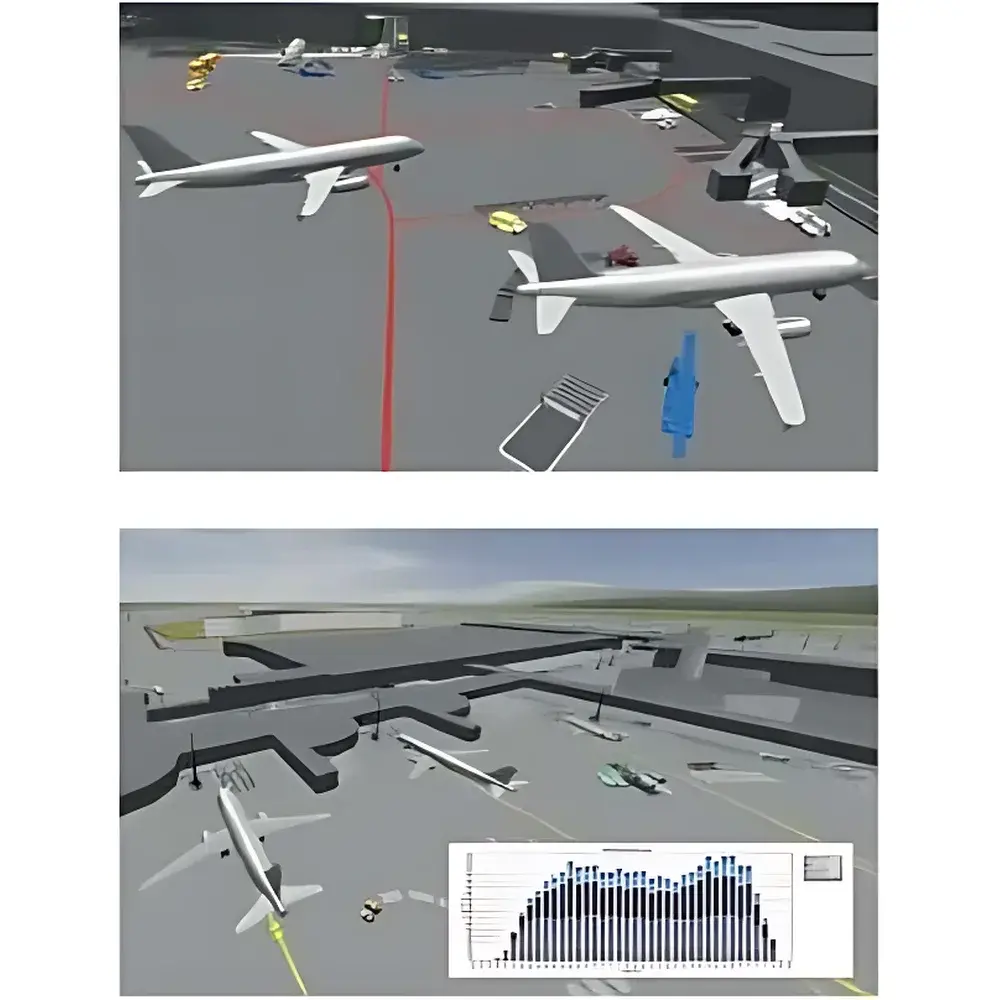
CAST Airport Ground Operations Simulation and Evaluation System
| Origin | Germany |
|---|---|
| Manufacturer Type | Authorized Distributor |
| Origin Category | Imported |
| Model | CAST |
| Pricing | Available Upon Request |
Overview
The CAST Airport Ground Operations Simulation and Evaluation System is a high-fidelity, agent-based discrete-event simulation platform engineered for strategic and tactical analysis of integrated airport surface operations. Built on a physics-informed 3D spatial engine, CAST models the dynamic interactions among aircraft, ground support equipment (GSE), airside vehicles, passenger flows, and ATC coordination logic in real time. It employs multi-agent system (MAS) architecture—where each entity (e.g., aircraft, tug, baggage cart, or passenger group) is instantiated with autonomous decision rules, state-dependent behaviors, and stochastic response parameters—to replicate emergent operational phenomena such as taxiway congestion, gate conflicts, ramp resource contention, and inter-airport connection dependencies. Unlike static capacity assessments or linear queuing models, CAST implements an open, directed multi-airport network topology that explicitly encodes inter-airport flight coupling (e.g., connecting passengers, shared crew scheduling, and interline baggage routing), enabling system-wide delay propagation analysis across hub-and-spoke or point-to-point networks.
Key Features
- Agent-Based Modeling Core: Each modeled entity possesses configurable attributes—including weight class, propulsion type, acceleration profile, service time distribution, and priority rules—allowing behaviorally accurate replication of heterogeneous ground movement patterns.
- Real-Time 3D Visualization Engine: GPU-accelerated rendering supports simultaneous display of aircraft trajectories, vehicle paths, pedestrian density heatmaps, and gate occupancy status at sub-second update intervals; all visual layers are georeferenced to ICAO-compliant airport layout data (AIXM 5.1 compatible).
- Multi-Airport Network Optimization Framework: Integrates capacity constraints (runway throughput, apron parking slots, de-icing pad availability) with inter-airport linkage constraints (minimum connection times, interline baggage transfer windows) to solve for system-optimal flow allocation using mixed-integer linear programming (MILP) solvers.
- Strategic Scenario Testing Suite: Supports parametric variation of demand profiles (hourly arrival/departure rates), infrastructure configurations (taxiway closures, new stand construction), staffing levels, and weather-induced capacity reductions to quantify resilience metrics under stress conditions.
- Regulatory Compliance Readiness: Output datasets conform to ICAO Annex 14 Vol. I & II reporting structures and support EASA AMC 20-23 / FAA AC 150/5200-37 documentation requirements for airport master planning and safety risk assessments.
Sample Compatibility & Compliance
CAST accepts standard aviation industry data formats including AIXM 5.1 for aerodrome geometry, IATA TIM for flight schedules, and ICAO Doc 9837-compliant GSE performance specifications. All simulation outputs—including delay distributions, resource utilization histograms, and conflict frequency matrices—are structured for direct ingestion into airport safety management systems (SMS) and comply with ISO/IEC 15408 (Common Criteria) evaluation assurance level EAL2+ for deterministic model verification. The system architecture supports audit trails aligned with ICAO Safety Management Manual (SMM) Chapter 4.5 for traceability of input assumptions, parameter adjustments, and scenario outcomes.
Software & Data Management
CAST operates on a client-server architecture with role-based access control (RBAC) and TLS 1.3 encrypted data transmission. Simulation projects are version-controlled via integrated Git-compatible repository management. All model runs generate immutable log files containing full state snapshots at user-defined intervals (e.g., per-minute or per-flight-event), supporting reproducibility and regulatory audit readiness. Export capabilities include CSV (for statistical post-processing), KML/KMZ (for GIS integration), and JSON-LD (for semantic interoperability with digital twin platforms). Optional FDA 21 CFR Part 11–compliant electronic signature modules are available for validation-critical environments requiring formal change control and user accountability.
Applications
- Airport master planning and infrastructure investment prioritization
- Pre-implementation validation of new ATC procedures (e.g., ASDE-X integration, RWSL deployment)
- Quantification of delay cost attribution across airlines, ground handlers, and ANSPs
- Safety risk assessment of proposed gate reassignments or taxiway reconfigurations
- Supporting ICAO Global Aviation Safety Plan (GASP) Key Performance Areas (KPAs) related to surface movement efficiency
- Training air traffic controllers and ramp coordinators using realistic, replayable operational scenarios
FAQ
Does CAST support integration with live airport operational databases (e.g., A-CDM or AODB)?
Yes—CAST provides certified ODBC and REST API interfaces for bidirectional synchronization with AODB, A-CDM, and flight information display systems (FIDS), enabling “digital twin” mode where simulation inputs are continuously updated from live feeds.
Can CAST simulate non-routine events such as runway incursions or emergency evacuations?
Yes—customizable event triggers and rule-based anomaly injection allow modeling of degraded modes, including unscheduled maintenance, bird strike delays, and contingency gate assignments, with full impact propagation across the network.
Is CAST validated against real-world airport operational data?
CAST has undergone third-party verification using historical ADS-B, MLAT, and surface surveillance logs from Frankfurt (EDDF), Zurich (LSZH), and Amsterdam (EHAM); mean absolute percentage error (MAPE) for taxi time prediction is ≤8.3% across 12-month validation periods.
What hardware configuration is required for large-scale multi-airport simulations?
Minimum recommended configuration: Dual Xeon Gold 6330 CPUs, 256 GB RAM, NVIDIA A100 40GB GPU; cluster deployment options support distributed memory parallelization across up to 32 nodes for continental-scale network simulations.




