
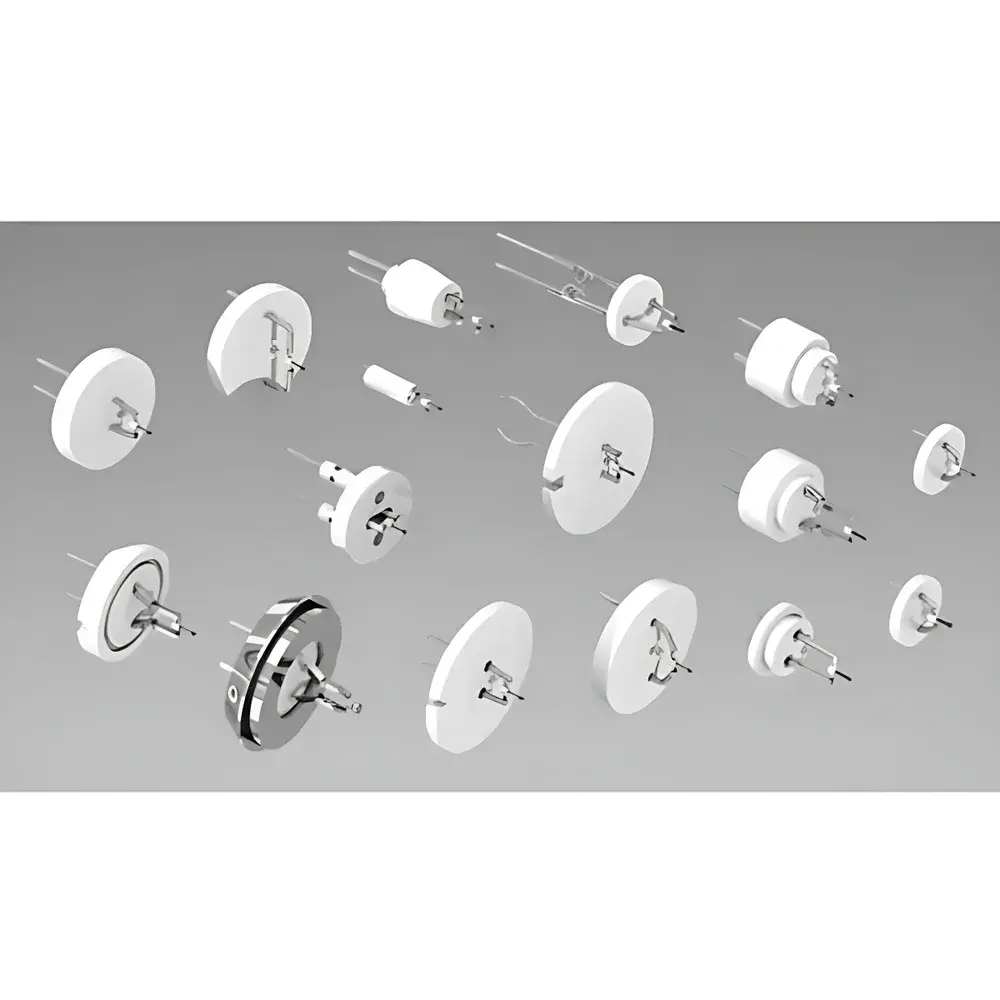
Cathode Emitter for Electron Microscopy – Kimball Physics LaB₆ and Refractory Metal Cathodes
| Brand | Kimball Physics |
|---|---|
| Base Compatibility | Zeiss, JEOL (JSM/GC/E), Hitachi S, Philips, Leica-AEI, PerkinElmer/ETEC, Camscan-AEI, Cameca-AEI, BioRad-AEI, Amray, VG-AEI |
| Cathode Materials | LaB₆ (single-crystal), CeB₆, Ta (tantalum disc), BaO-coated disc (low-temperature operation), Y₂O₃-coated Ir (poor-vacuum tolerant) |
| Base Types | Standard AEI ceramic, Compact CB-104 (Kimball Physics), Kovar/molybdenum pin variants, customer-supplied mount interface |
| Microflat Configurations | 60°–90° cone angles |
| microflat diameters | 6 µm, 15 µm, 20 µm (e.g., Code 60-06, 90-15, 90-20) |
| Richardson Constant | LaB₆ = 29 A·m⁻²·K⁻², CeB₆ = 3.6 A·m⁻²·K⁻² |
| Operating Vacuum | 1×10⁻⁶ Pa to 1×10⁻⁴ Pa (material-dependent) |
| Lifetime | >1,500 h (LaB₆, typical in UHV SEM/TEM conditions) |
| Certification | RoHS-compliant materials |
Overview
Kimball Physics cathode emitters are precision-engineered thermionic electron sources designed for integration into high-performance electron optical systems—including scanning electron microscopes (SEM), transmission electron microscopes (TEM), electron beam lithography tools, X-ray generators, free-electron lasers (FELs), and particle accelerators. These emitters operate on the principle of thermionic emission, where thermal energy excites electrons across the material’s work function barrier, generating a stable, high-brightness electron beam. The core performance metrics—brightness, coherence, emission stability, and operational lifetime—are directly governed by cathode material selection, crystallographic orientation, microflat geometry, base thermal/electrical design, and vacuum compatibility. Unlike field-emission guns (FEGs), thermionic cathodes offer robustness against moderate vacuum fluctuations and reduced sensitivity to residual gas adsorption, making them preferred for industrial QA/QC labs, multi-user facilities, and applications requiring long-term unattended operation.
Key Features
- Single-crystal lanthanum hexaboride (LaB6) cathodes with controlled orientation for optimal brightness and low angular divergence
- Customizable cone angle (60° or 90°) and microflat diameter (6 µm, 15 µm, 20 µm) to match column optics and desired probe current density
- High-tolerance ceramic bases (AEI-standard, CB-104 compact, or custom-machined) with precise thermal anchoring and low-resistance electrical feedthroughs
- Alternative emitter materials for specialized environments: CeB6 (lower evaporation rate), Ta discs (high melting point, cost-effective), BaO-coated discs (enhanced emission at cryogenic temperatures), and Y2O3-coated Ir discs (tolerant to pressures up to 1×10⁻⁴ Pa)
- Hermetically sealed packaging with inert-gas purge to preserve surface integrity prior to installation
- Full traceability documentation including crystallographic verification, emission testing reports, and base dimensional inspection certificates
Sample Compatibility & Compliance
These cathodes are mechanically and electrically compatible with major OEM electron microscope platforms, including Zeiss SIGMA/ULTRA series, JEOL JSM and JEM lines (K- and GC-type bases), Hitachi SU/S-4800, Philips/FEI legacy systems, Leica/AEI, PerkinElmer/ETEC EBL tools, and Camscan/Cameca microprobes. All cathodes comply with RoHS Directive 2011/65/EU for hazardous substance restrictions. Manufacturing adheres to ISO 9001:2015 quality management standards, with process controls validated for repeatable microflat fabrication, stoichiometric purity verification (via XRD and EDX), and emission stability screening under simulated operational thermal cycling. For regulated environments (e.g., pharmaceutical TEM analysis per USP or semiconductor metrology per SEMI E10), cathode lot records support GLP/GMP audit trails.
Software & Data Management
While cathode emitters are hardware components without embedded firmware, their integration supports full traceability within instrument control ecosystems. Kimball Physics provides digital emission characterization reports (PDF + CSV) containing measured I-V curves, brightness vs. temperature profiles, and lifetime degradation trends under standardized test conditions (e.g., constant power mode at 1,800 K). These datasets are structured for import into laboratory information management systems (LIMS) or electron microscope vendor software (e.g., JEOL JSM-IT or Thermo Fisher Avizo) for correlation with imaging performance metrics. Optional NIST-traceable calibration services include beam current linearity validation and brightness mapping via Faraday cup arrays, supporting ISO/IEC 17025-compliant instrument qualification.
Applications
- High-resolution SEM imaging and EDS/WDS microanalysis where signal-to-noise ratio demands sustained brightness >10⁶ A·cm⁻²·sr⁻¹
- Transmission electron microscopy (TEM) illumination systems requiring uniform Köhler illumination and minimal chromatic aberration
- Electron beam lithography (EBL) tools operating at 10–100 kV, where beam stability over multi-hour exposure sequences is critical
- In-situ TEM holders with integrated heating/cooling stages, leveraging BaO-coated or Y2O3/Ir cathodes for stable emission under dynamic vacuum and temperature gradients
- Industrial X-ray sources for non-destructive testing (NDT), where Ta or LaB6 cathodes enable high-duty-cycle pulsed operation
- Accelerator injector systems requiring high charge-per-pulse consistency and low emittance growth
FAQ
What vacuum level is required for optimal LaB6 cathode operation?
LaB6 cathodes perform best at ≤1×10⁻⁶ Pa (UHV range). Operation above 1×10⁻⁴ Pa significantly accelerates boron depletion and reduces lifetime. Y2O3/Ir variants extend usable range to ~1×10⁻⁴ Pa.
Can I retrofit a Kimball Physics cathode into an older Philips or AEI SEM?
Yes—standard AEI ceramic bases and replacement codes (e.g., “VG-AEI” or “Philips EM400”) are dimensionally and electrically matched to legacy columns. Mechanical fit verification is recommended prior to purchase.
How is emission current stability monitored during routine use?
Stability is assessed via real-time filament current monitoring and secondary electron yield tracking using the microscope’s built-in Faraday cup or beam current meter. Drift exceeding ±2% over 8 hours indicates cathode aging or contamination.
Are custom microflat geometries available for non-standard column designs?
Yes—Kimball Physics offers full custom engineering, including non-standard cone angles, asymmetric microflats, and hybrid base interfaces (e.g., direct-mount to custom flanges or water-cooled holders).




