
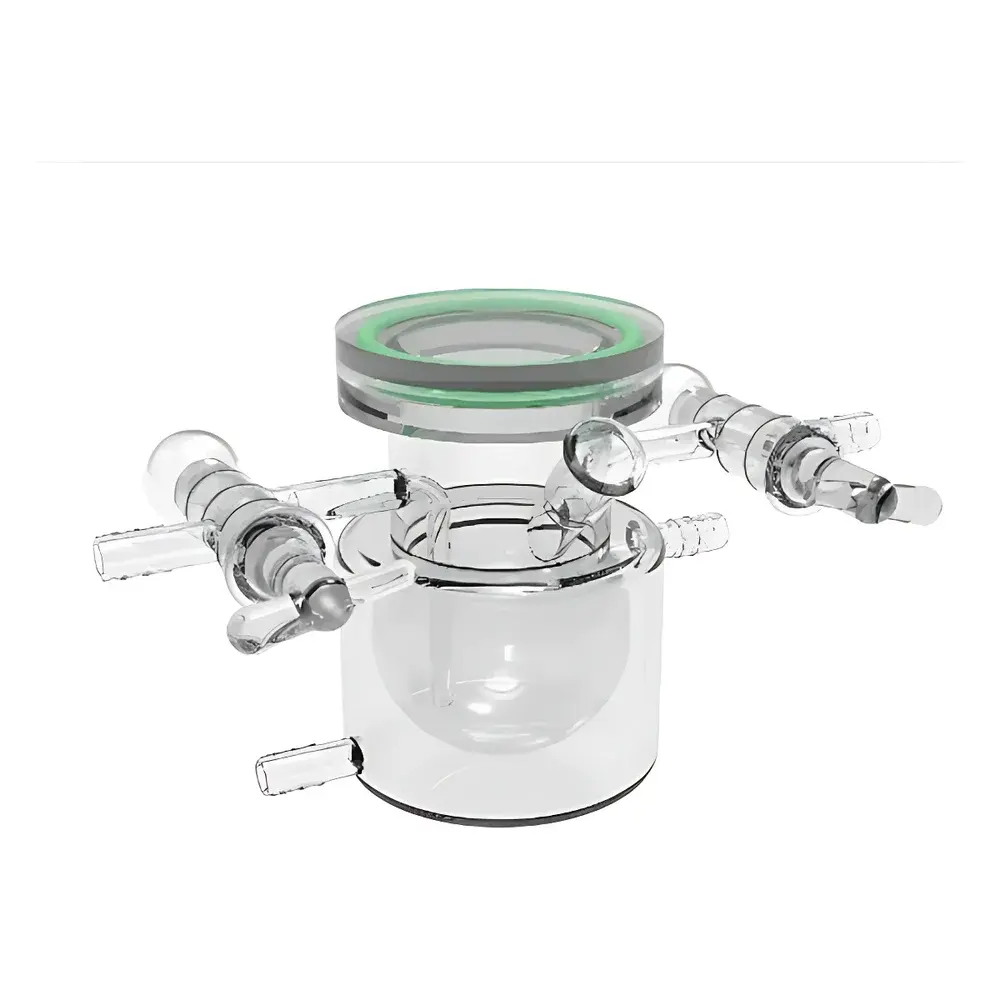
CEL-APR250H-3 / CEL-APR100H-3 Integrated Photochemical Reactor with Temperature Control
| Brand | CEAULIGHT (Zhongjiaojinyuan) |
|---|---|
| Origin | Beijing, China |
| Manufacturer Type | Direct Manufacturer |
| Product Origin | Domestic (China) |
| Model | CEL-APR250H-3 / CEL-APR100H-3 |
| Light Source Type | Broadband UV–Vis Lamp (Xenon or Mercury Arc Compatible) |
| Irradiation Mode | External Illumination |
| Construction Material | Borosilicate Glass (3.3) |
| Cooling/Heating Jacket | Integrated Double-Wall Water Circulation Sleeve |
| Gas Handling | Bottom-Inlet Gas Delivery Tube with Inline Glass Stopcock |
| Sampling Ports | Two Standardized Septum-Piercing Inlets (GL14/GS14) |
| Optical Window | UV-Grade Fused Silica (≥185 nm Transmission) |
| Sealing | DIN 2769 Flange with Viton O-Ring |
| Reaction Volume | 100 mL (CEL-APR100H-3) / 250 mL (CEL-APR250H-3) |
| Operating Pressure | Ambient (1 atm), Non-Pressurized Configuration |
Overview
The CEL-APR250H-3 and CEL-APR100H-3 are benchtop integrated photochemical reactors engineered for precise control of both optical irradiation and thermal conditions during heterogeneous and homogeneous photocatalytic reactions. These systems operate on the principle of external illumination—where a collimated or focused broadband light source (e.g., high-intensity xenon or mercury arc lamp) is directed through a high-transmittance fused silica viewport onto the reaction mixture contained within a borosilicate glass vessel. The reactor’s double-wall jacket enables active temperature regulation via external recirculating chiller or heater (±0.5 °C stability typical under steady-state flow). Designed for reproducible photochemical kinetics studies, each unit supports gas-phase reactant introduction, real-time headspace sampling, and in situ monitoring under ambient pressure—making them suitable for fundamental research in solar fuel synthesis, environmental remediation, and mechanistic photochemistry.
Key Features
- Monolithic borosilicate glass construction (DIN/ISO-compliant tubing and joints) ensures chemical inertness toward acids, bases, and organic solvents across pH 1–14.
- Integrated thermostatic jacket with standardized inlet/outlet ports (¼” NPT) compatible with standard laboratory chillers (e.g., Huber, Julabo) and temperature controllers.
- Bottom-fed gas delivery tube extends to the vessel base, minimizing bubble coalescence and maximizing interfacial contact area between gaseous reagents (e.g., CO₂, H₂O vapor, O₂) and photocatalyst suspension.
- Dual septum-piercing sampling ports (GL14 thread) allow sequential liquid-phase extraction or headspace gas sampling without system venting—critical for time-resolved product quantification (e.g., H₂, O₂, CH₄ by GC-TCD/FID).
- UV-grade fused silica window (10 mm thickness, ≥90% transmission at 254 nm, ≥85% at 185 nm) maintains spectral fidelity and withstands thermal shock during prolonged irradiation.
- DIN 2769 flanged sealing interface with fluorocarbon (Viton®) elastomer gasket provides leak-tight operation up to 0.5 bar gauge pressure and complies with ISO 2852 mechanical integrity requirements.
Sample Compatibility & Compliance
These reactors accommodate suspensions of powdered photocatalysts (e.g., TiO₂ P25, g-C₃N₄, MOFs), colloidal quantum dots, and molecular photosensitizers in aqueous or mixed-solvent media. Solid loading concentrations up to 2 g·L⁻¹ are supported without clogging. The design conforms to general laboratory safety standards for Class I non-pressurized photochemical apparatus (per IEC 61000-4-3 EMI immunity and EN 61010-1 electrical safety). While not certified for explosion-proof use, the absence of internal electronics or ignition sources renders them appropriate for use with flammable gases (H₂, CH₄) when operated inside certified fume hoods meeting ANSI Z9.5 ventilation guidelines. Documentation supports GLP-aligned experimental traceability when paired with validated lamp power meters and calibrated thermistors.
Software & Data Management
As hardware-only platforms, the CEL-APR series does not include embedded firmware or proprietary software. Temperature logging is performed externally using industry-standard data acquisition systems (e.g., NI CompactDAQ, Keysight 34972A) interfaced via PT100 or thermistor inputs. Light intensity monitoring requires separate radiometric calibration—typically using NIST-traceable UV-A/UV-C photodiode sensors (e.g., International Light ILT2400) positioned at the viewport plane. All mechanical interfaces follow ISO metric threading and DIN flange dimensions, enabling integration into automated reactor networks governed by LabVIEW or Python-based control scripts compliant with ASTM E2500-13 (verification of computerized systems).
Applications
- Photocatalytic water splitting for stoichiometric H₂/O₂ evolution under simulated solar irradiation (AM 1.5G).
- CO₂ photoreduction to C₁ products (CO, CH₄, CH₃OH) using Ru/Ir-based co-catalysts in aqueous or gas-phase configurations.
- Advanced oxidation processes (AOPs) for degradation of pharmaceuticals, dyes, and endocrine disruptors under UV–Vis activation.
- Photoelectrochemical precursor screening—compatible with immersed working electrodes and reference electrodes (e.g., Ag/AgCl) via auxiliary port adaptation.
- Quantum yield determination per ISO 10193 and IUPAC recommendations, leveraging dual-wavelength actinometry (ferrioxalate, potassium iodide).
FAQ
Is the reactor compatible with vacuum or positive pressure operation?
No—these models are designed strictly for ambient-pressure use. For pressurized photochemical studies, consider the CEL-APR300HP series with reinforced quartz body and ISO-KF vacuum flanges.
Can the fused silica window be replaced with other optical materials?
Yes—custom windows (e.g., MgF₂ for deep-UV <170 nm, CaF₂ for IR extension) can be supplied upon request, subject to dimensional compatibility and thermal expansion matching.
What light sources are recommended for optimal spectral match?
Xenon short-arc lamps (e.g., 300 W, AM1.5G-filtered) for solar simulation; mercury vapor lamps (e.g., 125 W Hg-Xe) for discrete-line UV excitation; LED arrays require collimation optics to ensure uniform irradiance across the 35 mm viewport diameter.
Does the system include temperature feedback control?
No—the jacket is passive; users must supply an external PID-controlled chiller/heater with flow rate ≥1.5 L·min⁻¹ and temperature stability ≤±0.3 °C.
Are spare parts and consumables available internationally?
Yes—Viton O-rings, GL14 septa, fused silica windows, and replacement glass vessels are stocked in EU and US distribution hubs with lead times ≤10 business days.




