
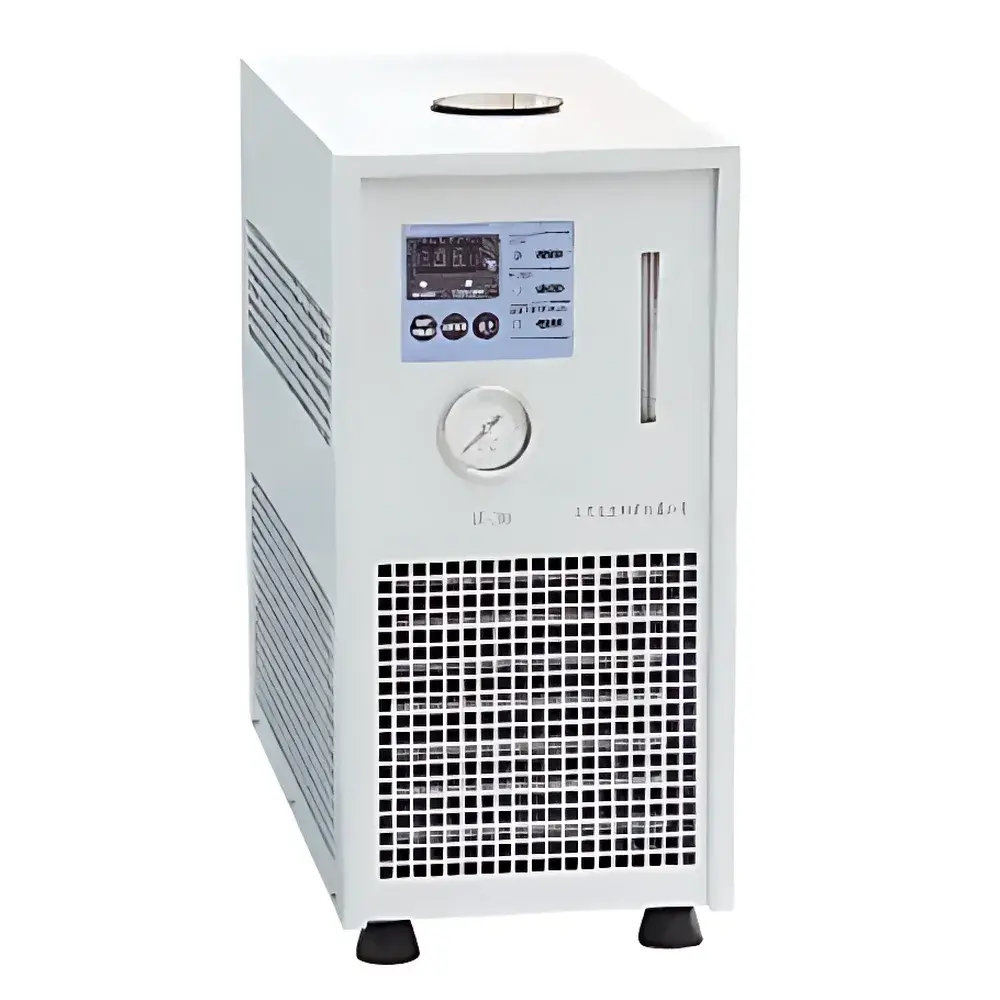
CEL-CR300 Circulating Chiller by CEA (China Education Goldsource)
| Brand | CEA |
|---|---|
| Origin | Beijing, China |
| Manufacturer Type | Direct Manufacturer |
| Product Category | Domestic |
| Model | CEL-CR300 |
| Instrument Type | Integrated Circulating Chiller |
| Cooling Method | Water-cooled Compressor-based Refrigeration |
| Temperature Control Range | −10 to 35 °C |
| Temperature Stability | ±0.1 °C |
| Refrigeration Capacity | 300 W |
| Circulation Pump Pressure | 0.6–0.8 bar |
| Flow Rate | 15 L/min |
| Reservoir Volume | 4 L |
| Operating Mode | Continuous Duty |
| Display | Real-time Digital Readout of Temperature, Pressure & Liquid Level |
| Enclosure | Sealed Reservoir & Closed-Loop Tubing |
| Inlet/Outlet Ports | Stainless Steel, Ø25 mm |
| Weight | 30 kg |
| Dimensions (W×D×H) | 230 × 475 × 475 mm |
Overview
The CEL-CR300 Circulating Chiller is an integrated, compressor-based temperature control system engineered for precision thermal management in laboratory environments. It operates on a closed-loop refrigeration cycle, utilizing R134a or equivalent eco-compliant refrigerant to actively cool and stabilize heat-transfer fluid—typically deionized water or water-glycol mixtures—within its 4-liter stainless-steel reservoir. The chiller circulates the conditioned fluid via a high-efficiency, brushless DC pump delivering up to 15 L/min at a maximum pressure of 0.8 bar, enabling reliable thermal coupling with analytical instruments such as UV-Vis spectrophotometers, HPLC column ovens, laser sources, vacuum pumps, and small-scale reactors. Its dynamic PID-controlled temperature regulation achieves ±0.1 °C stability across the full operating range of −10 °C to +35 °C, supporting both active cooling and precise ambient-temperature maintenance. Designed for continuous 24/7 operation, the CEL-CR300 features a compact footprint (230 × 475 × 475 mm), making it suitable for benchtop integration in space-constrained labs without compromising thermal performance or system reliability.
Key Features
- Integrated design with built-in compressor, evaporator, expansion valve, condenser, reservoir, and circulation pump — no external components required
- Digital LED interface displaying real-time temperature, system pressure, and liquid level; intuitive navigation for setpoint adjustment and mode selection
- Dynamic PID temperature control algorithm optimized for rapid thermal response and minimal overshoot during load transients
- Hermetically sealed reservoir and fully enclosed fluid path prevent evaporation, oxidation, and particulate contamination of coolant
- Stainless steel inlet/outlet ports (Ø25 mm) compatible with standard Swagelok, Camlock, or reinforced silicone tubing; supports quick-connect adaptors for diverse instrument interfaces
- Multi-stage safety architecture including over-temperature cutoff, low-level fluid alarm, high-pressure shutdown, and motor overcurrent protection
- Low-noise operation (<55 dB(A) at 1 m) achieved through vibration-dampened compressor mounting and acoustic insulation
Sample Compatibility & Compliance
The CEL-CR300 is compatible with aqueous and low-viscosity water-glycol solutions (up to 30% v/v). It is not intended for use with organic solvents, oils, or corrosive fluids. Its closed-loop architecture ensures compatibility with instruments requiring stable, non-oxidizing coolant delivery—particularly those sensitive to thermal drift or microbubble formation. While not certified to UL/CSA or CE for medical device applications, the unit conforms to IEC 61010-1:2010 for electrical safety in laboratory equipment. Its temperature stability and repeatability meet typical requirements for ASTM E2923 (Standard Practice for Calibration of Temperature-Controlled Baths) and ISO/IEC 17025-accredited calibration workflows when used with traceable reference thermometers.
Software & Data Management
The CEL-CR300 operates as a standalone analog/digital hybrid controller with no embedded firmware or network connectivity. All operational parameters are configured locally via front-panel buttons and displayed in real time. For laboratories requiring audit-ready records, optional external data loggers (e.g., Omega OM-DAQPRO-5300 or Keysight 34972A) may be connected via the unit’s analog 0–5 V or 4–20 mA output signals (available upon request with OEM configuration). These outputs correspond to measured temperature and pump status, enabling integration into LabVantage, Empower, or custom SCADA systems. The absence of onboard software eliminates cybersecurity vulnerabilities and simplifies 21 CFR Part 11 compliance when paired with validated third-party logging infrastructure.
Applications
- Thermal stabilization of optical components in spectroscopy and interferometry systems
- Cooling of high-power LED arrays and diode lasers in photobiomodulation and materials processing setups
- Temperature control of HPLC autosampler trays, detector cells, and column ovens to ensure retention time reproducibility
- Heat dissipation for rotary evaporators, vacuum pumps, and small-scale electrochemical cells
- Supporting GLP-compliant dissolution testing apparatus where bath temperature uniformity must remain within ±0.2 °C per USP <724>
- Preconditioning of samples or sensors prior to mechanical or thermal characterization
FAQ
What is the recommended coolant type for the CEL-CR300?
Deionized water is preferred for optimal heat transfer and corrosion resistance. For sub-zero operation (−10 °C to 0 °C), a 30% propylene glycol/water mixture is advised to prevent freezing while maintaining viscosity and thermal conductivity.
Can the CEL-CR300 be used in a vertical orientation or mounted on a rack?
No. The unit must be operated in its designated horizontal benchtop position to ensure proper refrigerant phase distribution and oil return to the compressor.
Is remote monitoring or control possible?
Not natively. However, analog voltage/current outputs can be interfaced with external PLCs or data acquisition systems for supervisory monitoring and alarm relay triggering.
What maintenance intervals are recommended?
Visual inspection of tubing and connections every 3 months; reservoir cleaning and coolant replacement every 6–12 months depending on usage frequency and ambient dust levels; annual professional service check of refrigerant charge and compressor performance is advised.
Does the CEL-CR300 support external temperature feedback from the user’s instrument?
No. It operates in internal-sensor mode only. For cascade or master-slave configurations, an external temperature controller with analog setpoint input capability is required.



