
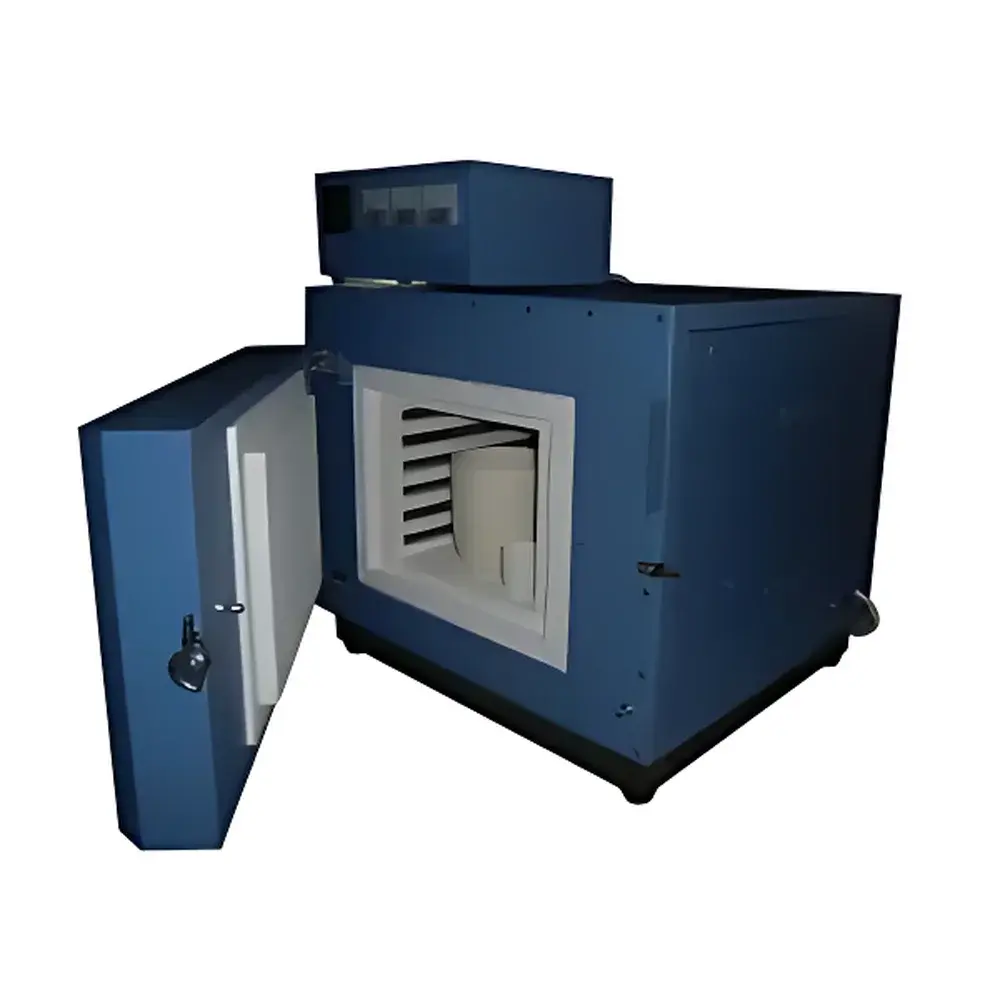
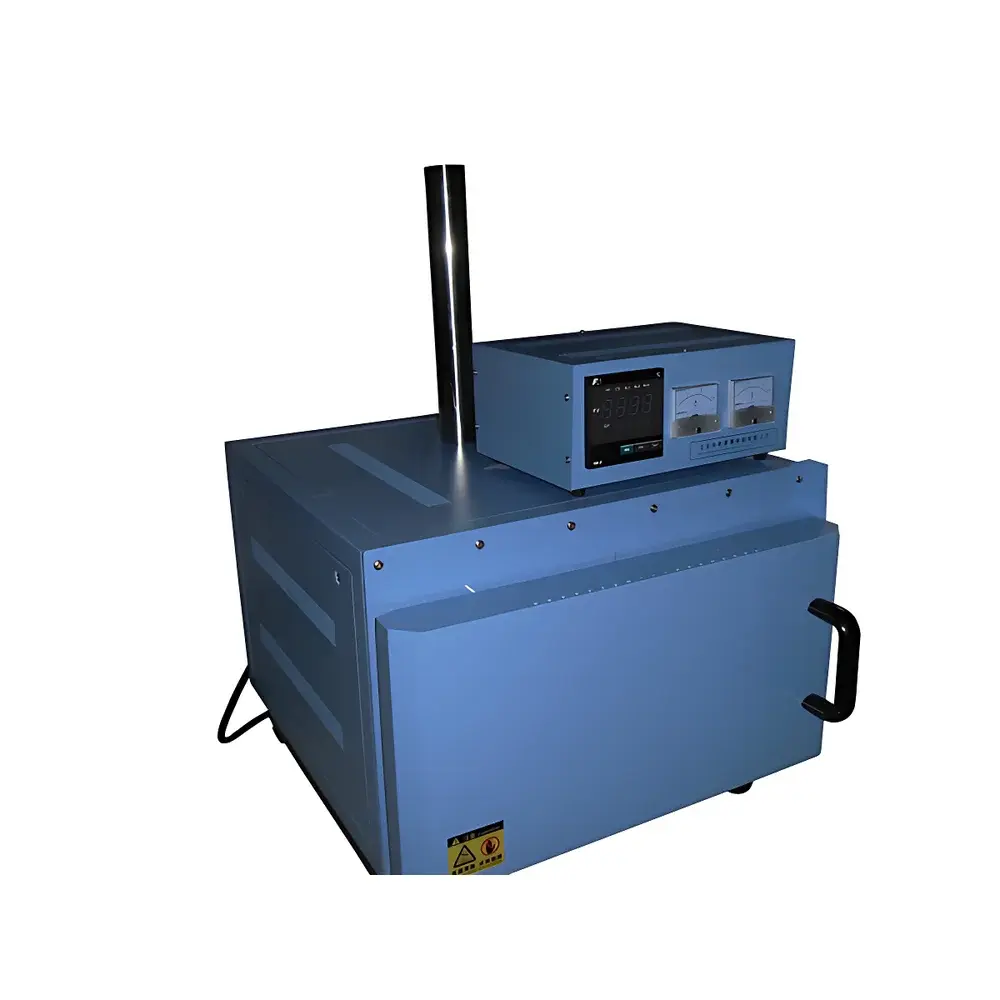
Zhongke Aobo TL3014 High-Temperature Box Furnace
| Brand | Zhongke Aobo |
|---|---|
| Model | TL3014 |
| Type | Box-Type Muffle Furnace |
| Max Temperature | 1400 °C |
| Temperature Control Accuracy | ±1 °C |
| Rated Power | 7.5 kW |
| Heating Rate to Max Temp | 80 min |
| Heating Method | Resistance Wire (High-Temp Alloy) |
| Internal Chamber Dimensions | 400 × 300 × 250 mm (L×W×H) |
| Chamber Volume | 30 L |
| Insulation | Ceramic Fiber Module |
| Power Supply | 380 V, 3-Phase, 16 A |
Overview
The Zhongke Aobo TL3014 is a high-performance, laboratory-grade box-type muffle furnace engineered for precise thermal processing across materials science, analytical chemistry, pharmaceutical QA/QC, and industrial R&D environments. Designed around a robust ceramic fiber insulation architecture and dual-side embedded resistance heating elements, the furnace delivers rapid, uniform, and repeatable heating up to 1400 °C—enabling ashing, calcination, sintering, heat treatment, and thermal gravimetric sample preparation under controlled ambient or inert gas conditions. Its modular construction separates the furnace chamber from the intelligent temperature controller, facilitating serviceability and minimizing thermal coupling between electronics and the hot zone. The TL3014 complies with fundamental safety and performance expectations aligned with IEC 61000-6-3 (EMC emissions) and IEC 61000-6-2 (immunity), and its operational parameters support method validation under ISO/IEC 17025-accredited laboratories.
Key Features
- High-efficiency ceramic fiber insulation: Reduces external surface temperature to ≤55 °C at 1000 °C hold, improving operator safety and energy efficiency by ~40% versus traditional brick-lined furnaces.
- Dual-sided heating configuration: Enables symmetrical thermal distribution across the 30 L chamber (400 × 300 × 250 mm), minimizing axial and radial temperature gradients (<±3 °C at setpoint).
- Precision digital temperature control: Equipped with an imported PID-based controller featuring 0.1 °C resolution, programmable ramp-soak profiles (up to 30 segments), and auto-tuning functionality.
- Modular, service-oriented design: Independent controller housing allows field replacement without disassembling the furnace body; heating elements are accessible via side panels for rapid maintenance.
- Enhanced process flexibility: Standard rear-mounted exhaust port (M12 thread) supports optional gas inlet/outlet fittings for nitrogen, argon, or air purging—critical for ashing protocols per ASTM D3174 or ISO 1171.
- Robust electrical architecture: 3-phase 380 V / 16 A input ensures stable power delivery during extended high-temperature holds; integrated over-temperature cutoff, short-circuit protection, and door-safety interlock meet EN 60519-1 requirements.
Sample Compatibility & Compliance
The TL3014 accommodates crucibles, boats, and trays up to Ø90 mm × 60 mm height, supporting standard silica, alumina, and platinum ware. It is routinely deployed in regulated workflows including USP (ash residue), EPA Method 2540E (total solids ignition), ASTM E119 (fire-resistance testing pre-conditioning), and coal analysis per ASTM D3172–D3176. While not certified to UL or CE as a complete system, its component-level compliance with RoHS, REACH, and IEC 60335-1 (household safety) provides traceable documentation for internal GLP/GMP audits. Optional data logging modules enable 21 CFR Part 11-compliant electronic records when paired with validated software.
Software & Data Management
The furnace operates via standalone front-panel interface with real-time temperature display, alarm status, and profile memory (10 user-defined programs). For advanced integration, optional RS485 Modbus RTU output enables connection to SCADA systems or LIMS platforms. Third-party software (e.g., LabVIEW, MATLAB, or custom Python scripts) can acquire time-stamped temperature data at 1 Hz resolution. Audit trail functionality—including operator ID, parameter changes, and event timestamps—is available through add-on firmware modules compliant with ALCOA+ data integrity principles.
Applications
- Thermal decomposition of organic matrices in environmental samples (soil, sludge, filter media) prior to elemental analysis (ICP-OES/MS).
- Residue-on-ignition (ROI) determination in pharmaceutical excipients and active ingredients per Ph. Eur. 2.2.33.
- Calibration and conditioning of reference materials used in thermogravimetric analyzers (TGA) and differential scanning calorimeters (DSC).
- Pre-sintering of ceramic green bodies and metal oxide precursors in battery material R&D.
- Standardized ashing of food, feed, and botanicals per AOAC 942.05 and ISO 2171.
- Heat treatment of calibration standards for radiation thermometry (ITS-90 fixed points).
FAQ
What is the recommended maintenance interval for the heating elements?
Heating elements should be visually inspected every 200 operating hours at ≥1200 °C; replacement is typically required after 1,500–2,000 hours at 1400 °C under continuous operation.
Can the TL3014 be operated under vacuum or reducing atmospheres?
No—this model is rated for ambient air or inert gas purge only. Vacuum or hydrogen-compatible variants require custom engineering (e.g., water-cooled flanges, quartz viewports, and specialized seals).
Is the temperature uniformity verified and documented?
Uniformity is characterized per ASTM E2203 using a 9-point thermocouple mapping procedure at 1000 °C and 1400 °C; as-shipped units include a factory verification report showing ≤±3 °C deviation across the working zone.
Does the furnace support remote monitoring via Ethernet or Wi-Fi?
Not natively—but RS485 Modbus output allows integration with industrial gateways (e.g., Siemens Desigo, Ignition SCADA) for networked supervision and alarm forwarding.
What crucible materials are compatible at 1400 °C?
Alumina (Al₂O₃) crucibles rated ≥1600 °C and silicon carbide (SiC) boats are recommended; avoid quartz above 1100 °C and stainless steel entirely.



