
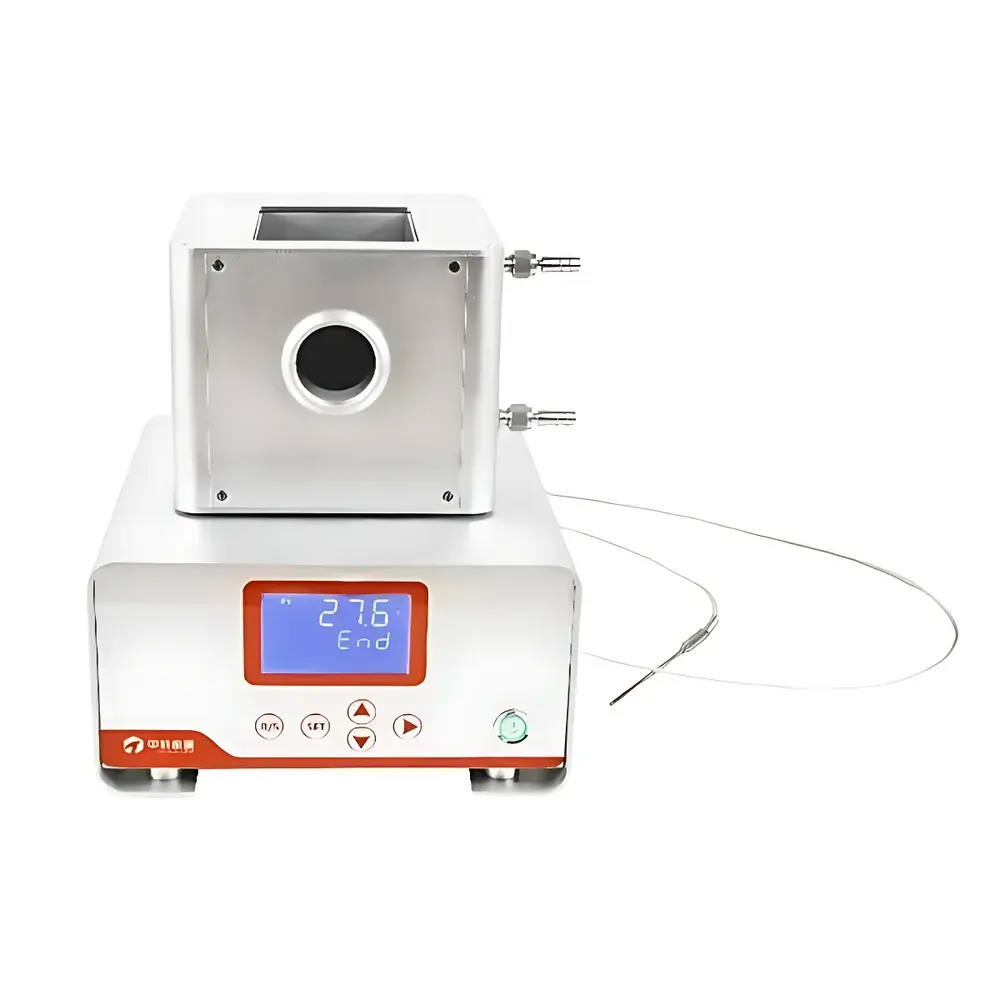
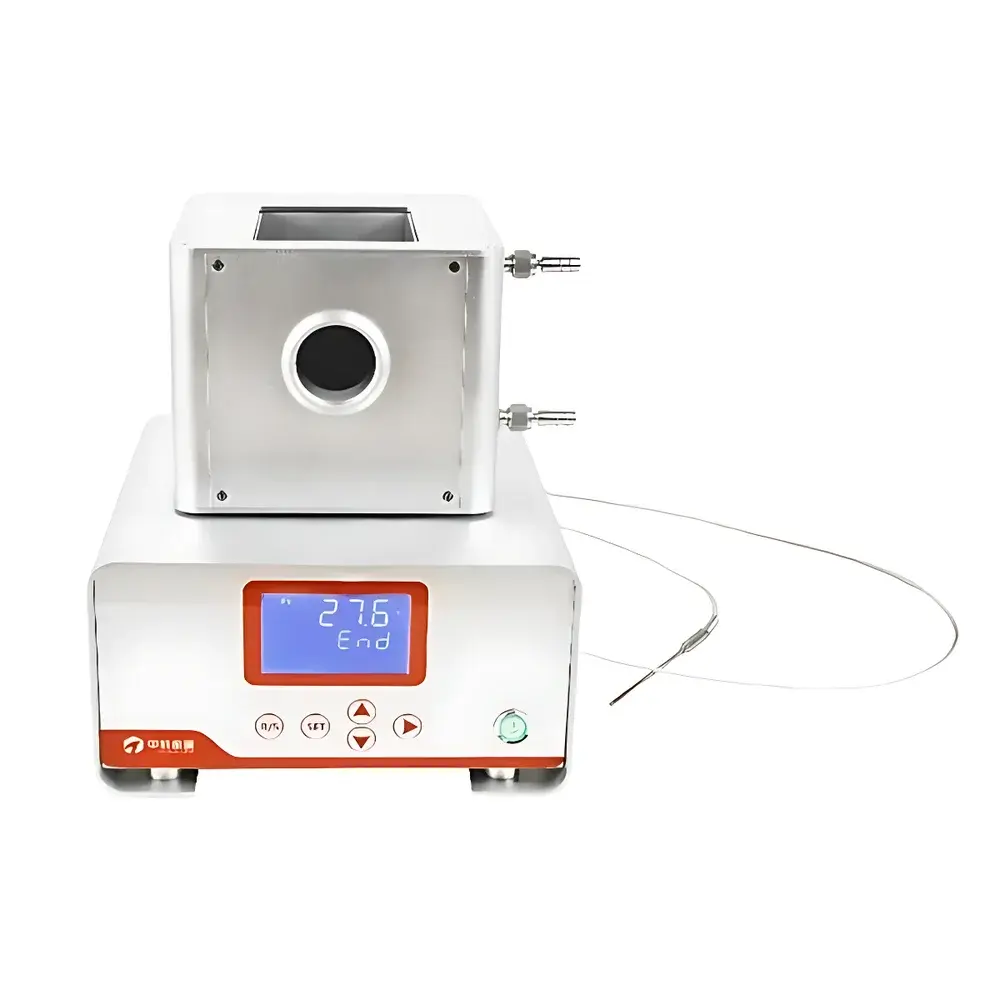
CEL-CWKT Reaction Vessel Dedicated Circulating Temperature Control Base
| Brand | CEL (Zhongjiao Jinyuan) |
|---|---|
| Model | CEL-CWKT |
| Origin | Beijing, China |
| Manufacturer | Zhongjiao Jinyuan Co., Ltd. |
| Type | Domestic Laboratory Temperature Control Platform |
| Temperature Range Options | (1) –10 °C to 95 °C |
| Temperature Stability | ±0.1 °C |
| Circulating Medium Volume | 500 mL |
| Max Operating Pressure | 0.6 MPa |
| Power Input | 200–240 V AC, 50–60 Hz, 150 W |
| Built-in Magnetic Stirring | Up to 1500 rpm |
| Display | LCD with dual-channel readout (setpoint temperature & vessel temperature, both resolved to 0.1 °C) |
| Compatible Reactor Series | CEL-HPR100T, CEL-MPR100/KPR100, CEL-HPR250T, CEL-MPR250/KPR250, CEL-HPR250S, HPRS-PEC250 |
| Optional External Chillers | HX105 (–10 °C to 95 °C), CH-3012S (–30 °C to 200 °C) |
| External Dimensions (L×W×H) | 245 × 239 × 235 mm |
Overview
The CEL-CWKT Reaction Vessel Dedicated Circulating Temperature Control Base is an engineered thermal management platform designed specifically for laboratory-scale photochemical, catalytic, and synthetic reaction systems using standardized high-pressure or parallel reaction vessels. Unlike conventional heating mantles or immersion baths, the CEL-CWKT employs a closed-loop external circulation architecture—where temperature-controlled fluid (e.g., water, silicone oil, or ethanol-based coolant) is actively pumped through a thermally conductive base plate beneath the reactor vessel. This design enables precise heat transfer via conduction across the vessel’s bottom surface while minimizing thermal gradients, evaporation losses, and localized hot spots. The system operates on the principle of forced-convection thermal equilibrium, delivering stable, repeatable temperature control across a broad operational range—from cryogenic conditions at –30 °C up to high-temperature synthesis at 200 °C—making it suitable for exothermic screening, kinetic studies, and multi-step sequential reactions requiring strict thermal protocol adherence.
Key Features
- High-stability temperature regulation with ±0.1 °C accuracy across full operating range, verified under steady-state load conditions.
- Integrated magnetic stirring motor (1500 rpm maximum) co-located within the base unit, eliminating need for separate stir plates and reducing footprint and alignment complexity.
- Dual-sensor real-time monitoring: independent measurement of setpoint temperature and actual vessel-bottom temperature, both displayed simultaneously on a backlit LCD interface with 0.1 °C resolution.
- Modular compatibility with multiple CEL reactor platforms—including HPR, MPR, KPR, and PEC-series vessels—enabling standardized thermal control across 100 mL and 250 mL configurations.
- Robust stainless-steel housing with sealed internal fluid pathways rated to 0.6 MPa, supporting safe operation with pressurized reactors under inert or reactive atmospheres.
- Low-power consumption (150 W nominal) optimized for continuous unattended operation in regulated laboratory environments.
Sample Compatibility & Compliance
The CEL-CWKT base is mechanically and thermally calibrated for use with CEL’s standard reactor families: CEL-HPR100T, CEL-MPR100/KPR100 (100 mL variants); CEL-HPR250T, CEL-MPR250/KPR250, CEL-HPR250S, and HPRS-PEC250 (250 mL variants). All compatible vessels feature standardized flange geometry and thermal contact area dimensions, ensuring uniform heat transfer efficiency. The system supports common circulating media—including deionized water, glycol-water mixtures, silicone oils (e.g., DC200 series), and low-viscosity alcohols—selected per required temperature range and chemical compatibility. While not certified to ISO/IEC 17025 or ASTM E2877, the platform meets general laboratory equipment safety requirements per IEC 61010-1:2010 and is routinely deployed in GLP-compliant research labs where traceable temperature control and audit-ready operational logs are maintained via external data acquisition systems.
Software & Data Management
The CEL-CWKT operates as a standalone hardware platform with no embedded microcontroller-based software stack. Temperature setpoints, stirring speed, and real-time sensor outputs are managed exclusively through its front-panel LCD interface. For integration into automated workflows or long-duration experiments, analog voltage outputs (0–5 V or 4–20 mA, configurable upon request) are available for external DAQ systems. When paired with optional chiller units (HX105 or CH-3012S), users may leverage manufacturer-provided PC software (e.g., CH-Series LabView-compatible drivers) to log temperature profiles, generate time-stamped reports, and synchronize thermal events with spectroscopic or gas chromatographic data acquisition—supporting 21 CFR Part 11–aligned metadata tagging when used with validated LIMS environments.
Applications
- Photocatalytic hydrogen evolution and CO₂ reduction assays requiring precise thermal stabilization during illumination cycles.
- Kinetic profiling of heterogeneous catalysis under controlled isothermal conditions from sub-zero to near-supercritical liquid-phase regimes.
- Parallel reaction screening across multiple 100 mL or 250 mL vessels with synchronized thermal ramping and hold protocols.
- Material synthesis involving temperature-sensitive precursors (e.g., metal–organic frameworks, quantum dots) where narrow ΔT tolerance prevents decomposition or phase segregation.
- Method development for USP or -compliant compounding processes requiring documented thermal consistency in small-batch reactors.
FAQ
What circulating fluids are recommended for –30 °C operation?
Ethanol–water mixtures (e.g., 40% ethanol by volume) or specialized low-temperature heat transfer fluids (e.g., Dowtherm J) are recommended. Silicone oils are unsuitable below –10 °C due to viscosity-induced flow resistance.
Can the CEL-CWKT be used with non-CEL reactors?
Mechanical compatibility is limited to vessels with identical bottom diameter (Ø90 mm for 100 mL models; Ø110 mm for 250 mL models) and flat, polished stainless-steel bases. Thermal performance cannot be guaranteed outside CEL’s validated reactor lineup.
Is the magnetic stirrer speed adjustable independently of temperature control?
Yes—the LCD interface provides separate rotary encoder controls for temperature setpoint and stirring speed, enabling decoupled optimization of mixing intensity and thermal profile.
Does the base include overtemperature or dry-run protection?
The unit incorporates thermal cutoff fuses and flow-sensing logic when connected to optional chillers (HX105/CH-3012S); however, standalone operation lacks active dry-run detection. Users must ensure minimum fluid level in the external reservoir before activation.
How is calibration traceability established?
CEL provides factory calibration certificates referencing NIST-traceable RTD probes. End-users are advised to perform periodic verification using a calibrated handheld thermometer inserted into the vessel’s thermal well or immersed in the circulating loop.



