
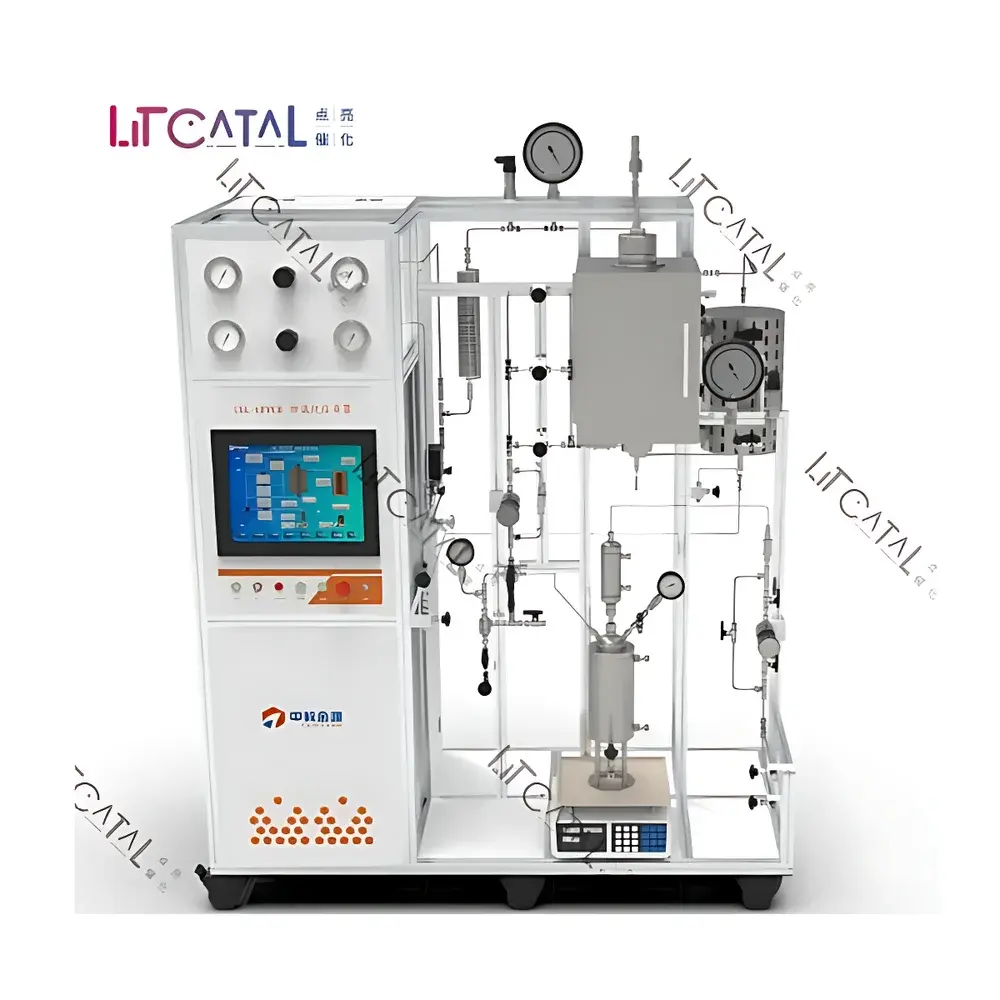
CEL-GPPCH Custom Hydrogenation Catalyst Evaluation System
| Brand | CEAULIGHT |
|---|---|
| Origin | Beijing, China |
| Manufacturer Type | OEM Manufacturer |
| Country of Origin | China |
| Model | CEL-GPPCH Custom Hydrogenation Catalyst Evaluation System |
| Pricing | Available Upon Request |
| Dimensions | 1410 mm × 730 mm × 1664 mm |
| Construction Material | ASTM A312 TP316L Stainless Steel |
| Reactor Temperature Range | 0–300 °C (precision oil-bath heating) |
| Vaporizer Temperature Range | 0–600 °C |
| Tubing Trace Heating Range | 0–200 °C |
| Maximum Operating Pressure | <10 MPa |
| Liquid Feed Flow Rate | 0.1–5 mL/min |
| Gas Feed Flow Rate | 0–500 sccm (expandable gas channels) |
| Catalyst Bed Volume | <100 mL |
| Mass Measurement | 0–15 kg (0.1 g resolution) |
| Safety Systems | Proportional pressure relief valve, rupture disc, independent overtemperature alarm with hardwired interlock |
| Data Acquisition | Real-time logging, automated report generation, GLP-compliant audit trail |
Overview
The CEL-GPPCH Custom Hydrogenation Catalyst Evaluation System is a fully integrated, software-controlled fixed-bed catalytic reactor platform engineered for rigorous kinetic and stability assessment of heterogeneous hydrogenation catalysts under industrially relevant conditions. It operates on the principle of continuous-flow heterogeneous catalysis, where gaseous H₂ and/or liquid substrates are co-fed through a temperature- and pressure-regulated catalyst bed housed in a 316L stainless steel reactor. The system supports gas-phase, liquid-phase, and gas–liquid–solid triphasic reaction modes—enabling precise simulation of hydroprocessing, fine chemical hydrogenation, and biomass upgrading environments. Its modular architecture allows configuration-specific adaptation—including extended gas train integration, high-pressure liquid injection, or inline cold-trap condensate collection—while maintaining full compliance with ASME B31.3 process piping standards and ISO 13849-1 functional safety requirements for laboratory-scale pressurized systems.
Key Features
- Precision temperature control via dual-zone oil-bath heating: reactor zone (0–300 °C, ±0.5 °C stability) and vaporizer zone (0–600 °C, ±1.0 °C), both with independent PID tuning and real-time ramp/soak programming
- Integrated trace-heated stainless steel tubing (0–200 °C) to prevent condensation and ensure quantitative delivery of volatile feeds
- Redundant safety architecture: ASME-certified rupture disc, proportional back-pressure regulator, and hardwired thermal cutoffs at all critical nodes (reactor, vaporizer, condensate receiver)
- Automated mass monitoring using industrial-grade load cell (0–15 kg, 0.1 g resolution) synchronized with time-stamped condensate accumulation data
- Modular gas distribution manifold supporting up to six independently controlled gas channels (H₂, N₂, Ar, CO, NH₃, etc.), each equipped with mass flow controllers (MFCs) calibrated per ISO 6344
- Industrial-grade 15.6″ IP65-rated touch-panel PC running embedded Windows IoT with deterministic real-time I/O scanning (≤100 ms cycle time)
Sample Compatibility & Compliance
The CEL-GPPCH accommodates powdered, extruded, or pelletized catalysts with particle sizes ranging from 20 µm to 5 mm and total bed volumes up to 100 mL. It accepts aqueous, organic, and multiphase feedstocks—including chlorinated solvents, amine-containing streams, and sulfur-laden model compounds—without compromising material integrity or measurement fidelity. All wetted parts conform to ASTM A312 TP316L specifications for corrosion resistance in reducing and mildly acidic environments. The system meets CE Machinery Directive 2006/42/EC, PED 2014/68/EU (Category II), and complies with laboratory implementation requirements for ISO/IEC 17025:2017 accredited testing facilities. Optional validation packages support IQ/OQ documentation aligned with FDA 21 CFR Part 11 and EU Annex 11 for regulated R&D workflows.
Software & Data Management
Control and data acquisition are managed through CEAULIGHT’s proprietary CatalystLab™ v4.2 software suite—a deterministic SCADA environment built on OPC UA architecture. It provides synchronized logging of >128 process variables (temperature, pressure, flow, mass, valve position) at user-defined intervals (100 ms–5 min). Raw data exports in HDF5 and CSV formats include embedded metadata (operator ID, method version, calibration timestamps). Automated report generation includes customizable templates compliant with ASTM D3226, ISO 10723, and USP guidelines. Audit trails record all parameter changes, manual overrides, and system events with SHA-256 hashing and immutable timestamping—fully traceable for GLP/GMP internal audits.
Applications
- Hydrodesulfurization (HDS) and hydrodenitrogenation (HDN) catalyst screening under simulated refinery conditions
- Kinetic modeling of asymmetric hydrogenation reactions for pharmaceutical intermediate synthesis
- Long-term stability testing (≥500 h) of supported Pd, Pt, Ni, and Ru catalysts under cyclic thermal and compositional stress
- In situ product quantification via direct coupling to GC-FID, GC-TCD, or GC-MS systems using heated transfer lines (up to 250 °C)
- Reaction calorimetry integration for ΔH estimation via real-time enthalpy balance calculations
- Co-feeding studies evaluating hydrogen inhibition effects in tandem catalytic systems
FAQ
Can the CEL-GPPCH operate under true high-pressure hydrogenation conditions (>5 MPa)?
Yes—the system is rated for continuous operation up to 10 MPa with appropriate MOC verification; standard configurations include dual-stage pressure regulation and leak-tested weldments per ISO 15848-1 Class A.
Is remote monitoring and control supported?
Yes—CatalystLab™ supports secure TLS 1.3-enabled remote access via VPN or corporate SSO; no cloud dependency or external telemetry is enabled by default.
How is catalyst loading and unloading performed safely?
The reactor employs a top-access quick-clamp flange with integrated purge ports; optional inert-gas purging and residual H₂ detection (0–1000 ppm H₂ sensor) are available for safe catalyst exchange.
Does the system support integration with TPR/TPD analyzers?
Yes—dedicated gas inlet/outlet ports with Swagelok VCR fittings and standardized 1/4″ OD tubing interfaces enable seamless connection to commercial chemisorption instruments (e.g., Micromeritics AutoChem, Thermo Scientific TPDRO).
What validation documentation is provided with delivery?
Each unit ships with Factory Acceptance Test (FAT) report, material test reports (MTRs) for all 316L components, NIST-traceable calibration certificates for all sensors, and a complete wiring and P&ID package in PDF and AutoCAD formats.



