
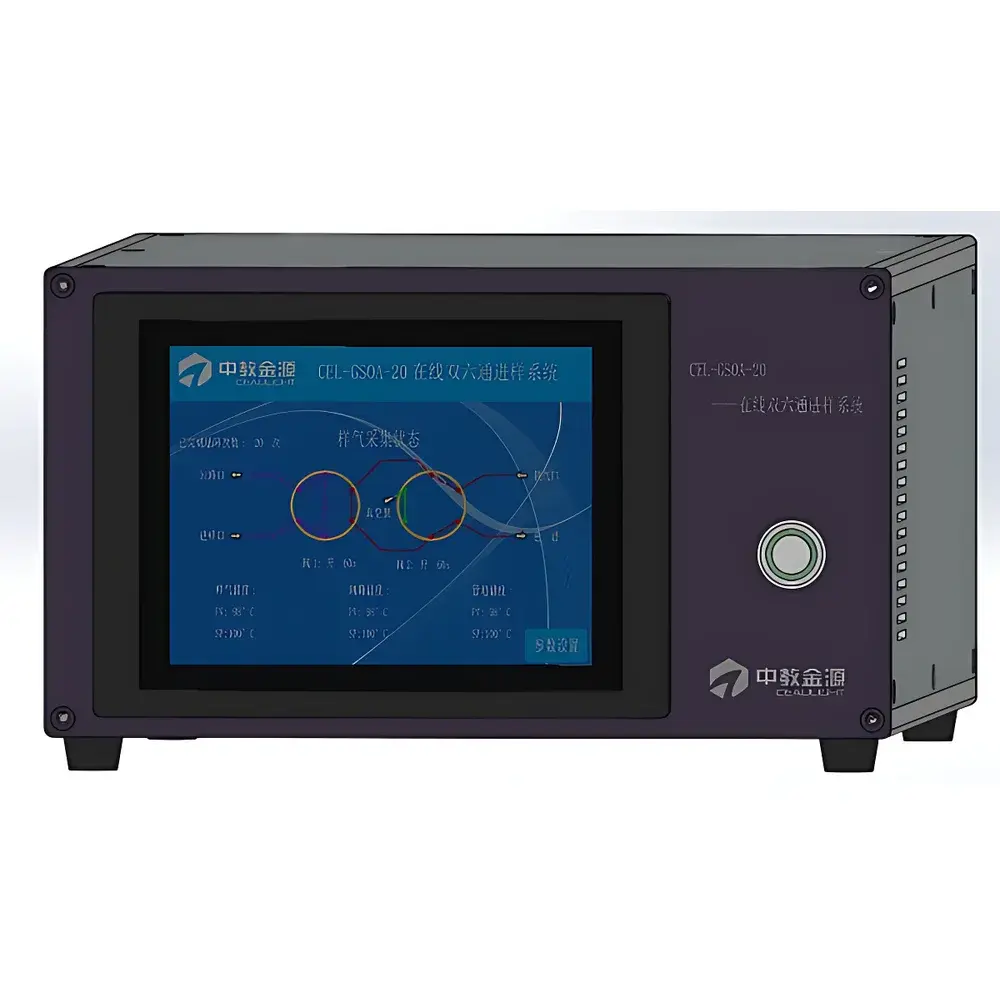
CEL-GSOA-20 Online Dual Six-Port Auto-Sampling System
| Brand | CEL (Zhongjiao Jin Yuan) |
|---|---|
| Origin | Beijing, China |
| Manufacturer Type | OEM Manufacturer |
| Country of Origin | China |
| Model | CEL-GSOA-20 |
| Pricing | Upon Request |
| Actuation | Pneumatic (Domestic) |
| Maximum Valve Body Temperature | <200 °C |
| Tubing Temperature Control | Yes |
| GC Compatibility | Universal (Agilent, Shimadzu, CEL, etc.) |
| Vacuum Pump Interlock Control | Yes |
| Sampling Timing Resolution | 0.01 min |
| Sampling Sequence Programmability | Fully Configurable (Number & Interval) |
Overview
The CEL-GSOA-20 Online Dual Six-Port Auto-Sampling System is an engineered gas-phase sampling interface designed for continuous, non-invasive monitoring of catalytic reaction atmospheres in closed-loop photocatalytic and thermocatalytic microreactor systems. It operates on a dual six-port valve architecture—two independently actuated, high-integrity pneumatic switching valves—enabling sequential, timed extraction of representative gaseous samples directly from pressurized or vacuum-assisted reactor effluent streams without interrupting catalytic turnover or compromising system integrity. The system implements precise carrier-gas purging and thermal management to prevent condensation, adsorption, or catalytic memory effects during transfer, ensuring analytical fidelity for downstream gas chromatographic (GC) quantification of H₂, O₂, CO, CO₂, CH₄, C₂H₆, and other low-molecular-weight reaction products.
Key Features
- Dual six-port pneumatic valve manifold with synchronized or staggered actuation logic, supporting both parallel and serial sampling protocols
- Integrated valve body temperature control (up to 199 °C) to maintain volatile species in vapor phase and eliminate cold-trapping artifacts
- Heated sample transfer lines with independent PID-controlled zoning, compatible with reactor outlet temperatures up to 350 °C
- Gas-purged valve cavity design using inert carrier (N₂ or Ar) to suppress oxidation and minimize residual cross-contamination between runs
- Real-time vacuum pump interlock: automatically triggers pump activation/deactivation synchronized with valve switching to maintain stable system backpressure
- High-resolution timing engine with 0.01-minute (600 ms) minimum step resolution for precise control over sampling frequency, dwell time, and cycle repetition
- Modular GC interface: standardized 1/8″ Swagelok® or VCR fittings; supports direct coupling to Agilent 7890/8890, Shimadzu GC-2030, and CEL’s own GC-based gas analyzers
Sample Compatibility & Compliance
The CEL-GSOA-20 is validated for use with reactive, corrosive, and condensable gas mixtures typical of photocatalytic water splitting (H₂/O₂ evolution), CO₂ hydrogenation (CH₄, CO, C₂+ hydrocarbons), VOC degradation (formaldehyde, acetaldehyde, NOₓ intermediates), and NH₃ synthesis screening. All wetted surfaces are constructed from electropolished 316 stainless steel or fused silica-lined tubing to ensure chemical inertness and low surface reactivity. The system complies with fundamental requirements of ISO 17025 for method traceability and supports GLP/GMP-aligned workflows when integrated with chromatographs equipped with 21 CFR Part 11–compliant software (e.g., OpenLab CDS, LabSolutions). Valve actuation logs, temperature setpoints, and sampling timestamps are exportable as CSV for audit trail reconstruction.
Software & Data Management
The system interfaces via RS-232 or optional USB-to-serial adapter with third-party GC acquisition software or custom LabVIEW/Python control environments. A dedicated configuration utility (Windows-based, no runtime license required) enables definition of multi-step sampling sequences—including conditional triggers based on external TTL signals (e.g., light-on/off pulses from photoreactor controllers). All operational parameters (valve positions, heater setpoints, interlock states) are logged with millisecond-level timestamping. Raw log files support post-hoc alignment with GC peak integration tables to correlate transient product formation rates with reaction conditions.
Applications
- Time-resolved kinetic profiling of H₂ and O₂ evolution in suspended or immobilized photocatalyst slurry reactors
- In situ monitoring of CO₂ reduction selectivity shifts under variable light intensity, temperature, or co-catalyst loading
- Stability assessment of MOF- or perovskite-based catalysts during long-duration gas-phase oxidation tests
- Quantitative evaluation of catalyst deactivation via accumulation of carbonaceous deposits or sulfur poisoning indicators
- Method development for ASTM E3104-18–aligned photocatalytic activity benchmarking across laboratory-scale reactors
FAQ
Can the CEL-GSOA-20 be retrofitted onto an existing GC not manufactured by CEL?
Yes. Its universal pneumatic interface and pressure-tolerant valve design allow seamless integration with any benchtop or process GC featuring standard 1/8″ inlet ports and TTL-compatible trigger inputs.
Does the system support quantitative internal standard calibration?
Yes—by programming discrete injection events of certified gas standards into the sampling loop prior to or between reactor analyses, enabling response factor normalization per ICH Q2(R2) guidelines.
What maintenance intervals are recommended for the pneumatic valves?
Under continuous operation at ≤150 °C and clean synthetic air/N₂ purge, domestic pneumatic actuators require inspection every 6 months; seal replacement is advised annually or after 10,000 actuation cycles.
Is remote monitoring supported via Ethernet or Modbus?
Not natively—but the RS-232 output can be bridged to TCP/IP using industrial protocol converters (e.g., Moxa NPort), enabling SCADA-level visibility in centralized lab automation platforms.
Related Products



