
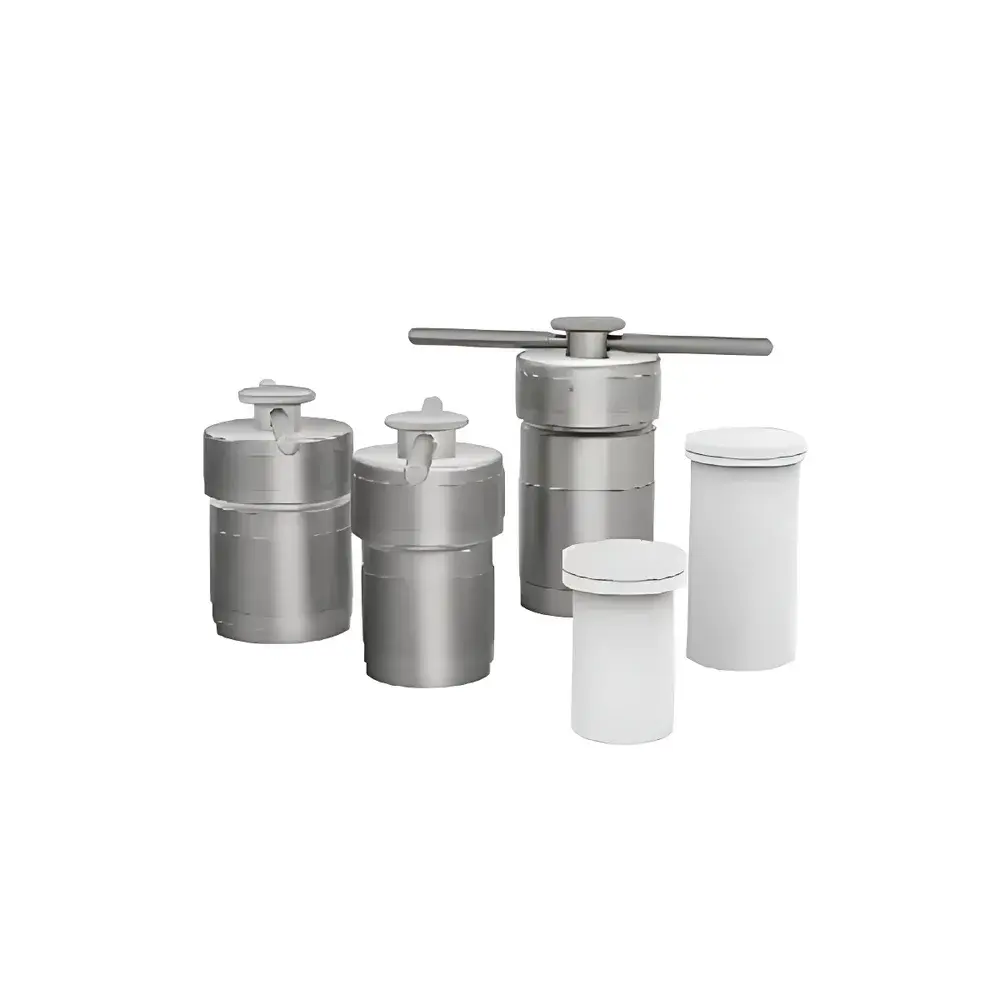
CEL-HAR Series Explosion-Proof Hydrothermal Autoclave Reactor
| Brand | CEAJIN |
|---|---|
| Origin | Beijing, China |
| Manufacturer Type | Direct Manufacturer |
| Region | Domestic (China) |
| Model | CEL-HAR |
| Pricing | Upon Request |
| Capacity Options | 50 mL, 100 mL, 150 mL |
| Max Operating Temperature | 220 °C |
| Max Working Pressure | 6 MPa |
| Vessel Material | ASTM A240 Grade 304 Stainless Steel |
| Liner Material | Virgin PTFE (Machined from Solid Rod Stock) |
| Liner Sealing | Dual-Line Self-Sealing Geometry |
| Safety Feature | Integrated Pressure Relief Orifice on Lid |
Overview
The CEL-HAR Series Explosion-Proof Hydrothermal Autoclave Reactor is a precision-engineered pressure vessel designed for controlled high-temperature, high-pressure hydrothermal synthesis, solvothermal reactions, sample digestion, and thin-film deposition under inert or reactive atmospheres. Based on the fundamental principles of sealed-vessel thermodynamics and vapor-phase equilibrium, the CEL-HAR operates by confining reaction mixtures within a chemically inert polytetrafluoroethylene (PTFE) liner housed inside a mechanically robust 304 stainless steel shell. Under elevated temperature, solvent vapor pressure increases, enabling accelerated reaction kinetics, enhanced mass transfer, and crystallization of metastable phases inaccessible under ambient conditions. Its explosion-proof architecture—featuring pressure-rated construction, dual-line self-sealing liner geometry, and an integrated pressure relief orifice—is specifically validated for safe operation up to 6 MPa and 220 °C, meeting essential mechanical integrity requirements for Class I Division 1 laboratory environments per IEC 60079-0 general requirements for explosion-proof apparatus.
Key Features
- Explosion-resistant design certified for continuous operation at 6 MPa and 220 °C, with pressure-relief orifice located on the lid to prevent over-pressurization during thermal runaway scenarios.
- PTFE liner machined from virgin solid rod stock—no seams, no bonding agents—ensuring maximum chemical resistance to concentrated acids (e.g., HF-free HNO₃/H₂SO₄), alkalis, and organic solvents across pH 0–14.
- Dual-line self-sealing interface between PTFE liner and lid: two independent conical sealing surfaces engage progressively under internal pressure, eliminating leakage paths without reliance on elastomeric gaskets.
- 304 stainless steel outer vessel precision-machined to ISO 2768-mK tolerances; optimized wall thickness distribution minimizes thermal stress concentration and extends liner service life by reducing mechanical abrasion during repeated thermal cycling.
- Modular configuration supports substrate-based material growth—including CVD-assisted nucleation, oriented crystallite deposition on Si/SiO₂, quartz, or conductive substrates—enabling reproducible synthesis of MOFs, perovskites, metal oxides, and 2D nanomaterials.
- Tool-free assembly/disassembly: hex-key-free lid engagement with radial torque distribution ensures uniform clamping force and eliminates cross-threading risk during routine laboratory use.
Sample Compatibility & Compliance
The CEL-HAR reactor accommodates heterogeneous solid–liquid systems, suspended nanoparticle dispersions, and viscous precursor solutions. It is compatible with aqueous, ethylene glycol, ethanol, DMF, and other low-volatility solvents (boiling point > 60 °C recommended). Solvents with flash points below 60 °C (e.g., acetone, diethyl ether, THF) are strictly prohibited due to vapor-phase explosion hazards. The device complies with ISO 15143-1 (pressure equipment—design principles for laboratory autoclaves) and incorporates safety margins aligned with ASME BPVC Section VIII, Division 1 design rules for unfired pressure vessels. While not certified to ATEX or IECEx directives, its pressure-relief orifice and mechanical interlock geometry support adherence to institutional GLP safety protocols and OSHA 1910.119 process safety management (PSM) guidelines for high-pressure lab-scale operations.
Software & Data Management
The CEL-HAR is a manually operated, non-instrumented reactor and does not integrate digital controllers, sensors, or data logging hardware. All operational parameters—including fill ratio (recommended ≤ 70% internal volume), heating ramp rate, dwell time, and cooling protocol—are defined externally via programmable ovens or muffle furnaces. Users are required to maintain manual logbooks documenting batch ID, reagent lot numbers, temperature/pressure profiles (where inferred from calibration curves), and post-reaction inspection records. For regulatory traceability, institutions may map CEL-HAR usage into electronic lab notebook (ELN) systems compliant with 21 CFR Part 11 when paired with validated furnace controllers and audit-trail-enabled thermal recording devices.
Applications
- Solvothermal synthesis of metal–organic frameworks (MOFs) such as MIL-101(Cr), UiO-66(Zr), and ZIF-8 under controlled pH and stoichiometric confinement.
- Growth of single-crystal perovskite thin films (e.g., CH₃NH₃PbI₃) on patterned FTO/glass substrates for photovoltaic prototype development.
- Acid digestion of geological, biological, and polymer samples prior to ICP-MS or AAS analysis—validated for EPA Method 3052 compliance when used with appropriate acid mixtures and cooling protocols.
- Nanoparticle crystallization studies, including TiO₂ anatase/rutile phase evolution, hydroxyapatite nucleation kinetics, and quantum dot size-tuning via residence time modulation.
- Green chemistry applications: water-mediated oxidation, hydrolysis, and condensation reactions minimizing organic solvent consumption and waste generation.
FAQ
Is the CEL-HAR reactor suitable for use with hydrofluoric acid (HF)?
No. Although the PTFE liner exhibits broad chemical resistance, HF causes progressive degradation of PTFE above 120 °C and may compromise liner integrity. Alternative liners (e.g., PFA or quartz-lined vessels) are required for HF-containing systems.
What is the recommended maximum fill volume?
70% of the nominal liner capacity—e.g., ≤35 mL for the 50 mL model—to ensure adequate headspace for vapor expansion and prevent mechanical extrusion of the liner during pressurization.
Can the reactor be used in a microwave-assisted synthesis system?
No. The 304 stainless steel body is incompatible with microwave fields and poses arcing and thermal runaway risks. CEL-HAR is intended exclusively for conductive or convective heating in conventional ovens.
How often should the PTFE liner be inspected or replaced?
Inspect visually before each use for discoloration, surface crazing, or dimensional deformation. Replace after 20–30 cycles at ≥200 °C or immediately upon detecting any microcrack or seal-line erosion.
Does the pressure relief orifice require periodic calibration or maintenance?
The orifice is a passive, fixed-diameter feature (not a pressure-safety valve) and requires no recalibration. However, it must remain unobstructed; clean with lint-free swabs and isopropanol after each use involving volatile or particulate-laden solvents.



