
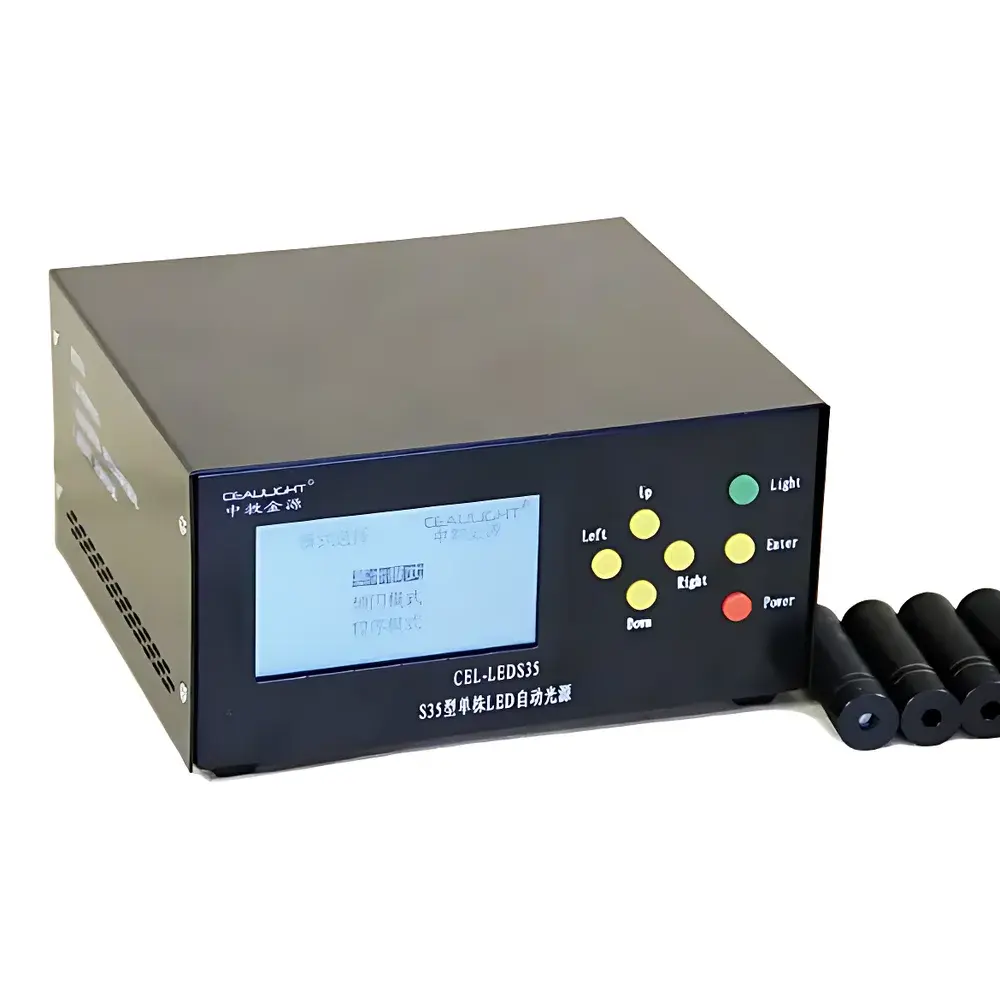
CEL-LEDS35 High-Power Multiband LED Light Source System (1W & 3W per Channel)
| Brand | CEAULIGHT (CEL) |
|---|---|
| Model | CEL-LEDS35 |
| Light Source Type | High-Efficiency Solid-State LED Array |
| Illumination Mode | Internal Irradiation Configuration |
| Max. Output Power per Channel | 3 W |
| Number of Independently Controllable Channels | 5 |
| Spectral Range | 265 nm – 940 nm |
| LED Drive Precision | ±0.01 mA |
| Timing Resolution | 0.01 min |
| Operating Temperature Range | −30 °C to +80 °C |
| Rated Lifetime | ≥100,000 h (L70, typical) |
| Control Interface | RS-232 (DB9 COM port) |
| Control Modes | Constant Current (CW), Pulsed (1 kHz, 5% duty cycle), Programmable Sequence (36-step) |
| Thermal Management | Active Heatsink with Real-Time Temperature Monitoring |
Overview
The CEL-LEDS35 is a precision-engineered, multi-channel high-power LED light source system designed for advanced optical laboratory applications requiring spectrally selective, stable, and programmable irradiation. Unlike broadband arc lamps (e.g., xenon or mercury), the CEL-LEDS35 utilizes discrete, high-brightness semiconductor emitters—each individually addressable—to deliver narrow-band illumination across deep UV (265–310 nm), near UV (365–405 nm), visible (420–750 nm), and near-infrared (800–940 nm) spectral regions. Its operation is based on solid-state electroluminescence, enabling exceptional wavelength specificity, rapid temporal response (<1 µs rise/fall time), and negligible thermal drift during extended operation. Engineered for reproducible photobiological, photochemical, and optoelectronic testing, the system supports internal irradiation configurations—ideal for reactor-integrated setups, custom optical cavities, and in situ illumination geometries where spatial confinement and thermal isolation are critical.
Key Features
- Five independently controlled LED channels, each supporting dynamic power scaling from 0.1 W to 3 W with current resolution of ±0.01 mA.
- Comprehensive spectral coverage: 22 discrete peak wavelengths—from 265 nm (UVC germicidal band) to 940 nm (NIR)—with calibrated radiant flux data traceable to NIST-traceable standards.
- Programmable illumination sequences: up to 36 user-defined steps per channel, supporting complex duty-cycle profiles, intensity ramps, and synchronized multi-wavelength protocols.
- Embedded microcontroller-based driver with real-time thermal feedback loop; integrated temperature sensors monitor heatsink baseplate and LED junction conditions to prevent thermal runaway and ensure long-term radiometric stability.
- RS-232 serial interface (DB9) enables full remote command control (SCPI-compatible syntax), facilitating integration into automated test benches, LIMS environments, and ISO/IEC 17025-compliant QA workflows.
- Optimized thermal architecture: forced-convection heatsink with low-thermal-resistance interface materials, sustaining rated output at ambient temperatures up to +55 °C without derating.
Sample Compatibility & Compliance
The CEL-LEDS35 is compatible with standard quartz, fused silica, and borosilicate optical windows (transmission >85% from 265 nm to 940 nm). Its internal irradiation design allows direct coupling into flow cells, photocatalytic reactors (e.g., slurry-type TiO₂ systems), microbial exposure chambers, and fiber-optic-coupled spectroscopic setups. All LED modules comply with IEC 62471:2006 (Photobiological Safety of Lamps) for Risk Group classification—UVC emitters (265/280 nm) are classified as RG3 (high risk), requiring interlocked enclosures per EN 60825-1. The system’s firmware supports audit trail logging and user-access-level configuration (admin/operator modes), aligning with GLP and GMP documentation requirements for regulated photostability testing (ICH Q1B, USP Analytical Instrument Qualification).
Software & Data Management
The CEL-LEDS35 operates natively via ASCII command protocol over RS-232, allowing seamless integration with LabVIEW, Python (PySerial), MATLAB, or custom SCADA platforms. Optional Windows-based control software provides GUI-driven sequence building, real-time current/temperature telemetry, and CSV export of operational logs—including timestamped channel status, setpoints, and thermal events. All parameter changes are logged with user ID, timestamp, and pre/post values—supporting 21 CFR Part 11 compliance when deployed with electronic signature-enabled host systems. Firmware updates are delivered via signed HEX files with CRC-32 validation to ensure integrity.
Applications
- Photocatalysis research: wavelength-resolved quantum yield determination for TiO₂, g-C₃N₄, and MOF-based systems under monochromatic excitation.
- UV disinfection efficacy studies: dose-response modeling for bacteriophage MS2, E. coli, and SARS-CoV-2 surrogates using 265 nm and 280 nm UVC LEDs.
- Photobiomodulation (PBM) screening: systematic evaluation of cytochrome c oxidase activation across 630–850 nm bands in primary neuronal cultures.
- Accelerated photostability testing per ICH Q1B: controlled irradiation of pharmaceutical APIs and formulations under defined UV–vis–NIR stress conditions.
- Calibration of spectroradiometers and reference photodiodes: NIST-traceable irradiance sources for laboratory accreditation (ISO/IEC 17025).
- Optogenetics probe characterization: temporal fidelity verification of channelrhodopsin-2 (ChR2) and ChrimsonR activation kinetics using sub-millisecond pulsed modes.
FAQ
What is the spectral bandwidth (FWHM) of each LED emitter?
Typical FWHM ranges from ±5 nm (deep UV) to ±20 nm (visible/NIR), depending on the specific die and phosphor configuration. Full spectral emission profiles are provided in the calibration certificate shipped with each unit.
Can the CEL-LEDS35 be used in Class 100 cleanroom environments?
Yes—the housing meets IP52 ingress protection rating, and all internal components are assembled under ISO 14644-1 Class 5 conditions. Optional stainless-steel enclosure upgrades are available for full cleanroom compatibility.
Is radiometric calibration included with purchase?
Each unit ships with a factory calibration report referencing NIST-traceable spectroradiometric measurements at 25 °C, including absolute irradiance (W/m²/nm) at 10 cm working distance for every configured wavelength.
Does the system support TTL triggering for synchronization with cameras or detectors?
Yes—dedicated BNC sync outputs provide hardware-triggered pulse start/stop signals with <100 ns jitter, fully synchronized to internal timing engine.
How is thermal management validated during qualification?
Thermal performance is verified per IEC 61347-2-13:2016 through accelerated life testing at maximum load (3 W/channel, 40 °C ambient) for 1,000 hours, confirming junction temperature stabilization within ±2 °C and radiant flux decay <3% (L97).



