
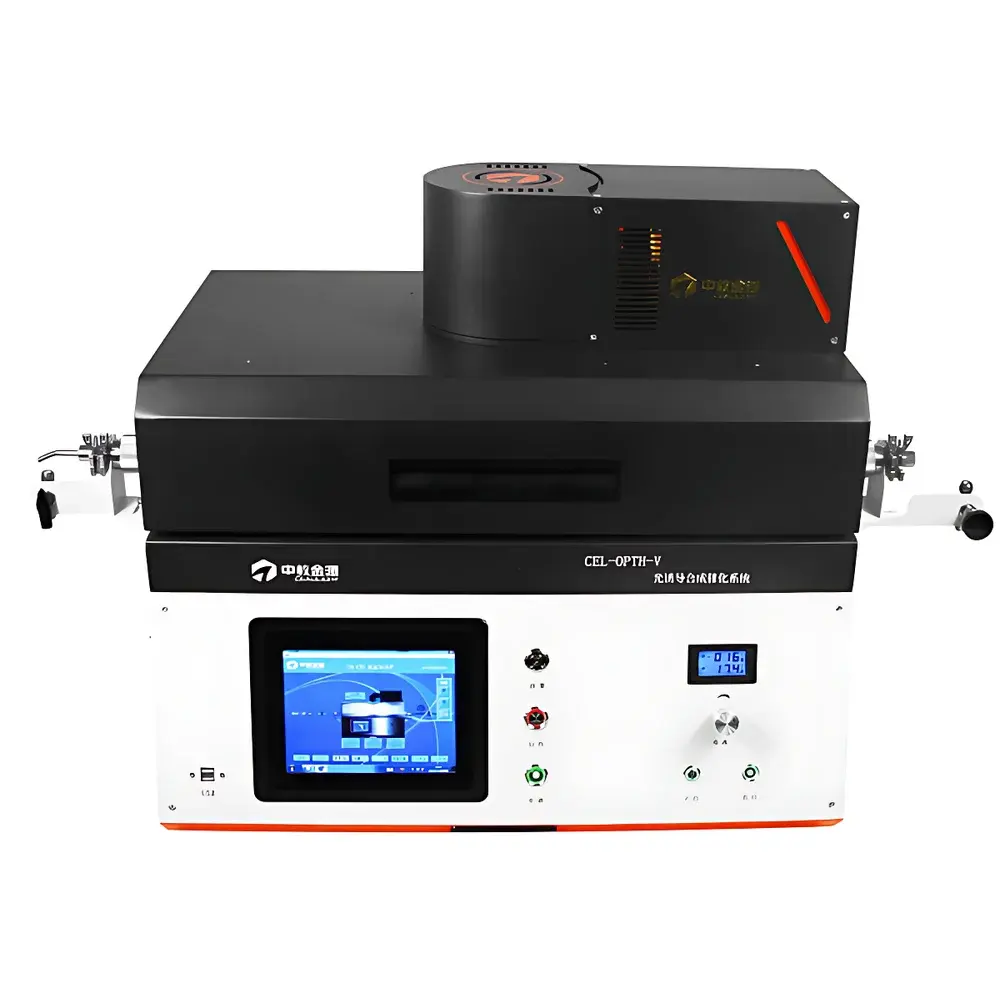
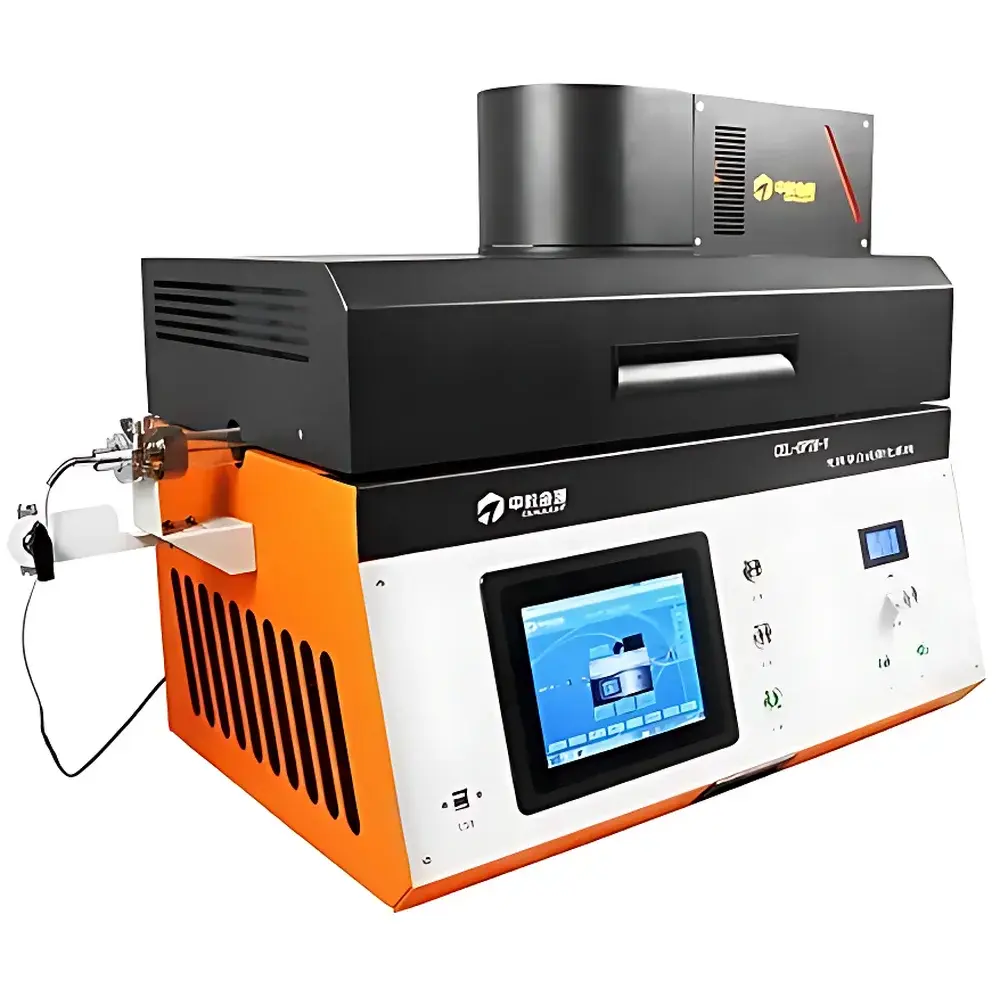
CEL-OPTH-V Photothermal Catalytic Synthesis and Evaluation System (Integrated Xenon Light Source)
| Brand | CEAULIGHT |
|---|---|
| Origin | Beijing, China |
| Manufacturer Type | Direct Manufacturer |
| Region | Domestic (China) |
| Model | CEL-OPTH-V |
| Price Range | USD 14,000 – 28,000 |
| Reaction Pressure | Ambient (Atmospheric) |
| Reaction Temperature | Up to 800 °C |
| Catalyst Loading Capacity | 1–10 g |
| Heating Power | 1.0 kW (Three-Zone Control, 220 V/50 Hz) |
| Temperature Uniformity | ±1 °C over 30 mm Work Zone |
| Quartz Tube Diameter | 30 mm |
| Light Source | 300 W PerkinElmer Xenon Lamp |
| Effective Irradiance | 500–2000 mW/cm² (Adjustable via M62 Filter Mount) |
| Light Delivery | Fiber-Coupled Quartz Light Guide |
| Gas Interface | 3 mm Swagelok Fitting |
| Optional Modules | High-Vacuum System (10⁻³ Pa), Mass Flow Controller (CEL-GPPCN), GC/HPLC/IC Analysis Integration |
Overview
The CEL-OPTH-V Photothermal Catalytic Synthesis and Evaluation System is an engineered platform for the controlled synthesis and functional characterization of advanced photocatalytic and thermocatalytic materials under simultaneous light irradiation and elevated temperature. Designed around Couette-type photothermal reaction geometry, it integrates a three-zone programmable high-temperature furnace (up to 800 °C), a UV-grade fused silica reaction tube (30 mm OD), and a collimated 300 W xenon lamp with fiber-optic light delivery. Unlike conventional photochemical reactors limited to ambient or low-temperature operation, the CEL-OPTH-V enables true photothermal synergy—where photon absorption and thermal activation occur concurrently within the catalyst bulk and surface. This architecture supports fundamental studies of lattice reconstruction, defect engineering, phase transformation kinetics, and charge-carrier dynamics under realistic operating conditions relevant to solar fuel generation and environmental remediation.
Key Features
- Triple-zone resistive heating system with independent PID control (ambient to 800 °C; ±0.1 °C setpoint accuracy; ≤±1 °C axial uniformity over 30 mm work zone)
- Optically transparent high-purity quartz reaction tube (UV-transmitting, >90% transmission from 190–2500 nm) with integrated quartz sample holder and radial light access port (30 mm diameter)
- Collimated 300 W xenon arc lamp with adjustable M62 filter mount—enabling spectral selection across UV, visible, and NIR ranges (190–1100 nm); output irradiance tunable from 500 to 2000 mW/cm² at sample position
- Fiber-coupled quartz light guide delivering incident photons coaxially through furnace top port—ensuring direct illumination of catalyst bed without optical path obstruction or thermal lensing
- Modular gas handling architecture supporting inert atmosphere purging, vacuum evacuation (down to 10⁻³ Pa with optional molecular pump), and precise multi-gas blending via mass flow controllers (MFCs) or rotameters
- Industrial-grade 8-inch HMI touchscreen running Kingview SCADA software—providing real-time logging of temperature profiles, light power, gas flows, pressure, and alarm states with configurable data export (CSV, Excel)
- Structural design compliant with IEC 61000-6-2 (EMC immunity) and IEC 61010-1 (safety for laboratory equipment); includes overtemperature cutoff, emergency power disconnect, and thermal insulation with forced-air cooling
Sample Compatibility & Compliance
The CEL-OPTH-V accommodates powdered, pelletized, or supported catalysts (1–10 g loading) in fixed-bed configuration. Its quartz reactor permits direct in situ observation and compatibility with downstream analytical interfaces—including GC-TCD/FID, IC, chemiluminescence NOx analyzers, and FTIR gas cells—without sample transfer. The system meets core requirements for GLP-compliant catalytic testing per ASTM E2758 (Standard Practice for Photocatalytic Activity Measurement) and ISO 22197-1 (Photocatalytic Air Purification). Optional high-vacuum module satisfies UHV-compatible material synthesis protocols (e.g., oxide epitaxy, nitride formation), while integrated MFCs support stoichiometric feed control aligned with USP analytical instrument qualification guidelines.
Software & Data Management
Control and data acquisition are managed via Kingview-based embedded SCADA software with full audit trail functionality. All operational parameters—including furnace segment temperatures, lamp current/voltage, light intensity (via calibrated photodiode feedback), gas flow rates, and system pressure—are timestamped and stored locally with user-defined sampling intervals (100 ms to 60 s). Data export supports CSV and Excel formats compatible with MATLAB, Python (pandas), and JMP for kinetic modeling (e.g., Langmuir-Hinshelwood fitting, Arrhenius analysis). The software architecture supports 21 CFR Part 11-compliant electronic signatures when deployed with external authentication servers, enabling use in regulated R&D environments requiring traceability and change control.
Applications
- Synthesis and annealing of metal oxide semiconductors (TiO₂, g-C₃N₄, BiVO₄, WO₃) under UV–vis irradiation to tailor crystallinity, oxygen vacancy concentration, and heterojunction formation
- Photothermocatalytic CO₂ reduction to CH₄, CO, or C₂H₄ using Cu/TiO₂, Ni/g-C₃N₄, or plasmonic Au/TiO₂ systems
- Gas-phase photocatalytic oxidation of VOCs (formaldehyde, toluene), NOx, SOx, and NH₃ under simulated solar irradiance
- Overall water splitting (H₂/O₂ co-evolution) and selective half-reactions (oxygen evolution reaction, OER; hydrogen evolution reaction, HER) under thermal bias
- Thermally assisted photoinduced nitrogen fixation (N₂ → NH₃) on Fe-, Mo-, or Ru-based catalysts
- In situ thermal desorption spectroscopy (TDS) coupled with online GC detection for adsorption/desorption energetics
FAQ
What light sources are compatible beyond the standard 300 W xenon lamp?
The M62 filter mount accepts commercially available interference filters, bandpass filters, and dichroic mirrors; users may also integrate LED arrays (365 nm, 405 nm, 450 nm, 520 nm, 630 nm) or deuterium-halogen sources via custom couplers.
Can the system operate under reducing atmospheres such as H₂ or NH₃?
Yes—the quartz reactor and stainless-steel gas manifolds are rated for H₂, NH₃, CO, and CH₄ up to 800 °C; recommended maximum partial pressure is 1 bar for reactive gases.
Is remote monitoring supported?
The embedded Ethernet port enables Modbus TCP communication; third-party SCADA platforms (Ignition, Siemens Desigo, or LabVIEW) can poll real-time values via OPC UA gateway (optional add-on).
How is temperature calibration verified?
Each unit ships with NIST-traceable calibration certificate for all three thermocouple zones (Type K); users may perform field verification using a calibrated reference thermometer inserted through auxiliary port.
What maintenance intervals are recommended for the xenon lamp and quartz components?
Lamp lifetime is rated at ≥1000 h at rated power; quartz tube and light guide should be inspected quarterly for haze or microcracking—especially after thermal cycling above 600 °C.



