
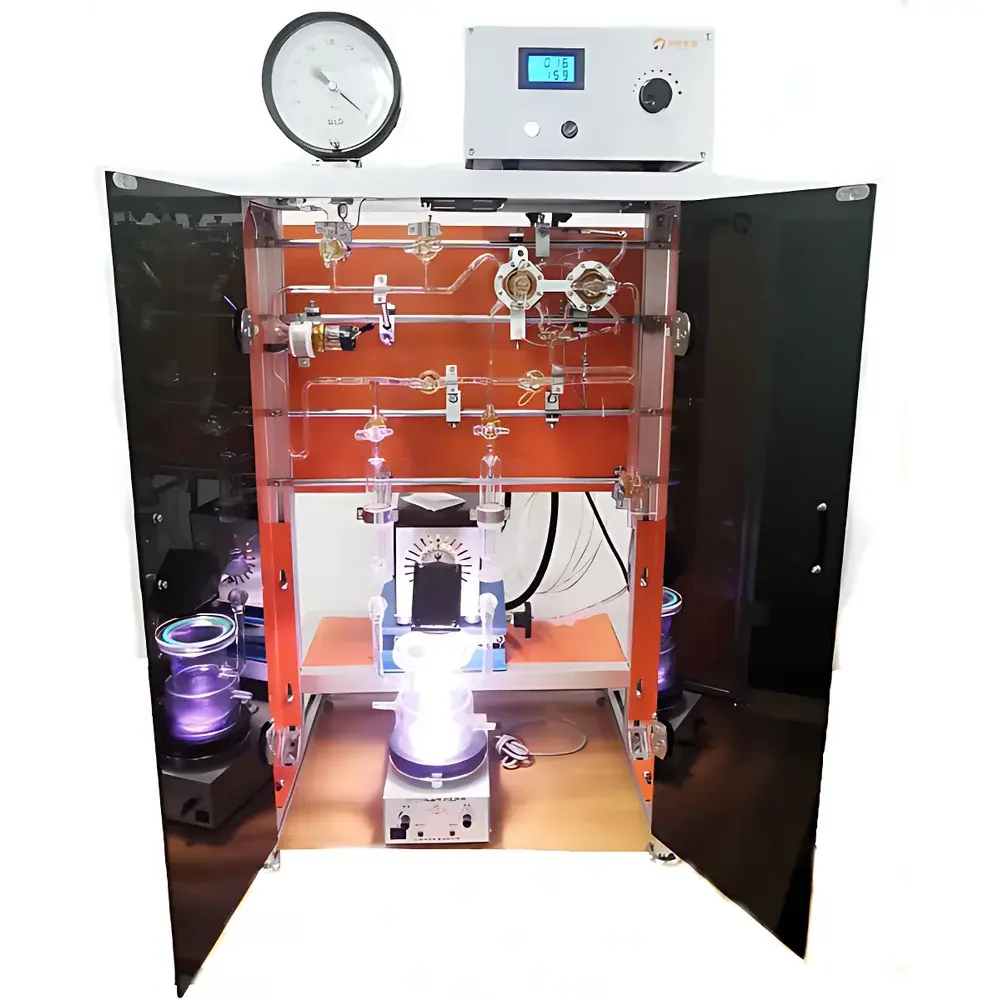
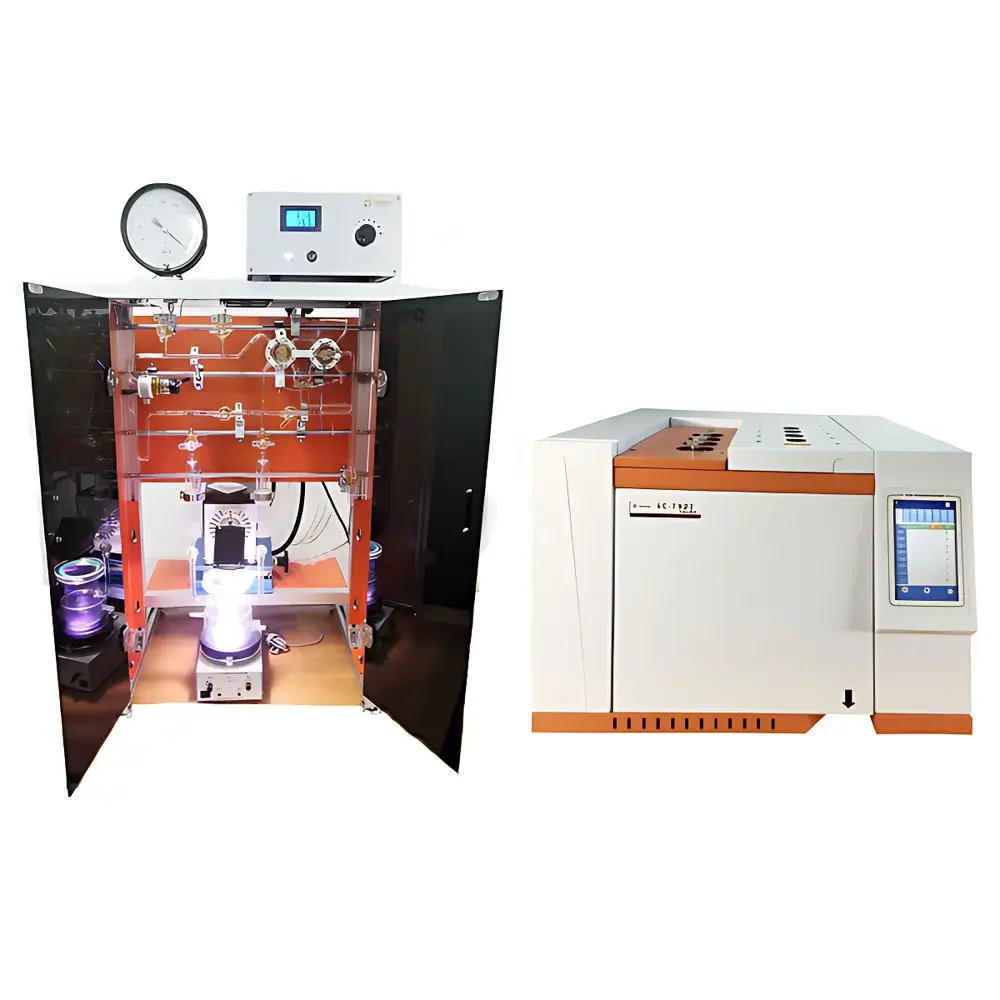
CEL-PAEM-D8 Photocatalytic Activity Evaluation System
| Brand | CEL (Zhongjiao Jinyuan) |
|---|---|
| Origin | Beijing, China |
| Manufacturer | Zhongjiao Jinyuan Co., Ltd. |
| Type | Domestic |
| Model | CEL-PAEM-D8 |
| Operating Pressure | −0.1 MPa (vacuum) |
| Max Reaction Temperature | 200 °C |
| Catalyst Loading Capacity | 250 mL |
| Reactor Volumes | 25 / 50 / 100 / 250 mL |
| Gas Circulation Flow Rate | 1.8 L/s (corrosion-resistant blower) |
| Vacuum Pump Speed | 2 L/s with anti-backflow solenoid valve |
| Detection Limits | H₂/O₂ ≥ 0.001 mL |
| Sampling Modes | Manual or Software-Controlled Automatic (8-position, temperature-controlled valves <200 °C) |
| Control Interface | USB & RJ45 |
| Measurement Resolution | 0.01 mL & 0.01 min |
| Enclosure Dimensions | 560 mm (W) × 470 mm (D) × 860 mm (H) |
Overview
The CEL-PAEM-D8 Photocatalytic Activity Evaluation System is an engineered platform for quantitative, reproducible assessment of photocatalytic performance under controlled gas-phase and liquid-phase reaction conditions. Built upon the Couette-type closed-loop gas circulation principle, it integrates a vacuum-tight borosilicate glass reactor network with real-time gas analysis readiness—designed specifically for low-turnover, high-value catalytic systems where material economy and measurement fidelity are critical. Unlike open or semi-open photoreactor configurations, the PAEM-D8 employs a fully enclosed, light-shielded cabinet architecture that eliminates ambient photon interference while enabling stable thermal management up to 200 °C. Its modular reactor design supports variable volumes (25–250 mL), allowing systematic scaling from screening-grade catalyst validation to mechanistic gas-evolution studies—including overall water splitting, selective CO₂ reduction, and oxidative organic transformations. The system operates under dynamic vacuum (−0.1 MPa, maintained over 72 h), ensuring rigorous exclusion of atmospheric contaminants prior to irradiation and facilitating accurate quantification of trace gaseous products such as H₂, O₂, CO, CO₂, CH₄, CH₃OH, and HCOOH.
Key Features
- Fully integrated glass gas circuitry with patented glass sampling valves—chemically inert, ultra-low dead-volume, and compatible with aggressive solvents and reactive intermediates.
- Temperature-regulated automatic sampling manifold (≤200 °C), supporting eight independent valve positions for sequential, time-resolved gas extraction without manual intervention.
- Dual-mode operation: software-driven autonomous testing cycles or operator-initiated manual sampling—both synchronized with real-time pressure, temperature, and timing metadata logging.
- U-shaped internal cold trap embedded in the glass flow path—enhances vacuum integrity and separates volatile condensables (e.g., alcohols, aldehydes) from permanent gases prior to GC injection.
- Light-shielded enclosure constructed with translucent acrylic panels—permits visual monitoring of reactor status while preventing stray-light-induced side reactions and ensuring optical isolation during UV–vis irradiation.
- Universal GC interface: standardized pneumatic and electrical connections (RJ45 + USB) enable seamless integration with third-party gas chromatographs (Agilent, Shimadzu, Thermo Fisher) via optional dual six-port auto-sampling modules (e.g., CEL-GSOA-20/V).
Sample Compatibility & Compliance
The CEL-PAEM-D8 accommodates heterogeneous photocatalysts across diverse material classes—including metal oxides (TiO₂, WO₃, BiVO₄), polymeric semiconductors (g-C₃N₄), chalcogenides (CdS, MoS₂), MOFs, and co-catalyst-modified composites. Its inert glass construction ensures compatibility with aqueous, organic, and mixed-phase reaction media. All operational parameters—including vacuum hold, temperature ramping, and gas residence time—are programmable and auditable, supporting compliance with GLP-aligned experimental documentation practices. While not certified to ISO/IEC 17025 or ASTM E2937 by default, the system’s deterministic control logic, timestamped data export, and hardware-level vacuum interlocks provide foundational traceability required for method validation under internal QC protocols or pre-submission research workflows.
Software & Data Management
The proprietary PAEM Control Suite (v3.x) delivers deterministic sequence execution via a deterministic state-machine architecture. Users define multi-step protocols—including evacuation, purge, irradiation onset, timed sampling, and pressure recovery—with sub-minute temporal resolution (0.01 min) and volumetric precision (0.01 mL). All events are logged with UTC timestamps, sensor readings, and actuator statuses into a structured CSV/SQLite database. Exported datasets include full audit trails suitable for post-hoc kinetic modeling (e.g., pseudo-first-order rate constants, quantum yield calculations) and cross-platform statistical analysis. The software supports remote monitoring via Ethernet (RJ45), firmware updates over USB, and direct linkage to LIMS environments through configurable API hooks.
Applications
- Quantitative H₂/O₂ co-evolution kinetics for overall water splitting validation—critical for assessing stoichiometric charge balance and identifying back-reaction pathways.
- Isotopic labeling experiments (e.g., H₂¹⁸O, ¹³CO₂) to confirm reaction origin and distinguish surface-adsorbed vs. bulk-phase intermediates.
- Structure–activity relationship (SAR) mapping of doped or heterojunction photocatalysts under standardized irradiance (AM1.5G, 300–800 nm) and controlled mass transport.
- Long-duration stability testing (>100 h) with periodic automated sampling—enabling deactivation mechanism studies and catalyst lifetime benchmarking.
- Multi-gas product profiling in CO₂ photoreduction: simultaneous detection of CO, CH₄, CH₃OH, HCOOH, and C₂-species to evaluate selectivity trade-offs and carbon chain growth efficiency.
FAQ
Can the CEL-PAEM-D8 be used for gas–solid photocatalysis without liquid phase?
Yes—the system supports dry-powder catalyst beds in fixed-bed or suspended configurations using inert carrier gases (Ar, N₂, He) and optional quartz wool packing to ensure uniform irradiation and minimize channeling.
What vacuum level can be sustained during extended operation?
The system maintains −0.1 MPa (100 mbar absolute) continuously for ≥72 h under dynamic conditions, verified via integrated pressure transducer feedback and automatic pump cycling.
Is calibration traceable to NIST or other national standards?
While the base instrument does not include factory-certified gas standards, its volumetric and temporal measurement subsystems are calibrated against traceable reference instruments during production; users may integrate certified gas mixtures for endpoint calibration per ISO 6142.
How is light source alignment managed during reactor exchange?
The lamp mount is rear-positioned on a rigid optical bench, decoupling illumination geometry from reactor insertion—ensuring consistent photon flux density (PFD) across all reactor volumes without realignment.
Does the system support real-time gas concentration calculation?
No—real-time quantification requires external GC or MS detection; the PAEM-D8 provides precise, timed sample delivery to the analyzer and synchronizes acquisition triggers via TTL/RS232 handshake protocols.
Related Products



