
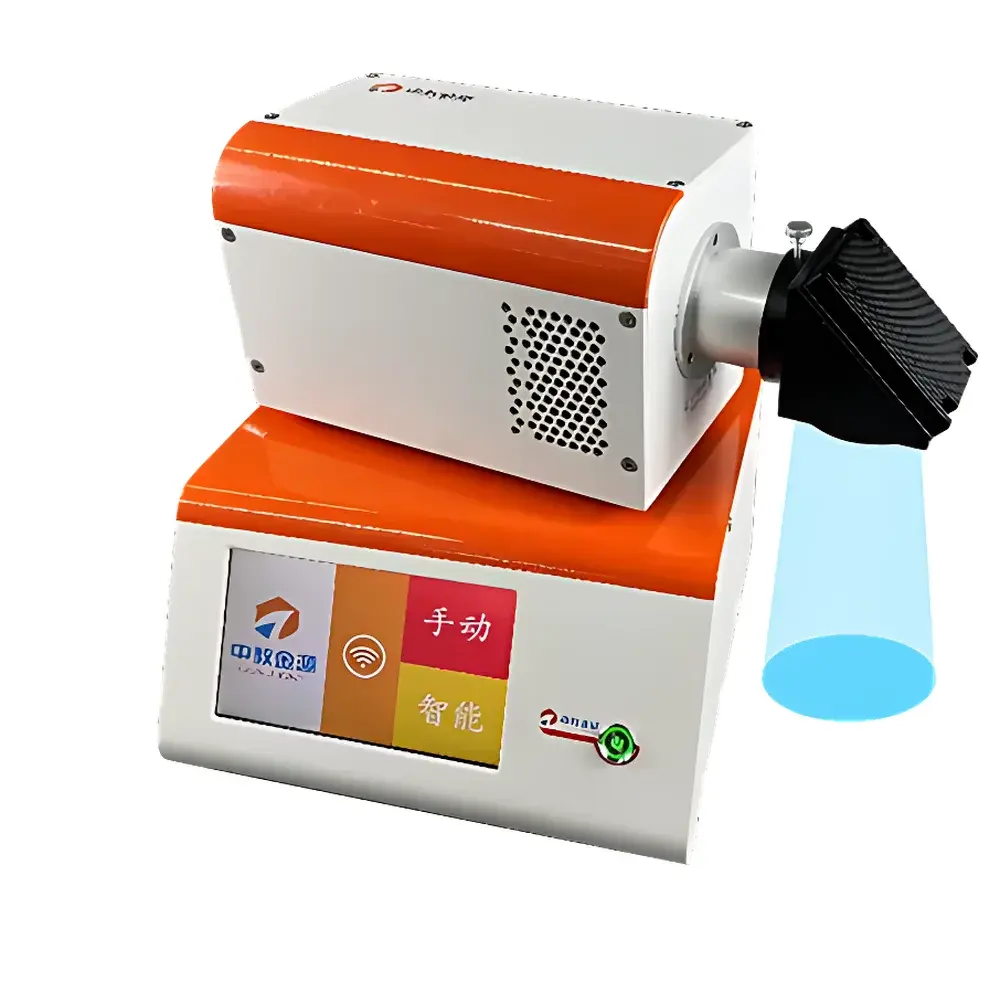
CEL-PF300-T10 Xenon Light Source System
| Brand | CEL (Zhongjiao Jinyuan) |
|---|---|
| Origin | Beijing, China |
| Manufacturer Type | Direct Manufacturer |
| Product Category | Domestic |
| Model | CEL-PF300-T10 |
| Light Source Type | Xenon Arc Lamp |
| Illumination Mode | External Irradiation |
| Display | 7-inch Touchscreen Interface |
| Control System | Embedded Intelligent Controller with Fiber-Optic Power Feedback |
| Cooling | Low-Voltage Variable-Speed Fan with Thermal Delay Logic |
| Safety Design | Full-Low-Voltage Operation (≤24 VDC Control Circuitry) |
| Lamp Replacement | Tool-Free Hot-Swap Capable |
| Spectral Range (Ozone-Free) | 300–2500 nm |
| UV Output (<390 nm) | 2.6 W |
| Visible Output (390–770 nm) | 18.6 W, 5600 K, 5000 lm |
| IR Output (>770 nm) | 28.8 W |
| Total Radiant Output | 50 W |
| Input Power | 300 W (Ignition: 30 kV, Operating: 14 V DC) |
| Operating Current | 21 A (10–22 A range, recommended 18 A) |
| Lamp Lifetime | >1000 h (up to 6000 h under optimal conditions) |
| Power Stability | <±1% (with fiber-optic closed-loop feedback) |
| Adjustable Irradiance | 0–20 Sun (1 Sun = 1000 W/m², calibrated at 15 cm working distance using CEL-NP2000) |
| Programmable Modes | Manual, Fiber-Feedback Stabilized, Time-Programmed Intensity Ramp, Auto-Start/Stop, Remote Monitoring via Optional Software or Mobile App |
Overview
The CEL-PF300-T10 Xenon Light Source System is a high-stability, externally irradiating broadband light source engineered for precision photochemical and photophysical research in academic laboratories and industrial R&D settings. Based on a 300 W short-arc xenon lamp, it delivers spectrally continuous output from 300 nm to 2500 nm (ozone-free configuration), covering deep UV through near-infrared—enabling simulation of natural solar irradiance (AM1.5G), controlled visible excitation, and targeted UV-driven processes. Its optical architecture employs a collimated beam path with integrated thermal management and real-time radiometric control, distinguishing it from basic lamp housings by enabling quantitative, reproducible photon flux delivery essential for kinetic studies, quantum yield determination, and standardized photocatalytic testing per ISO 22197-1, ASTM E2725, and IEC 61215 protocols.
Key Features
- Fiber-optic closed-loop power feedback system: A calibrated Hamamatsu photodiode receives sampled light via fused-silica optical fiber, decoupling sensor drift from thermal fluctuations and maintaining irradiance stability within ±1% over extended operation.
- Intelligent 7-inch touchscreen interface: Supports multi-mode operation—including manual intensity setting, time-programmed irradiance ramping (e.g., simulating diurnal solar cycles), auto-start/stop scheduling, and real-time display of calibrated power density (W/m²) at 15 cm working distance.
- Full-low-voltage safety architecture: All control circuitry operates below 24 VDC; ignition is isolated via high-voltage pulse module (30 kV), eliminating shock hazard during routine maintenance or lamp replacement.
- Modular mechanical design: Standardized flange interfaces enable rapid coupling with CEL reaction vessels (e.g., CEL-SPH200, CEL-LAB50), photochemical reactors, and environmental chambers without optical realignment.
- Thermally adaptive cooling: Multi-point temperature monitoring (lamp envelope, reflector housing, power supply) dynamically modulates fan speed to sustain consistent junction temperature and minimize spectral drift.
- Tool-free lamp exchange: Patented socket mechanism allows safe, rapid xenon lamp replacement without disassembly—critical for minimizing downtime in high-throughput screening workflows.
Sample Compatibility & Compliance
The CEL-PF300-T10 is compatible with standard quartz-jacketed batch reactors, flow-through photoreactors, gas-phase catalytic cells, and custom optical mounts accepting ≥60 mm diameter collimated beams. Its spectral fidelity and irradiance uniformity support compliance with internationally recognized photochemical test standards: ISO 10678 (photocatalytic degradation of organic dyes), ISO 22197-2 (NOₓ removal), ASTM D4213 (photostability of coatings), and USP for extractables/leachables testing under UV stress. When paired with CEL-NP2000-2A calibrated power meters and NIST-traceable reference detectors, the system meets GLP documentation requirements for audit-ready irradiance logging, including timestamped intensity records, lamp-on hours, and thermal event logs.
Software & Data Management
The system supports optional integration with CEL’s LabControl software suite (Windows-based) or mobile web application for remote monitoring and control. Logged data—including real-time irradiance, lamp voltage/current, internal temperatures, and operational mode transitions—are exported in CSV format with ISO 8601 timestamps. Audit trails comply with FDA 21 CFR Part 11 requirements when deployed with user authentication, electronic signatures, and immutable record retention. Firmware updates are delivered via USB or Ethernet, preserving configuration integrity across revisions.
Applications
- Photocatalytic water splitting (H₂/O₂ evolution) and CO₂ photoreduction under simulated AM1.5G illumination
- Gas-phase VOC abatement kinetics in laminar-flow reactors
- Photoinduced polymerization and crosslinking studies requiring precise UV–vis dose control
- Accelerated photostability testing of pharmaceuticals, polymers, and OLED materials
- In vitro photobiomodulation and circadian rhythm studies using tunable visible spectra
- Calibration and validation of spectroradiometers, quantum sensors, and actinometers
- Multi-wavelength photolysis experiments enabled by interchangeable bandpass and longpass filters (e.g., QD365, UVIRCut420, AM1.5G)
FAQ
What spectral range does the CEL-PF300-T10 cover without ozone generation?
It emits continuously from 300 nm to 2500 nm when equipped with the standard ozone-free lamp envelope and quartz output window.
Can irradiance be calibrated traceably to international standards?
Yes—when used with the CEL-NP2000-2A power meter and factory-applied K-factor correction, output is referenced to NIST-traceable silicon photodiode calibration at 15 cm.
Is the system compatible with third-party reactors or optical tables?
All mechanical interfaces follow ISO-KF40 vacuum flange standards; beam height is fixed at 120 mm above baseplate, enabling direct integration with most commercial photochemical platforms.
How is thermal drift mitigated during long-duration experiments?
Real-time thermal feedback from six embedded sensors adjusts fan speed and modulates lamp current to maintain radiant output stability better than ±1% over 8-hour continuous operation.
Does the system meet electrical safety requirements for laboratory use?
It conforms to IEC 61010-1:2010 (Safety Requirements for Electrical Equipment for Measurement, Control, and Laboratory Use) and carries CE marking for EMC and LVD directives.




