
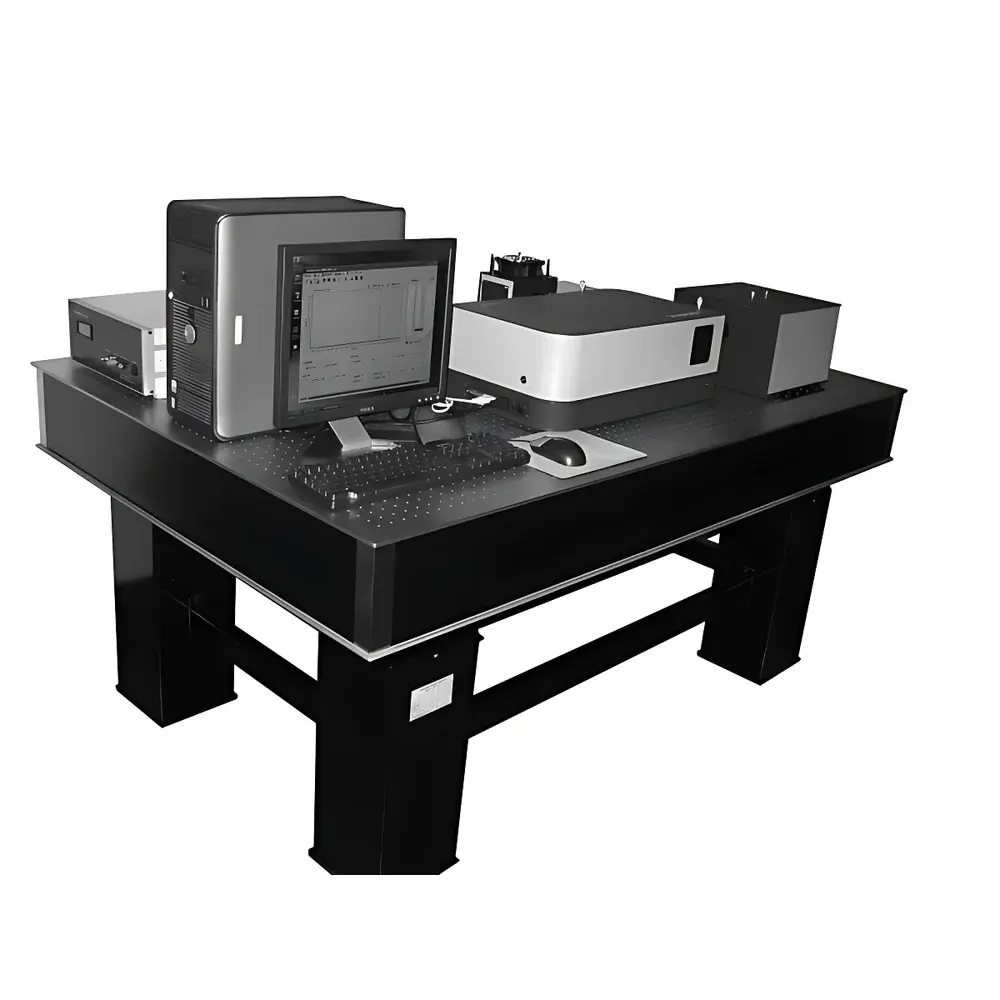
CEL-QPCE2010 Solar Cell Quantum Efficiency / Incident Photon-to-Current Efficiency (QE/IPCE) Measurement System
| Brand | CEL |
|---|---|
| Origin | Beijing, China |
| Manufacturer Type | Direct Manufacturer |
| Region Classification | Domestic (China) |
| Model | CEL-QPCE2010 |
| Price | USD 41,800 (FOB Beijing) |
Overview
The CEL-QPCE2010 Quantum Efficiency / Incident Photon-to-Current Efficiency (QE/IPCE) Measurement System is a precision optical-electronic instrumentation platform engineered for quantitative spectral characterization of crystalline silicon photovoltaic devices. It operates on the fundamental principle of monochromatic photocurrent spectroscopy—where a tunable, calibrated monochromator delivers discrete wavelength bands (typically 300–1200 nm) onto the device under test (DUT), while a low-noise, lock-in-amplified current measurement subsystem quantifies the resulting photocurrent under controlled bias and illumination conditions. The system computes absolute external quantum efficiency (EQE), defined as the ratio of collected electrons per incident photon at each wavelength, and derives incident photon-to-current efficiency (IPCE) values traceable to NIST-calibrated reference detectors. Designed specifically for single-crystalline and multicrystalline silicon solar cells, the CEL-QPCE2010 supports standardized evaluation under simulated AM1.5G spectral irradiance (IEC 60904-8, ASTM E2527) and enables rigorous assessment of spectral responsivity, charge carrier collection efficiency, and interfacial recombination losses.
Key Features
- Monochromator-based spectral scanning from 300 nm to 1200 nm with ≤1.5 nm optical bandwidth and wavelength repeatability better than ±0.2 nm
- Integrated lock-in amplifier with dual-phase detection for high signal-to-noise ratio (SNR > 60 dB) under low-light and low-bias conditions
- Automated sample stage with XYZ positioning and optional motorized tilt adjustment for uniform beam incidence across cell surfaces
- Calibrated Si photodiode reference channel traceable to national standards for absolute EQE determination
- Configurable bias light source (LED or halogen) supporting both zero-bias and forward/reverse bias QE measurements per IEC 60904-8 Annex A
- Modular optical path design allowing field-upgradable integration of integrating sphere accessories for reflectance/transmittance analysis
Sample Compatibility & Compliance
The CEL-QPCE2010 accommodates standard 156 mm × 156 mm (M2) and 166 mm × 166 mm (G1) silicon wafers and finished cells with busbar or busbarless metallization. It supports active area definition via adjustable aperture masks (1 cm², 2 cm², and custom sizes) and is compatible with both front- and rear-illuminated configurations. All measurement protocols align with international photovoltaic testing standards including IEC 60904-8 (spectral response measurement), IEC 60904-3 (AM1.5G reference spectrum), and ASTM E2527 (quantum efficiency testing of PV devices). Data acquisition and reporting comply with GLP documentation requirements, supporting audit-ready metadata logging (wavelength, bias voltage, modulation frequency, lock-in time constant, ambient temperature, and humidity).
Software & Data Management
The proprietary QPCE-Control Suite (v3.2+) provides full instrument orchestration via USB 2.0 interface, including automated wavelength sweep, bias sequencing, and real-time EQE/IPCE calculation. Raw photocurrent and reference diode signals are recorded with 16-bit resolution at user-defined integration times (10 ms–5 s). Export formats include CSV, ASCII, and XML for downstream analysis in MATLAB, Python (NumPy/Pandas), or PV modeling tools such as PC1D or Sentaurus Device. Software features built-in uncertainty propagation per GUM (JCGM 100:2018), automatic dark current subtraction, and spectral mismatch correction factors. Audit trail functionality logs all parameter changes, user actions, and calibration events—supporting FDA 21 CFR Part 11 compliance when deployed in regulated QC environments.
Applications
- Determination of spectral responsivity (A/W) and external quantum efficiency (EQE %) across UV-Vis-NIR range for c-Si cell process development
- Quantification of internal quantum efficiency (IQE) when combined with measured reflectance and transmittance data
- Evaluation of anti-reflection coating performance and surface passivation quality via wavelength-resolved collection efficiency
- Mapping of spatial uniformity using motorized XY stage (optional) to assess wafer-level process variation
- Validation of spectral mismatch errors in flash tester calibration and reference cell selection
- Research-grade characterization of heterojunction, PERC, TOPCon, and selective emitter architectures
FAQ
What is the difference between EQE and IPCE?
EQE (External Quantum Efficiency) and IPCE (Incident Photon-to-Current Efficiency) are numerically identical metrics—both express the ratio of collected charge carriers per incident photon at a given wavelength. The term IPCE is commonly used in photoelectrochemical literature, whereas EQE is standard in photovoltaics per IEC 60904-8.
Can the system measure reflectance and transmittance without hardware modification?
Reflectance and transmittance measurements require optional integrating sphere accessories (model IS-300Q) and calibrated reference standards (e.g., Spectralon® white tile, quartz window). These are not included in the base configuration but are fully supported via optical port expansion.
Is AM1.5G spectral irradiance generated internally or externally?
The CEL-QPCE2010 does not generate broadband AM1.5G light; it performs monochromatic QE measurements. AM1.5G-weighted short-circuit current density (Jsc) is calculated post-acquisition by convolving the measured EQE spectrum with the AM1.5G photon flux spectrum per IEC 60904-3.
Does the software support multi-user access control and electronic signatures?
Yes—the QPCE-Control Suite includes role-based user accounts, password-protected method templates, and electronic signature capture for critical operations, satisfying 21 CFR Part 11 requirements when validated on Windows OS platforms in GxP environments.





