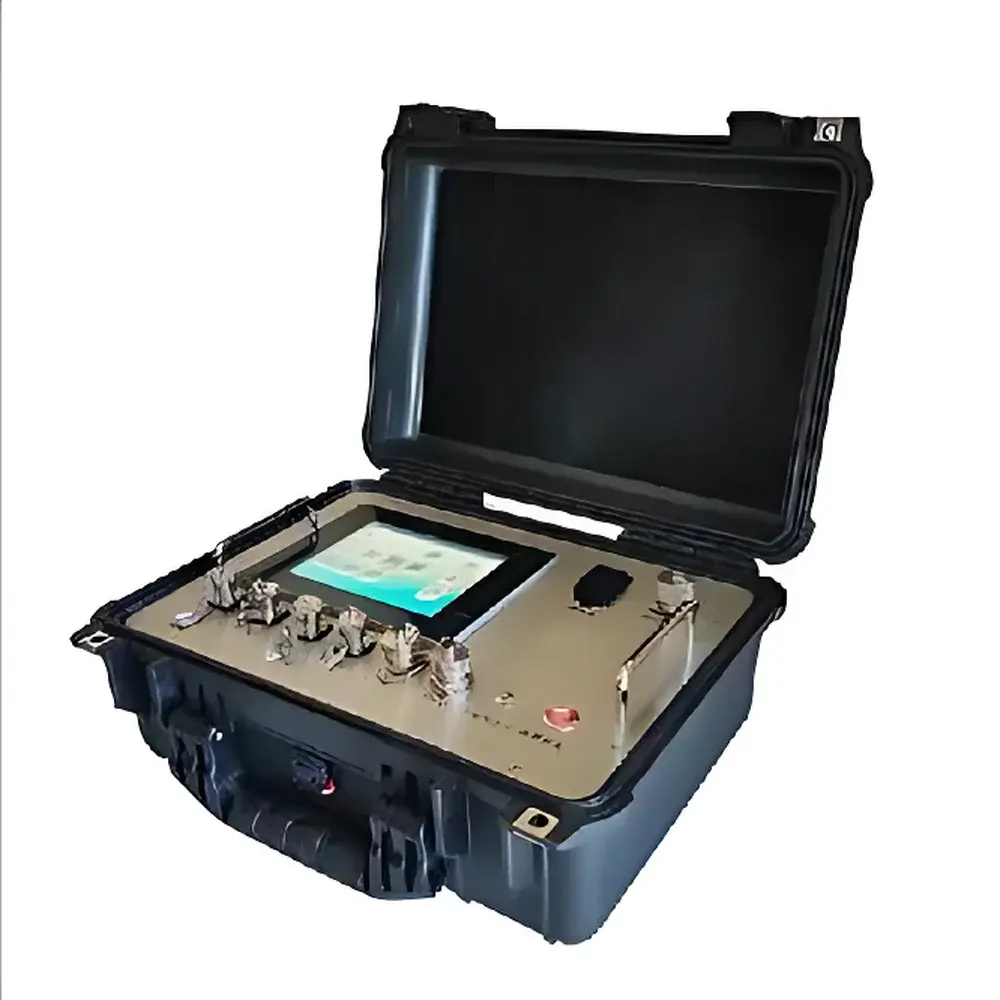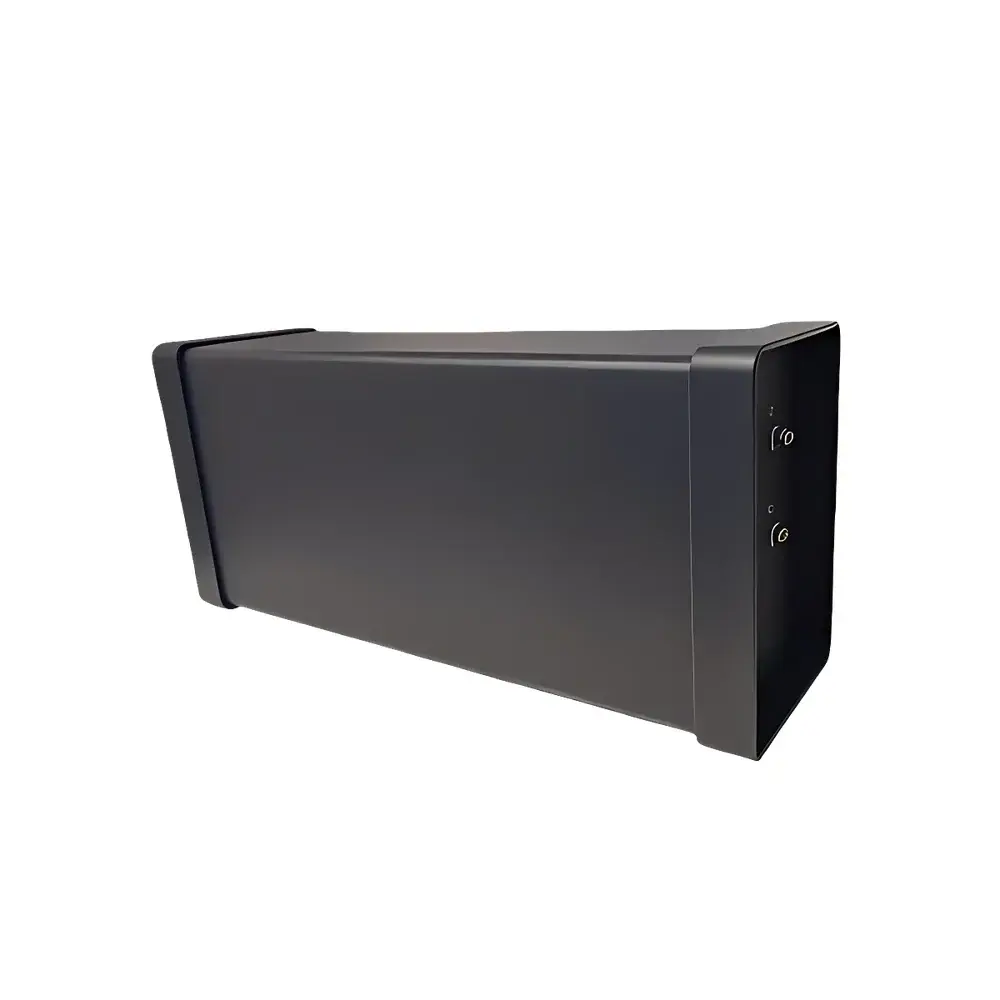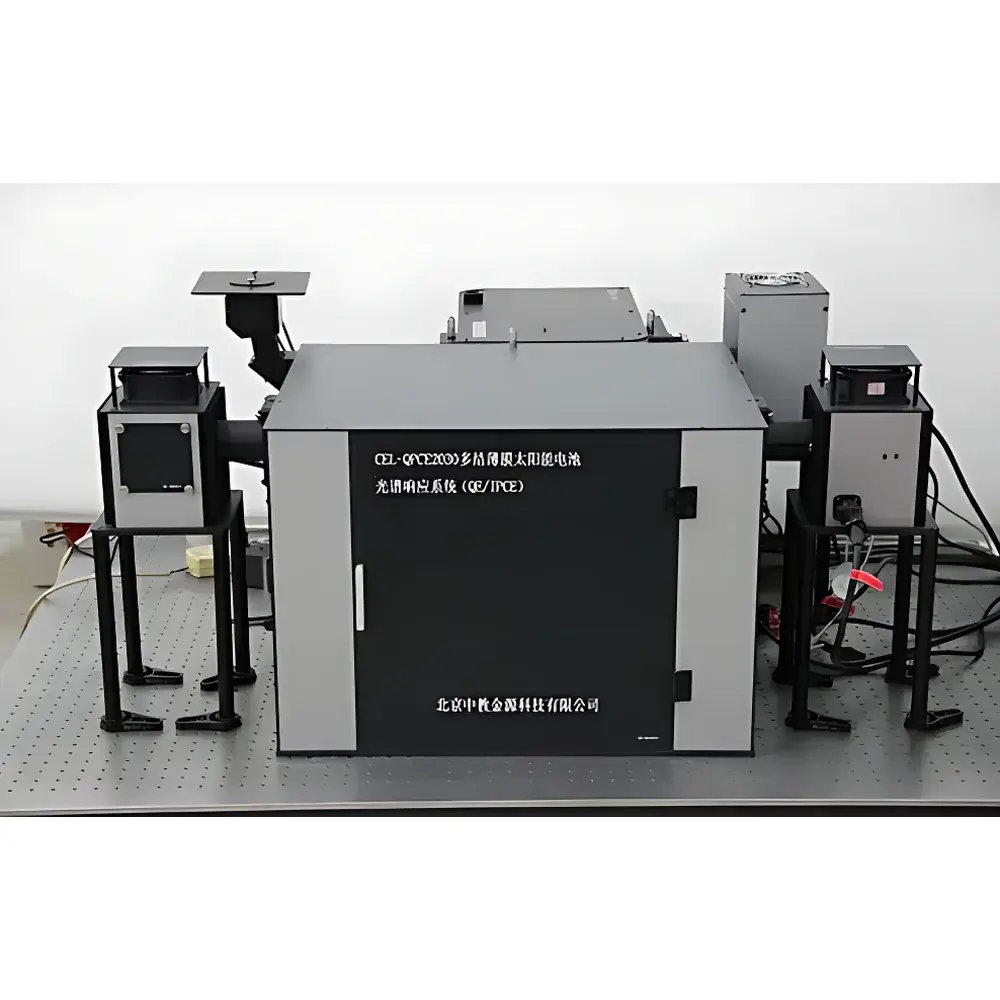
CEL-QPCE2030 Multi-Junction Thin-Film Solar Cell Quantum Efficiency & Spectral Response Measurement System
| Brand | CEL (Zhongjiaojinyuan) |
|---|---|
| Origin | Beijing, China |
| Manufacturer Type | Direct Manufacturer |
| Model | CEL-QPCE2030 |
| Trigger Mode | Steady-State Operation |
| Spectral Range | 200–1700 nm |
| Wavelength Resolution | ≥1 nm (continuously adjustable) |
| Scan Mode | Fully Automated Monochromator-Based Spectral Sweep |
| Repeatability | <0.3% (short-circuit current, J<sub>sc</sub>) |
| Operating Modes | DC and AC (chopped, 5–1000 Hz) |
| Bias Voltage Range | ±3 V (setting accuracy: ±1 mV) |
| Temperature Control Stage | 5–40 °C (±0.5 °C stability, optional) |
| Monochromator Focal Length | 300 mm or 150 mm (configurable) |
| Bias Light Sources | Up to 2 independent channels (Xe or halogen), each with dedicated filter sets |
| Bias Filters | 3 short-pass + 4 long-pass interference filters (imported) |
| Sample Compatibility | Single-junction, dual-junction, triple-junction, and higher-order thin-film solar cells (including GaInP/GaAs/Ge, perovskite/Si tandems, CIGS-based multijunctions) |
| Software | Integrated, fully automated acquisition and analysis suite with background subtraction, spectral deconvolution, J<sub>sc</sub> integration (AM1.5G), and layer-resolved QE/SR extraction |
Overview
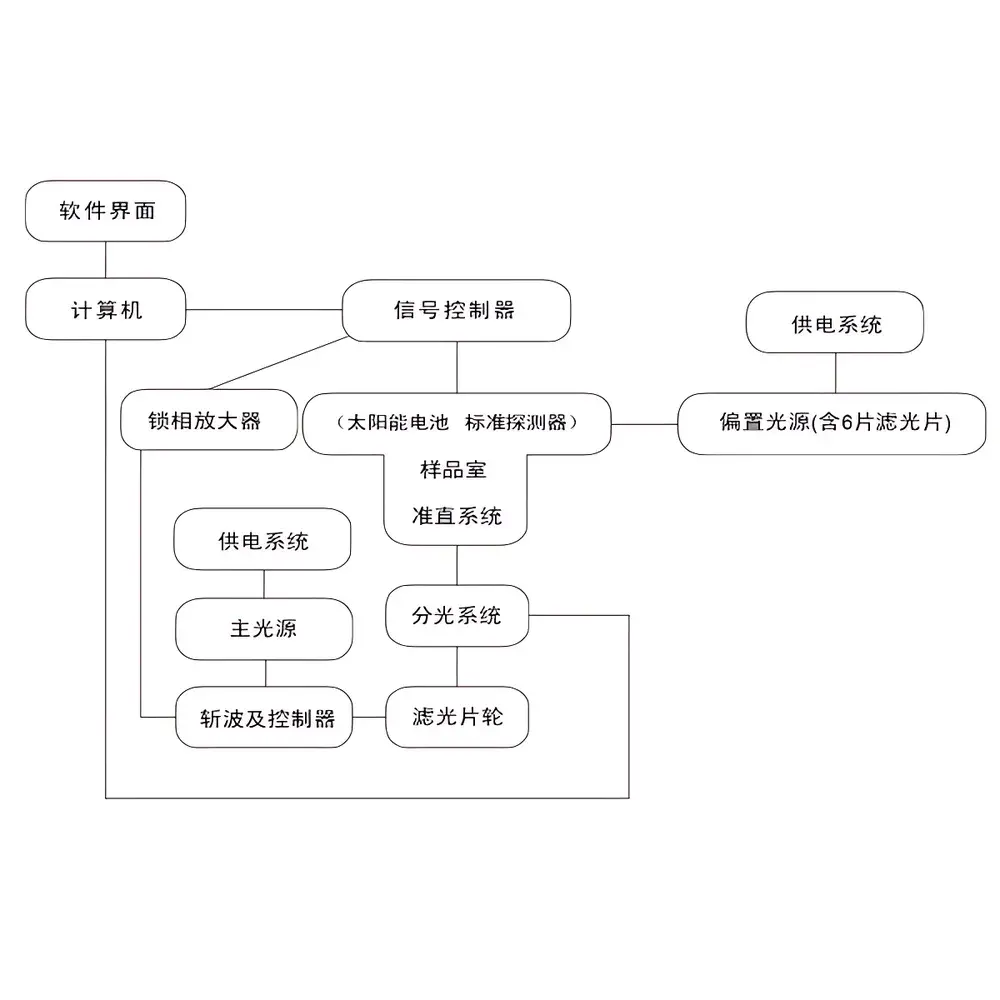
The CEL-QPCE2030 is a research-grade, fully automated quantum efficiency (QE) and spectral response (SR) measurement system engineered specifically for multi-junction thin-film photovoltaic devices. It operates on the principle of monochromatic photocurrent spectroscopy under controlled bias conditions, enabling layer-resolved characterization of tandem and cascaded solar cells. Unlike conventional single-junction testers, the CEL-QPCE2030 implements synchronized optical biasing and spectral scanning to isolate the photoresponse of individual subcells—critical for process development, interface optimization, and performance loss analysis in advanced photovoltaics. The system complies with key international test standards including IEC 60904-8 (spectral mismatch correction), IEC 60904-9 (class AAA solar simulation requirements for reference cell calibration), and ASTM E2527 (quantum efficiency measurement of multi-junction devices). Its steady-state excitation architecture ensures thermal equilibrium during measurement—essential for reproducible carrier collection analysis in low-diffusion-length thin-film absorbers such as perovskites, CIGS, and amorphous silicon.
Key Features
- Steady-state monochromatic illumination using high-stability xenon or halogen broadband sources coupled to a precision 300 mm (or 150 mm) focal length monochromator, delivering smooth, spike-free output across 200–1700 nm
- Dual independent bias light channels with motorized filter wheels housing 3 imported short-pass and 4 long-pass interference filters—enabling wavelength-selective forward biasing of non-measured subcells without mechanical alignment
- Patented optical dispersion architecture minimizing higher-order diffraction artifacts and stray light (<10−5 relative intensity), ensuring high-fidelity SR deconvolution for spectrally overlapping junctions
- Low-noise transimpedance amplification with lock-in detection (5–1000 Hz chopping) and correlated double sampling—optimized for weak photocurrent signals typical of thin-film subcells with active areas <1 cm²
- Modular sample stage with spring-loaded, low-contact-resistance electrodes and vacuum-assisted clamping—designed for fragile flexible substrates, glass/Mo/CIGS stacks, and epitaxial III-V wafers
- Fully integrated control software with automated AM1.5G-weighted Jsc integration, layer-by-layer QE/SR decomposition, and real-time background subtraction using dark-scan referencing
Sample Compatibility & Compliance
The CEL-QPCE2030 supports quantitative characterization of single-junction (Si, CIGS, CdTe, perovskite), dual-junction (a-Si/µc-Si, GaInP/GaAs), triple-junction (GaInP/GaAs/Ge), and emerging four-terminal perovskite/silicon tandems. Its optical design accommodates standard 2×2 cm², 5×5 cm², and custom-sized thin-film coupons—including textured, anti-reflection coated, and encapsulated samples. All hardware and firmware comply with electromagnetic compatibility (EMC) directives (IEC 61326-1), functional safety requirements for laboratory instrumentation (IEC 61010-1), and support audit-ready data logging aligned with GLP principles. Optional temperature-controlled stage (5–40 °C, ±0.5 °C) enables thermal-dependent QE mapping per IEC 60904-10.
Software & Data Management
The proprietary QEScan v4.x software provides end-to-end workflow automation—from hardware initialization and filter positioning to spectral scan execution, bias synchronization, and final report generation. Raw photocurrent, voltage, and wavelength data are stored in HDF5 format with embedded metadata (timestamp, instrument configuration, calibration certificates, ambient conditions). The software includes built-in algorithms for spectral deconvolution of multi-junction responses using constrained least-squares fitting, AM1.5G spectral integration (per ASTM G173-03), and uncertainty propagation based on NIST-traceable reference diode calibrations. Audit trails record all user actions, parameter changes, and calibration events—supporting 21 CFR Part 11 compliance when deployed in regulated R&D environments.
Applications
- Process optimization of tunnel junctions and recombination layers in III-V multijunction cells
- Quantifying interfacial recombination losses via subcell-resolved QE inflection analysis
- Validating spectral splitting efficiency in mechanically stacked perovskite/Si tandems
- Correlating deposition parameters (e.g., sputtering power, annealing time) with subcell external quantum efficiency (EQE) peaks
- Failure analysis of degraded modules by comparative layer-resolved SR decay profiling
- Calibration traceability for reference cells used in outdoor PV performance monitoring
FAQ
What types of multi-junction architectures can the CEL-QPCE2030 characterize?
It supports monolithic and mechanically stacked configurations—including GaInP/GaAs/Ge, perovskite/Si, CIGS/a-Si, and emerging all-perovskite tandems—with full spectral deconvolution capability up to four electrically isolated subcells.
Is the system compatible with external quantum efficiency (EQE) calibration standards?
Yes—the system accepts NIST-traceable Si and Ge photodiodes (e.g., Hamamatsu S1337 series) and integrates calibration factors directly into the data reduction pipeline per IEC 60904-8 Annex B.
Can the temperature-controlled stage be retrofitted to an existing installation?
Yes—temperature control is offered as a field-upgradable option with plug-and-play electrical and thermal interface modules.
Does the software support batch processing of multiple samples?
Yes—QEScan v4.x includes scriptable batch mode with customizable pass/fail thresholds, automatic report PDF generation, and CSV export for LIMS integration.
How is stray light minimized during NIR measurements (1200–1700 nm)?
Through a combination of order-sorting filters, double-monochromator mode (when 150 mm unit is selected), and real-time dark-current compensation using thermoelectrically stabilized InGaAs detectors.