
CEL-QPE Quartz Photoelectrochemical Reaction Cell
| Brand | CEAULIGHT (Zhongjiao Jinyuan) |
|---|---|
| Model | CEL-QPE40 / CEL-QPE60 |
| Construction | All-Quartz, Vacuum-Compatible, Three-Electrode Capable |
| Optical Window Diameter | 30–60 mm |
| Cell Volume | 50–500 mL |
| Window Material | UV-Grade Fused Silica (≥185 nm transmission) |
| Sealing Material | PTFE / PEEK / Nylon |
| Gas Handling | Dual Inlet/Outlet Ports with Swagelok™-Compatible Fittings |
| Electrode Configuration | Removable Three-Electrode Support (WE/CE/RE) |
| Operating Environment | Ambient to Vacuum |
| Compliance | Designed for ASTM E2573 (IPCE Measurement), ISO 10678 (Photocatalytic Activity Testing), and GLP-aligned electrochemical workflows |
Overview
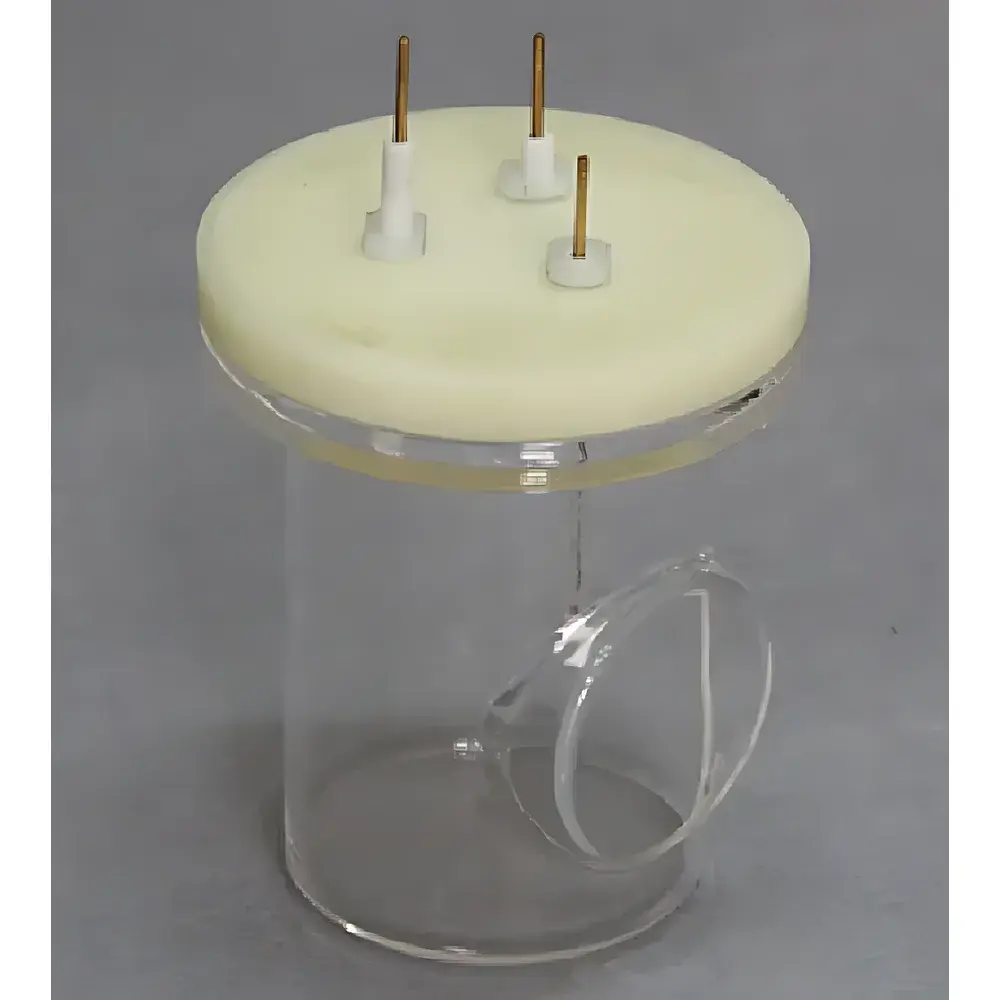
The CEL-QPE Quartz Photoelectrochemical Reaction Cell is a precision-engineered, all-quartz photoelectrochemical (PEC) measurement platform designed for quantitative investigation of light-driven interfacial charge transfer processes. Based on the principles of controlled illumination coupled with potentiostatic/galvanostatic electrochemical interrogation, the CEL-QPE cell enables rigorous determination of incident photon-to-current efficiency (IPCE), action spectra, photocurrent onset potentials, and charge separation kinetics under reproducible optical and electrochemical boundary conditions. Its fully sealed, flanged architecture eliminates leakage paths and optical misalignment issues common in conventional glass-jacketed cells, while its UV-grade fused silica body ensures high transmission across the full spectral range from 185 nm to 2,500 nm—critical for studies involving deep-UV photocatalysts (e.g., TiO₂ anatase, SrTiO₃) and visible-light absorbers (e.g., BiVO₄, g-C₃N₄). The cell operates under ambient, vacuum, or inert-gas-purged environments, supporting both steady-state and transient photoelectrochemical measurements per IUPAC-recommended protocols.
Key Features
- All-quartz construction with ≥99.99% pure synthetic fused silica—minimizes autofluorescence, thermal drift, and UV absorption losses
- Modular flange sealing system using chemically inert PTFE, PEEK, or nylon gaskets—ensures leak-tight integrity up to 10⁻³ mbar without metal contamination or outgassing
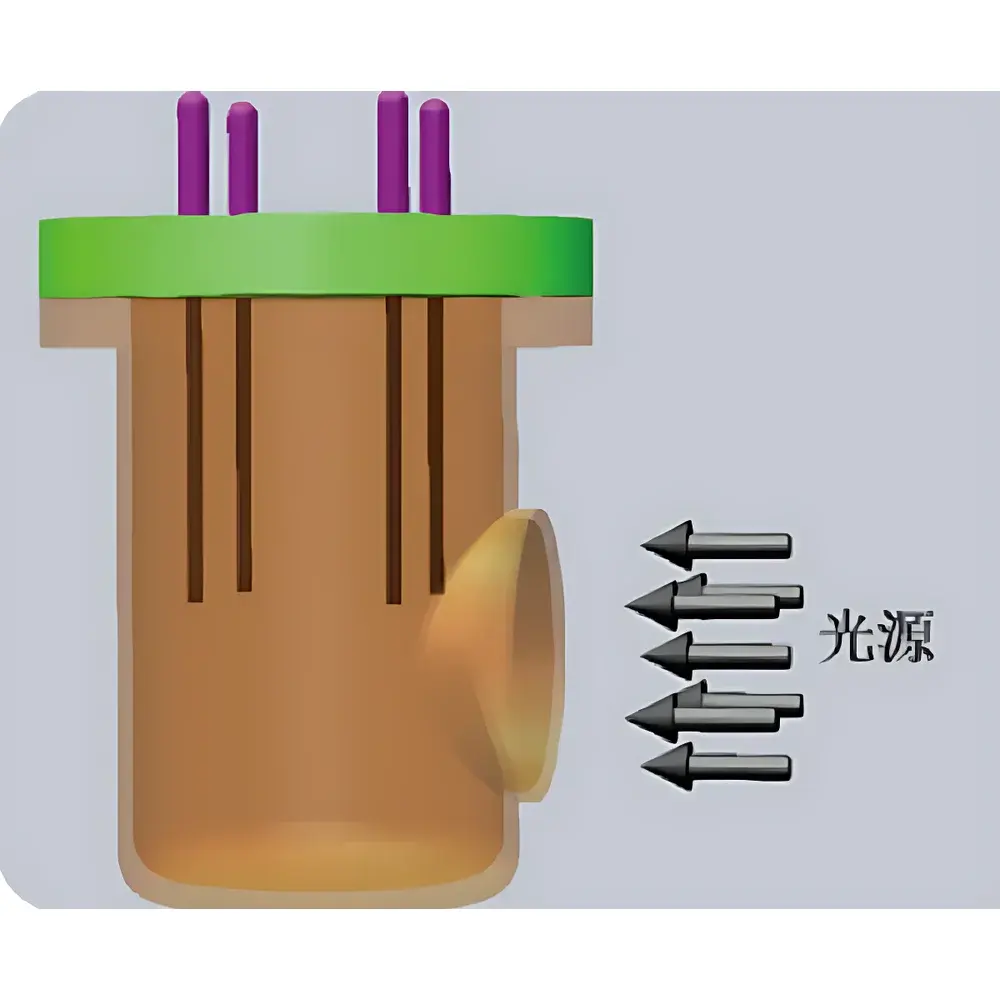
- Side-mounted optical windows with diameters of 30 mm (CEL-QPE40 series) or 60 mm (CEL-QPE60 series)—optimized for collimated beam alignment and uniform irradiance distribution across working electrode surfaces
- Integrated three-electrode support structure with independent, replaceable ports for working electrode (WE), counter electrode (CE), and reference electrode (RE)—compatible with standard Luggin capillaries and Ag/AgCl, SCE, or reversible hydrogen electrodes (RHE)
- Dual gas inlet/outlet ports fitted with 1/4″ Swagelok™ compression fittings—enabling controlled purging, O₂ removal, or reactive gas introduction (e.g., H₂S, NOₓ) during operando experiments
- Optional quartz lid with integrated septum port for liquid-phase reagent injection without breaking vacuum or atmosphere
Sample Compatibility & Compliance
The CEL-QPE cell accommodates planar, mesh, or wire-type working electrodes (up to 20 mm diameter) mounted on conductive substrates including FTO, ITO, Au sputtered quartz, or carbon cloth. Its geometry supports standardized electrode area definition (±0.5% tolerance) required for IPCE normalization per ASTM E2573–18. The cell’s material composition and surface finish comply with ISO 10678:2019 for photocatalytic activity assessment under simulated solar irradiation. For regulated laboratories, the mechanical design permits integration into 21 CFR Part 11–compliant electrochemical workstations when paired with audit-trail-enabled potentiostats (e.g., BioLogic SP-300, Pine Research WaveNow) and validated data acquisition software.
Software & Data Management
While the CEL-QPE cell itself is hardware-only, it is fully interoperable with industry-standard electrochemical instrumentation platforms. When used with potentiostats supporting scripting (e.g., EC-Lab®, AfterMath®, Thales XT), users can automate multi-step protocols—including dark current correction, chopped-light chronoamperometry, wavelength-resolved IPCE scans, and Mott-Schottky analysis. Raw current vs. time and current vs. potential datasets are exportable in .txt, .csv, or .mpt formats, enabling traceable post-processing in MATLAB, Python (SciPy/Pandas), or OriginPro. All experimental metadata—including lamp calibration factors, optical filter IDs, gas composition logs, and electrode history—can be embedded via user-defined headers, supporting FAIR (Findable, Accessible, Interoperable, Reusable) data practices.
Applications
- Quantitative IPCE mapping of photoanodes and photocathodes for solar fuel generation (H₂ evolution, CO₂ reduction)
- Time-resolved photocurrent decay analysis to extract minority carrier diffusion lengths and surface recombination velocities
- In situ/operando spectroelectrochemical coupling (e.g., with UV-Vis-NIR spectrophotometers or Raman probes)
- Stability testing under prolonged illumination and electrochemical bias (e.g., 100-h continuous operation per IEA PVPS Task 12 guidelines)
- Comparative evaluation of co-catalyst deposition methods (e.g., NiFeOx on BiVO₄) under identical optical/electrochemical conditions
- Photocorrosion resistance screening in acidic or alkaline electrolytes (pH 0–14) with real-time pH monitoring capability
FAQ
Can the CEL-QPE cell be used with a solar simulator calibrated to AM 1.5G?
Yes—the side-illumination geometry and large-diameter quartz window allow uniform irradiation of standard 1 cm² electrodes under Class AAA solar simulators, provided collimation optics are aligned to minimize edge effects.
Is the cell compatible with high-temperature electrochemical measurements?
No—the maximum recommended operating temperature is 80 °C due to thermal expansion mismatch between quartz and polymer seals; for elevated-temperature PEC studies, custom high-temp variants with ceramic seals are available upon request.
How is electrical feedthrough isolation achieved without metal contamination?
All electrode leads pass through hermetically sealed PTFE bushings with gold-plated copper contacts; no internal metallic components contact the electrolyte or reactant gases.
What maintenance is required to preserve UV transmission over time?
Routine cleaning with hot piranha solution (3:1 H₂SO₄:H₂O₂) followed by copious DI water rinse restores >95% of initial UV transmittance; avoid ultrasonic agitation to prevent microfracture propagation in fused silica.



