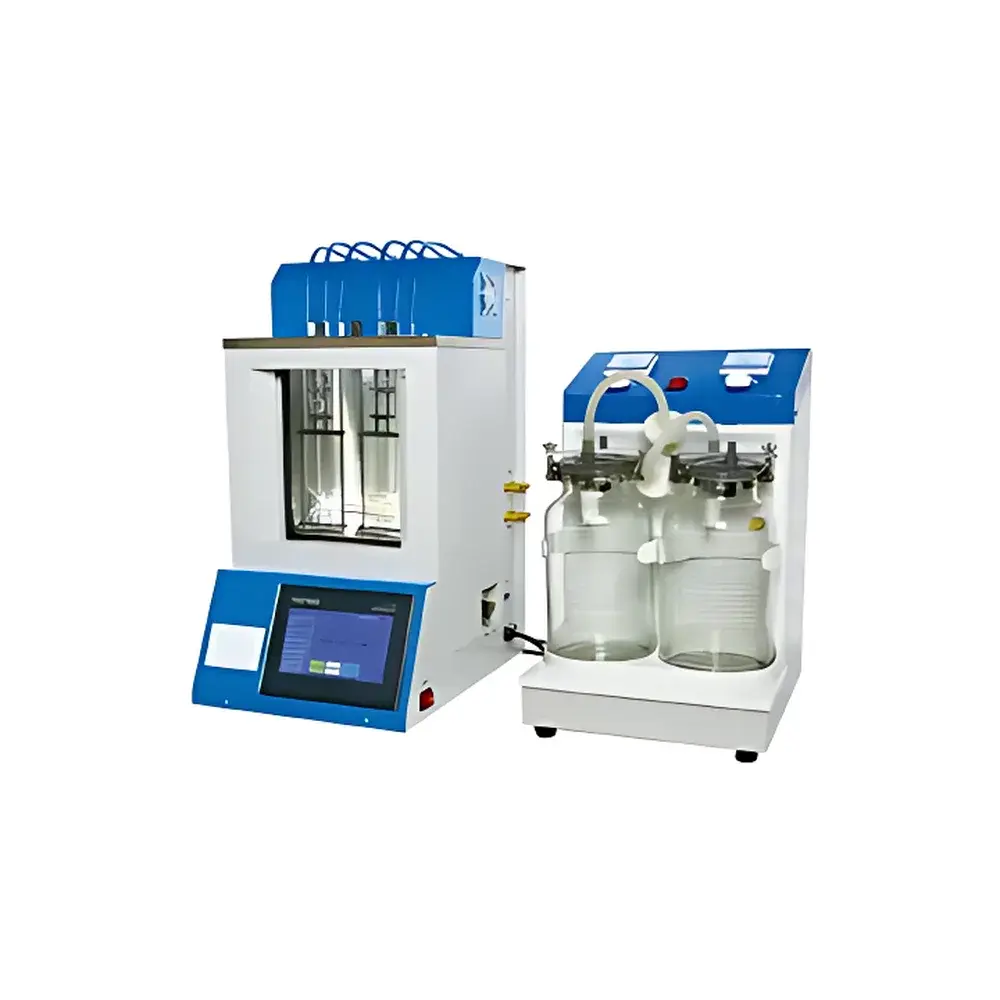
Timepower TP725 Fully Automated Kinematic Viscosity Tester
| Brand | Timepower |
|---|---|
| Model | TP725 |
| Origin | Beijing, China |
| Manufacturer | Timepower Instrument Co., Ltd. |
| Application | Petroleum, Power, Chemical, Inspection & Research Laboratories |
| Temperature Control Range | Ambient to 100 °C |
| Temperature Stability | ±0.01 °C |
| Temperature Resolution | 0.01 °C |
| Kinematic Viscosity Resolution | 0.00001 mm²/s |
| Power Supply | AC 220 V ±10%, 50 Hz ±10% |
| Max Power Consumption | ≤1500 W |
| Dimensions | 370 × 300 × 650 mm |
| Weight | ~28 kg |
Overview
The Timepower TP725 Fully Automated Kinematic Viscosity Tester is an engineered solution for precise, repeatable determination of kinematic viscosity in petroleum-based liquids—including lubricating oils, transformer oils, fuel oils, and hydraulic fluids—according to standardized capillary viscometry principles. It operates on the fundamental physical relationship defined by Poiseuille’s law, where kinematic viscosity (ν) is calculated as the product of flow time (t) and the calibrated viscometer constant (C), i.e., ν = C × t. The instrument implements a fully automated Ubbelohde-type capillary viscometer system, thermally stabilized within a precision-controlled oil bath. Unlike manual or semi-automated systems, the TP725 eliminates operator-dependent timing errors, thermal drift, and post-test handling variability by integrating temperature regulation, optical flow-time detection, computational processing, capillary rinsing, and hot-air drying into a single unattended workflow.
Key Features
- Dual independent test channels enable asynchronous kinematic viscosity measurements on two samples simultaneously—increasing laboratory throughput without compromising measurement integrity.
- High-stability temperature control system maintains bath temperature within ±0.01 °C across the full operating range (ambient to 100 °C), meeting stringent requirements of ASTM D445 and ISO 3104 for thermal equilibrium validation.
- U.S.-sourced optical detection module employs infrared liquid-level sensing technology, immune to ambient lighting interference and ensuring robust, zero-drift detection of meniscus passage at calibration marks.
- Automated post-test sequence includes solvent rinse, compressed-air purge, and programmable hot-air drying—eliminating carryover risk and enabling rapid turnaround between analyses.
- Dual-CPU architecture separates real-time control logic from data processing functions, enhancing system reliability and enabling concurrent operation of temperature regulation, timing acquisition, and result computation.
- Self-diagnostic firmware continuously monitors sensor status, heater performance, fluid level, and mechanical actuation—reporting fault codes with actionable guidance for maintenance personnel.
- Optional refrigeration module extends operational capability to sub-ambient temperatures (e.g., for low-temperature diesel or jet fuel testing per ASTM D7153), configurable via firmware upgrade.
Sample Compatibility & Compliance
The TP725 is validated for use with transparent and slightly hazy Newtonian petroleum products whose flow behavior conforms to laminar regime assumptions under standard test conditions (Re < 2000). Compatible sample types include mineral oils, synthetic lubricants, base stocks, biodiesel blends (B5–B20), and insulating oils per IEC 60296. All measurement protocols align with internationally recognized standards: ASTM D445 (Standard Test Method for Kinematic Viscosity of Transparent and Opaque Liquids), ISO 3104 (Petroleum Products — Transparent and Opaque Liquids — Determination of Kinematic Viscosity and Calculation of Dynamic Viscosity), and national standard GB/T 265. The system supports GLP-compliant audit trails when paired with optional time-stamped data export and user-access logging—facilitating FDA 21 CFR Part 11 readiness in regulated QA/QC environments.
Software & Data Management
Embedded firmware provides intuitive navigation via backlit LCD interface with capacitive touch-sensitive controls activated by proximity—minimizing mechanical wear and contamination risk in oily lab environments. Measurement data—including raw flow times, calculated kinematic viscosity (mm²/s), dynamic viscosity (mPa·s), density input (if entered), and temperature logs—is stored internally with timestamp (year/month/day/hour/minute) and retained during power loss. Export options include RS-232 serial output and USB flash drive transfer in CSV format for integration into LIMS or statistical process control platforms. No proprietary software installation is required; raw files are human-readable and compatible with Excel, Minitab, or Python-based analysis pipelines.
Applications
- Quality assurance of turbine oils and transformer oils in power generation facilities, verifying conformance to OEM specifications and aging indicators.
- Routine monitoring of lubricant viscosity in refinery QC labs to detect thermal degradation, oxidation, or dilution by fuel or coolant.
- Compliance testing for commercial fuel shipments per ASTM D975 (diesel) or D1655 (jet fuel), including cold-flow property correlation studies.
- Research-grade characterization of novel bio-lubricants and synthetic ester formulations where viscosity–temperature relationships (ASTM D341) must be established.
- Contract testing laboratories serving ISO/IEC 17025-accredited services requiring documented traceability, uncertainty budgets, and interlaboratory reproducibility validation.
FAQ
What capillary viscometers are compatible with the TP725?
The instrument accepts standard Ubbelohde-type capillaries certified to ASTM D446, with nominal constants ranging from 0.001 to 1.0 mm²/s². Users must calibrate each capillary using reference oils traceable to NIST SRMs.
Does the TP725 support dynamic viscosity calculation?
Yes—when sample density is manually entered or imported via external interface, the system computes dynamic viscosity (η = ν × ρ) in mPa·s with automatic unit conversion.
Can test results be exported directly to a laboratory information management system (LIMS)?
Yes—via ASCII-formatted serial output or USB mass storage mode, supporting direct ingestion by most modern LIMS platforms without middleware.
Is the oil bath circulation system self-contained?
Yes—the integrated pump and baffled bath design ensures uniform thermal distribution and meets ASTM D445’s requirement for “stirred bath” configuration.
What maintenance intervals are recommended for long-term accuracy?
Capillary cleaning verification every 50 tests; bath oil replacement every 6 months or after 1000 hours of operation; annual calibration check using certified reference oils.