
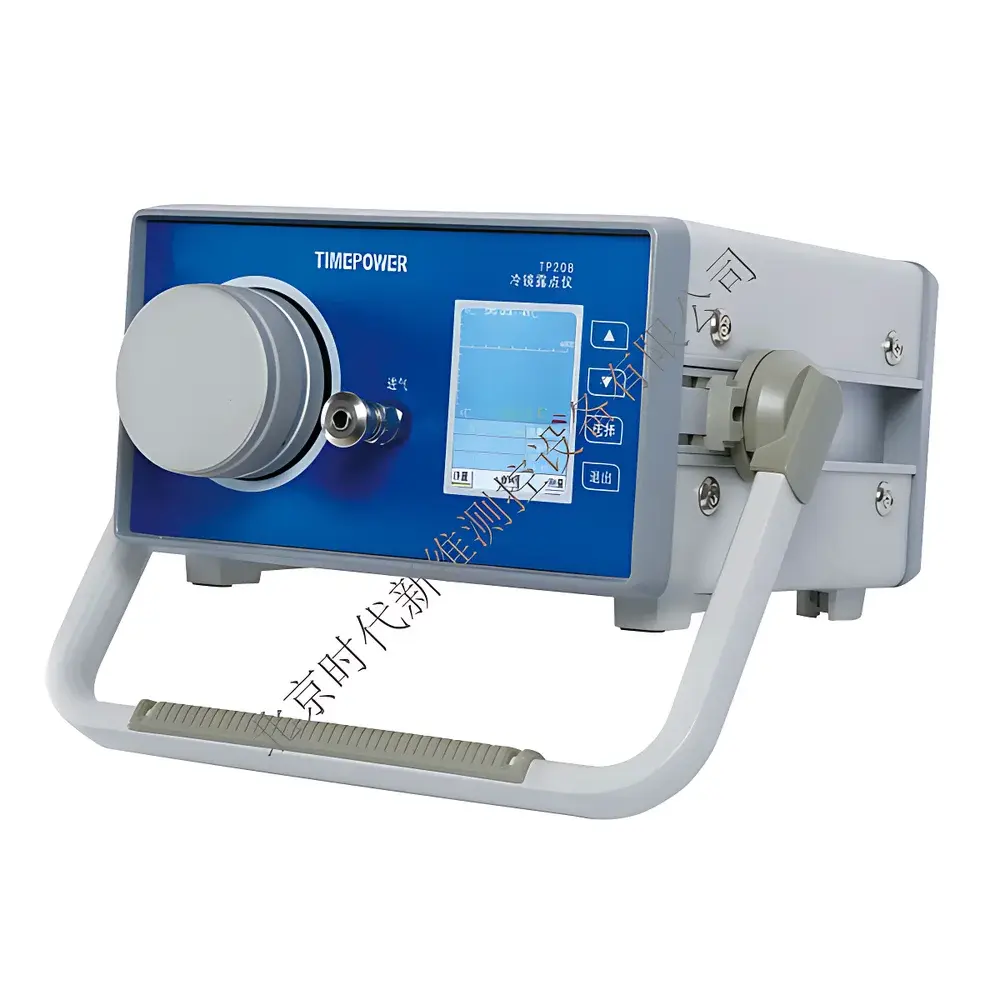
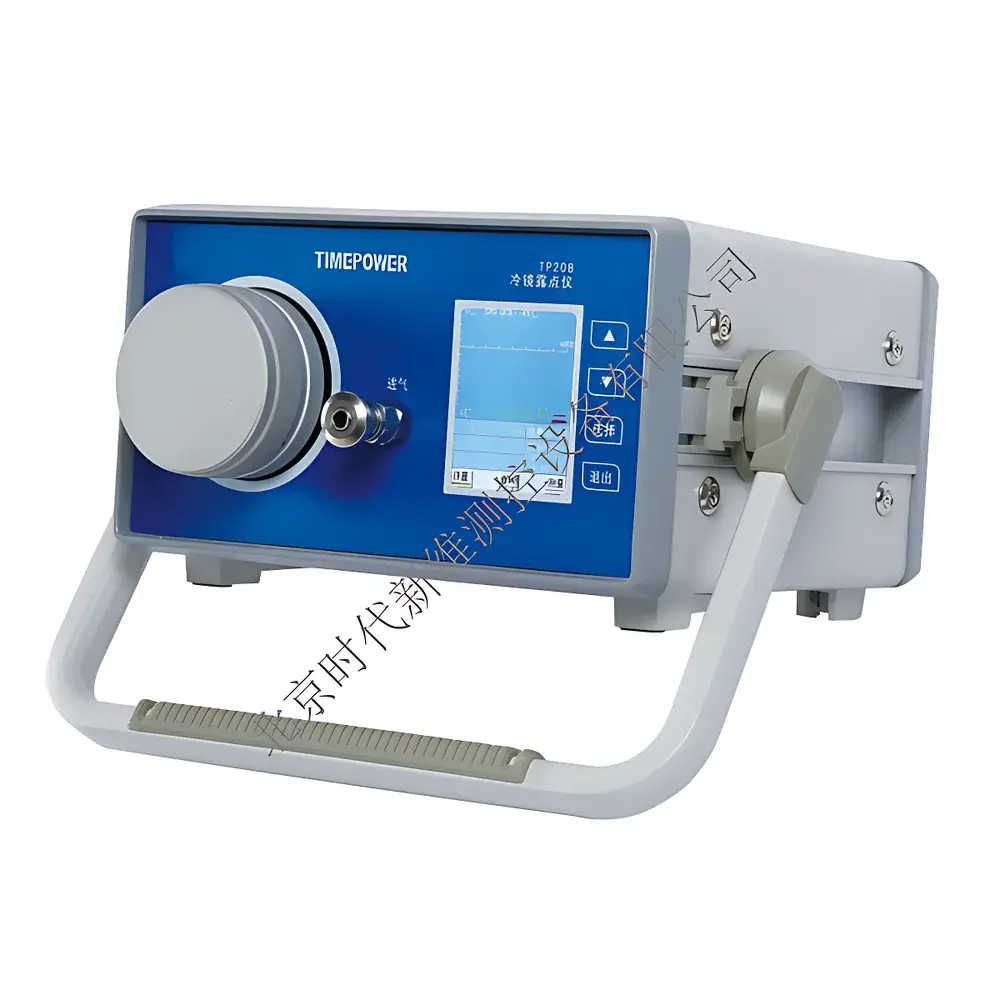
Timepower TP208 Precision Chilled-Mirror Dew Point Analyzer
| Brand | Timepower |
|---|---|
| Origin | Beijing, China |
| Manufacturer Type | Direct Manufacturer |
| Country of Origin | China |
| Model | TP208 |
| Pricing | Upon Request |
Overview
The Timepower TP208 Precision Chilled-Mirror Dew Point Analyzer is a primary-standard metrological instrument engineered for trace moisture measurement in industrial and laboratory gas streams. It operates on the fundamental thermodynamic principle of dew point determination: when a gas sample is cooled at constant pressure, water vapor condenses into liquid phase on a polished, temperature-controlled mirror surface at the saturation temperature—the dew point. This physical phase transition is detected in real time using high-sensitivity photometric reflection monitoring. Unlike sensor-based alternatives (e.g., aluminum oxide or tunable diode laser), the chilled-mirror method delivers direct, calibration-free traceability to the International Temperature Scale (ITS-90) and serves as a reference standard for validating secondary hygrometers. The TP208 is designed for continuous, high-reproducibility operation in demanding environments—including high-purity nitrogen blanketing systems, SF₆ insulation gas monitoring in high-voltage switchgear, and cleanroom compressed air qualification—where compliance with ISO 8573-1 Class 1–2 moisture specifications is mandatory.
Key Features
- Four-stage thermoelectric (Peltier) cooling architecture enabling stable mirror temperature control down to –60 °C at ambient 10 °C, with rapid thermal response and minimal power consumption (≤70 W).
- High-resolution optical detection system with real-time reflectance monitoring; automatic recognition of dew/frost layer formation ensures unambiguous phase-transition identification.
- 0.01 °C temperature resolution and ±0.2 °C absolute accuracy across the full measurement range (0 to –60 °C), validated per ISO/IEC 17025-accredited procedures.
- Integrated digital fuzzy logic control algorithm minimizes equilibration time to 3–5 minutes without manual intervention, significantly improving throughput in QC/QA workflows.
- Corrosion-resistant stainless steel and PTFE-wetted flow path compatible with aggressive gases including SF₆, HCl, Cl₂, and process-grade N₂—no catalytic degradation or memory effects.
- Full-color LCD interface displaying dew point temperature (°C), volumetric moisture concentration (µL/L), real-time cooling curve, mass flow rate (15–60 L/h), and system diagnostic status.
- Comprehensive self-diagnostic suite: alerts for suboptimal flow conditions, low optical signal strength (<99% reflectance), non-equilibrium state, and thermal instability—supporting GLP-compliant recordkeeping.
Sample Compatibility & Compliance
The TP208 accommodates dry and moderately humid gas matrices across pressure ranges from 10 mbar to 10 bar (1 kPa to 1 MPa), with flow rates precisely regulated between 15 and 60 L/h. Its inert flow path eliminates adsorption/desorption artifacts common in porous sensors, making it suitable for ultra-low dew point validation in semiconductor purge gases, pharmaceutical nitrogen generators, and aerospace breathing-air systems. The analyzer meets mechanical and electromagnetic compatibility requirements per IEC 61326-1 (industrial environment), and its measurement methodology aligns with ASTM D1193 (Type I–IV reagent water purity verification), ISO 8573-3 (compressed air moisture testing), and IEC 60480 (re-use of SF₆ gas). While not inherently 21 CFR Part 11 compliant, audit-ready data export (CSV/TXT) and timestamped event logs support integration into validated GMP environments when paired with secure networked data acquisition software.
Software & Data Management
The TP208 operates autonomously via embedded firmware but supports external data capture through RS-232 or optional USB-to-serial interface. All measurements—including dew point, µL/L conversion, equilibrium timestamps, flow rate, and diagnostic flags—are timestamped and stored in non-volatile memory. Exported datasets include metadata such as ambient temperature (–20 to +50 °C), relative humidity (<90% RH, non-condensing), and operational voltage (AC 220 V ±10%, 50 Hz ±10%). No proprietary software is required; raw output is ASCII-formatted and compatible with LIMS, SCADA, or statistical process control platforms. For regulated labs, third-party validation packages are available to document installation qualification (IQ), operational qualification (OQ), and performance qualification (PQ) against user-defined acceptance criteria.
Applications
- Power transmission: In-service moisture monitoring of SF₆ in circuit breakers and GIS to prevent dielectric failure per IEEE C37.122.1.
- Electronics manufacturing: Verification of <–40 °C dew point in nitrogen purging lines for solder paste printing and reflow ovens.
- Pharmaceutical production: Qualification of instrument air and fluidized-bed dryer purge gas per EU GMP Annex 1 and USP .
- Aerospace ground support: Certification of breathing oxygen and hydraulic test gas purity prior to aircraft pressurization tests.
- Calibration laboratories: Primary standard for calibrating aluminum oxide, quartz crystal microbalance, and tunable diode laser hygrometers.
FAQ
What pre-conditioning is required before first use or after extended idle periods?
A 15-minute purge with ≥99.999% pure nitrogen at 30 L/h is recommended to remove ambient moisture from the optical chamber and flow path. Verify optical energy remains within 99–100% on the display prior to initiating measurement.
Can the TP208 measure dew point in corrosive gas mixtures containing H₂S or NH₃?
Yes—the wetted components utilize electropolished 316L stainless steel and PTFE seals. However, prolonged exposure to >10 ppm H₂S may require more frequent mirror cleaning; consult the chemical compatibility matrix in Section 4.2 of the operator manual.
Is field recalibration possible without returning the unit to the manufacturer?
No—chilled-mirror analyzers rely on fundamental thermophysical properties and do not require periodic calibration. Verification is performed using certified chilled-mirror transfer standards traceable to NIST or PTB.
How does ambient temperature affect measurement stability at –60 °C?
The four-stage Peltier design maintains thermal gradient integrity only when ambient temperature is ≤10 °C. At higher ambient temperatures, the lower limit shifts upward (e.g., –50 °C at 25 °C ambient); this derating is documented in the technical specification sheet.
What maintenance intervals are recommended for long-term reliability?
Mirror cleaning with spectroscopic-grade methanol every 200 operational hours; inspection of Peltier cold-side heat sink fins for dust accumulation quarterly; annual verification of optical alignment and flow meter linearity by authorized service personnel.





