
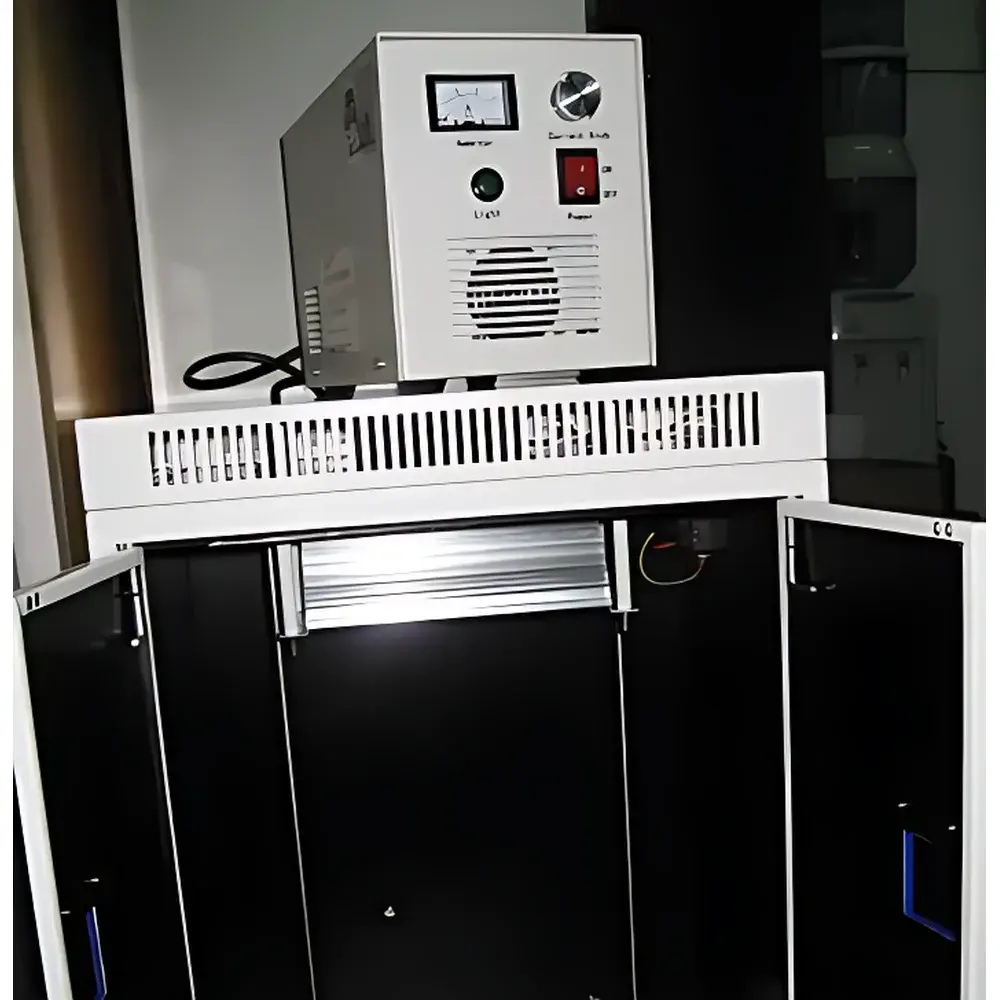
CEL-WLAX500 Low-Cost Large-Area Solar Simulator
| Brand | CME (Zhongjiao Jinyuan) |
|---|---|
| Origin | Beijing, China |
| Manufacturer Type | Direct Manufacturer |
| Origin Category | Domestic (China) |
| Model | CEL-WLAX500 |
| Pricing | Upon Request |
Overview
The CEL-WLAX500 is a large-area solar simulator engineered for reliable, uniform illumination in photovoltaic (PV) device characterization, perovskite solar cell testing, and thin-film optoelectronic R&D. It employs a high-intensity, long-arc xenon lamp as its primary light source—configured in an external irradiation (‘external illumination’ or ‘top-down’) geometry—to replicate the spectral distribution and spatial uniformity required for standardized solar simulation under AM1.5G conditions. Unlike compact benchtop simulators, the CEL-WLAX500 is designed with an extended optical path and optimized collimation optics to deliver stable, homogeneous irradiance across active areas up to 200 × 200 mm² (or larger with custom beam homogenizers). Its architecture follows established principles of broadband solar simulation: spectral matching achieved via precision filter stacks (including UV-enhancing and IR-suppressing components), temporal stability maintained through regulated DC power supply and active lamp cooling, and spatial uniformity validated using calibrated reference cells and scanning radiometers.
Key Features
- Long-arc xenon lamp system delivering continuous spectrum from 250 nm to 2500 nm, closely approximating ASTM E927-22 Class AAA spectral match requirements when equipped with appropriate filtering.
- External illumination configuration enables flexible integration with vacuum chambers, gloveboxes, and in-situ measurement stages—critical for air-sensitive perovskite and organic PV devices.
- Large uniform irradiation field: ≥90% spatial uniformity over 200 × 200 mm² at 1-sun intensity (100 mW/cm²), verified per IEC 60904-9:2020 Annex A procedures.
- Integrated thermal management system—including forced-air cooling and lamp current stabilization—ensures irradiance stability better than ±2% over 30 minutes (T90 response).
- Modular optical design supports optional accessories: AM1.5G bandpass filters, adjustable aperture masks, beam expanders, and calibrated Si/Ge/GaAs reference detectors.
- Compliant with core safety standards: CE-marked per EN 61000-6-3 (EMC) and EN 62471 (photobiological safety), with interlocked housing and UV-shielded viewport.
Sample Compatibility & Compliance
The CEL-WLAX500 accommodates a broad range of sample geometries and environmental configurations. Standard mounting allows direct placement of substrates up to 220 × 220 mm on ambient or temperature-controlled stages. For inert-atmosphere operation, it interfaces seamlessly with N₂- or Ar-purged gloveboxes (via optical feedthroughs) and low-pressure vacuum chambers (with quartz or MgF₂ windows). All optical components are selected for minimal outgassing and compatibility with cleanroom handling protocols. The system adheres to key photovoltaic testing standards: calibration traceable to NIM (National Institute of Metrology, China); spectral mismatch corrections aligned with IEC 60904-7; and irradiance uniformity assessments conducted in accordance with IEC 60904-9 Ed.3. While not pre-certified to ASTM E927 Class AAA by default, full compliance can be achieved through factory-installed filter sets and third-party verification reports.
Software & Data Management
The CEL-WLAX500 operates as a hardware platform compatible with industry-standard instrumentation control environments. It includes analog voltage outputs (0–5 V) for real-time irradiance monitoring and TTL-trigger inputs for synchronization with source meters (e.g., Keithley 2400/2450), quantum efficiency systems, or transient photocurrent recorders. No proprietary software is bundled; instead, integration is supported via SCPI-compatible serial commands (RS-232/USB) and LabVIEW™ drivers (provided upon request). Data logging, exposure timing, and lamp aging compensation are implemented within user-defined test sequences—enabling full audit trails compliant with GLP and internal QA workflows. When deployed in regulated environments, timestamped irradiance logs and lamp operating hours may be exported in CSV or HDF5 format for 21 CFR Part 11–aligned documentation.
Applications
- Current–voltage (J–V) characterization of silicon heterojunction, CIGS, and perovskite solar cells under standard test conditions (STC).
- Light-soaking studies and operational stability assessment (ISOS-L-1/L-2 protocols).
- Photoelectrochemical cell evaluation in three-electrode configurations with potentiostat coupling.
- Accelerated aging tests requiring controlled UV dose accumulation (e.g., UV index weighting per ISO 4892-2).
- Optical modeling validation using spatially resolved quantum efficiency maps.
- Calibration of reference solar cells and pyranometers against primary standards.
FAQ
What is the typical spectral output range of the CEL-WLAX500 without filters?
The unfiltered long-arc xenon lamp emits continuously from ~250 nm (deep UV) to ~2500 nm (near-infrared), with peak intensity near 800 nm.
Can the CEL-WLAX500 achieve Class AAA rating per ASTM E927?
Yes—when configured with the optional AM1.5G filter set and validated by an accredited laboratory, it meets Class AAA requirements for spectral match, spatial uniformity, and temporal stability.
Is the system compatible with glovebox integration?
Yes—the external illumination design and modular flange options support direct coupling to standard glovebox optical ports (CF-63 or KF-40).
Does the unit include radiometric calibration documentation?
Each system ships with a factory irradiance map (measured at 100 mW/cm²) and spectral irradiance curve (±5 nm resolution); NIST-traceable recalibration services are available on demand.
What maintenance intervals are recommended for the xenon lamp?
Lamp lifetime is rated at ≥1000 hours at rated power; we recommend output verification every 200 hours and replacement after 800–1000 hours to maintain STC compliance.



